
Landscaping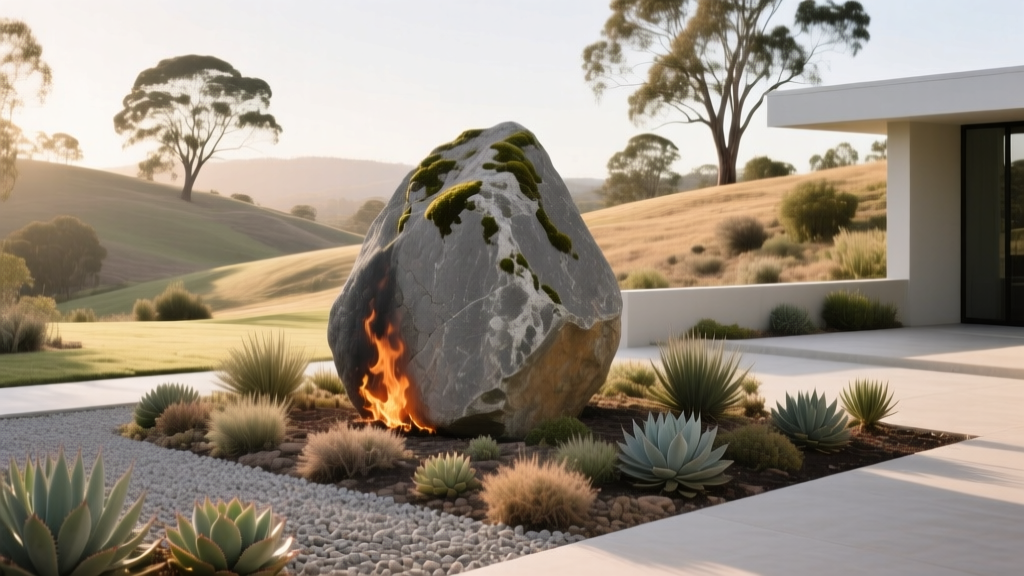
Fire-Resistant Boulder Placement: 2026 Focal Point Design
James MillerPublished
As wildfire seasons grow more unpredictable and local building codes become increasingly stringent, the 2026 landscaping paradigm has shifted heavily toward resilience without sacrificing aesthetics. Homeowners in fire-prone regions are no longer forced to choose between a sterile, concrete yard and a beautiful garden. Instead, landscape architects and fire safety experts are championing the use of non-combustible hardscaping materials to create stunning, safe outdoor environments. Among these materials, large landscape boulders have emerged as a premier choice. When strategically placed, boulders serve as dramatic garden focal points while simultaneously acting as vital components of a defensible space strategy.
The Role of Boulders in Defensible Space
To understand the value of a boulder focal point, one must first understand the mechanics of defensible space. According to the California Department of Forestry and Fire Protection (CAL FIRE), defensible space is the buffer created between a building and the grass, trees, shrubs, or any wildland area that surround it. This space is divided into specific zones, with the most critical being the Ember-Resistant Zone (Zone 0), which extends 0 to 5 feet from the home, and the Lean, Clean, and Green Zone (Zone 1), extending from 5 to 30 feet.
In 2026, updated International Wildland-Urban Interface Code (IWUIC) guidelines heavily emphasize the elimination of combustible materials in Zone 0. Wood mulches, highly resinous plants, and wooden decorative features are strictly discouraged. Landscape boulders, however, are entirely non-combustible. Placing a massive granite or basalt boulder as a focal point within 5 feet of your home's exterior not only creates a striking visual anchor but also provides a physical barrier against radiant heat and flying embers. Unlike wooden trellises or dense shrubbery, a boulder will not ignite, melt, or transmit fire to your siding or windows.
Choosing the Right Stone for Fire Zones
Not all rocks behave identically under extreme thermal stress. When selecting a boulder for a fire-resistant focal point, density and porosity are your primary considerations.
- Granite and Basalt (Igneous Rocks): These are the gold standards for fire-resistant landscaping. Formed under extreme heat and pressure, they are incredibly dense, non-porous, and highly resistant to thermal shock. They will not trap embers in microscopic crevices.
- Limestone and Sandstone (Sedimentary Rocks): While still non-combustible, these stones are more porous. In rare instances, if moisture is trapped deep inside a highly porous stone and exposed to sudden, intense radiant heat, the stone can crack or spall. Furthermore, deep crevices in layered sandstone can trap wind-blown embers and dry pine needles, creating a hidden ignition risk.
2026 Pricing Context: Expect to pay between $250 and $450 per ton for high-quality, dense granite landscape boulders in 2026, depending on your proximity to the quarry. Delivery and crane placement for focal-point stones (typically ranging from 2 to 5 tons) will add an estimated $800 to $1,500 to your total project cost.
Strategic Placement for Focal Points and Firebreaks
A boulder should never look like it was merely dropped onto the surface of your lawn. To achieve a natural, high-end aesthetic while maximizing fire safety, follow these placement principles:
1. The Rule of Burying
For a boulder to look like a natural outcropping and serve as a stable thermal mass, it must be partially buried. Excavate a hole deep enough to bury one-quarter to one-third of the boulder's total height. This lowers the stone's center of gravity, prevents it from shifting during heavy rains, and eliminates the gap underneath where dry, combustible leaves and debris could accumulate and hide embers.
2. Creating a Radiant Heat Shield
If your property borders a wildland area or a steep slope, use your focal point boulder to intercept radiant heat. Position the flattest, widest face of the boulder toward the most likely direction of a fire approach. The stone's thermal mass will absorb and deflect a significant amount of radiant energy, protecting the more vulnerable, fire-resistant plantings situated directly behind it.
3. Terracing and Slope Stabilization
On sloped properties, fire moves rapidly uphill. Integrating large boulders into a terraced retaining design slows the upward progression of surface fires. By using boulders to create flat, gravel-mulched planting terraces, you break the continuous vertical fuel ladder that allows ground fires to climb into tree canopies.
Integrating Fire-Resistant Companion Plantings
A focal point boulder needs a supporting cast. However, surrounding your stone with junipers, ornamental grasses, or wood bark mulch defeats the purpose of a fire-resistant design. Instead, frame your boulder with high-moisture, low-resin plants and inorganic mulches. The National Fire Protection Association (NFPA) Firewise USA program consistently recommends maintaining strict clearance between woody shrubs and hardscape features.
| Companion Plant / Material | Type | Fire-Resistant Traits (2026 Selections) | Placement Relative to Boulder |
|---|---|---|---|
| Decomposed Granite (DG) | Inorganic Mulch | Non-combustible, excellent drainage, prevents weed growth that could dry out and ignite. | Base layer surrounding the boulder (Zone 0 & 1). |
| Agave Americana | Succulent | High water content, lacks woody stems, resists ignition from flying embers. | Flanking the boulder to soften hard edges. |
| Achillea Millefolium (Yarrow) | Herbaceous Perennial | Low growing, high moisture content, dies back cleanly without leaving highly flammable woody debris. | Foreground planting to draw the eye toward the stone. |
| Ceanothus (Wild Lilac) | Deciduous/Evergreen Shrub | While some varieties are flammable, specific low-growing, irrigated cultivars are approved for Zone 1 when properly spaced. | Background planting, kept at least 5 feet from the boulder's edge. |
Step-by-Step Installation Guide
Installing a multi-ton boulder requires heavy machinery and careful planning. Here is the professional workflow for installing a fire-resistant focal point in 2026:
- Site Clearing and Prep: Remove all existing vegetation, roots, and combustible organic matter from a 10-foot radius around the intended placement site. This ensures your new focal point is immediately situated within a clean defensible space.
- Excavation and Base Preparation: Dig a hole roughly one-third the depth of the boulder's height. Fill the bottom 4 inches with crushed, angular gravel (not round river rock) to ensure proper drainage and prevent the stone from settling unevenly over time.
- Crane Placement: Utilize a certified rigging crew to lift and place the boulder. Ensure the most aesthetically pleasing face is oriented toward the primary viewing angle (e.g., the patio or street), while the broadest face acts as a shield toward the wildland interface.
- Backfilling and Sealing: Backfill the excavated area around the buried portion of the boulder with native soil mixed with decomposed granite. Tamp it down firmly to eliminate air pockets where embers could lodge.
- Finishing the Zone 0 Perimeter: Spread a 3-inch layer of crushed gravel or DG around the exposed base of the boulder, extending at least 5 feet outward to complete the ember-resistant zone.
Ongoing Maintenance for Fire Safety
Even non-combustible hardscaping requires maintenance to remain fire-safe. Wind-blown debris is the enemy of defensible space. Pine needles, dry oak leaves, and wind-blown seeds can accumulate in the natural fissures and crevices of your boulder. If an ember lands in a crevice filled with dry pine needles, it can smolder and eventually ignite surrounding vegetation.
Include your boulder focal point in your monthly property maintenance checklist. Use a backpack leaf blower or compressed air to clear debris from the stone's surface and crevices, especially during the dry, windy months of late summer and autumn. Inspect the gravel perimeter regularly for invasive weeds, pulling them by hand before they can dry out and become fuel.
"A truly fire-resistant landscape is not a one-time installation, but an ongoing commitment to managing fuels. Hardscape features like boulders drastically reduce your maintenance burden while providing permanent, beautiful structure to your garden." — 2026 Wildland-Urban Interface Design Guidelines.
Conclusion
Integrating landscape boulders as garden focal points is a masterclass in modern, fire-resistant design. By selecting dense, igneous stones, burying them properly to eliminate ember traps, and surrounding them with inorganic mulches and high-moisture companion plants, you create a yard that is as safe as it is stunning. As we navigate the environmental realities of 2026, leveraging the natural, non-combustible beauty of stone allows homeowners to protect their most valuable assets while enjoying a breathtaking, resilient outdoor living space.

