
Landscaping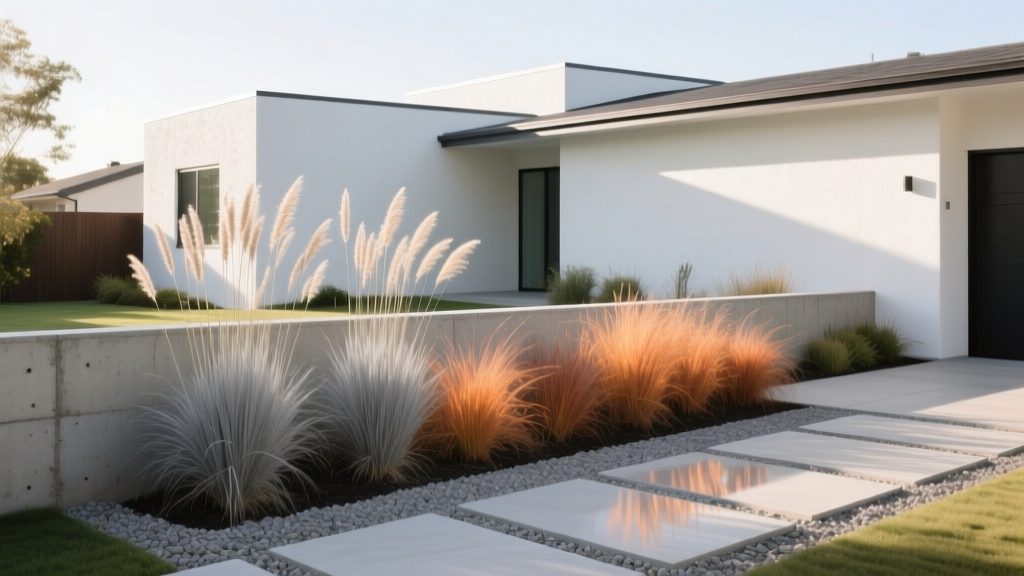
Modern Minimalist Fire-Resistant Front Yards in 2026
David ParkPublished
The Paradox of Ornamental Grasses in Fire-Safe Design
Modern minimalist landscaping has dominated residential exterior design trends heading into 2026. Characterized by clean architectural lines, restrained color palettes, and the soothing kinetic movement of ornamental grasses, this style offers unparalleled curb appeal. However, for homeowners in wildfire-prone regions, traditional ornamental grasses present a severe liability. True grasses (family Poaceae), such as Pampas grass or Miscanthus, cure into highly flammable, volatile tinder by late summer. When embers blow in from a miles-away wildfire, these dry grasses act as flash fuel, rapidly carrying fire to the home's structure.
The challenge for contemporary landscape architects in 2026 is resolving this paradox: How do we maintain the wispy, architectural aesthetic of ornamental grasses while adhering to strict fire-resistant landscaping codes? The solution lies in botanical substitution, strategic spatial planning, and the integration of non-combustible hardscaping. By utilizing 'grass-like' monocots that retain high foliar moisture and pairing them with expansive minimalist hardscapes, homeowners can achieve a stunning, fire-safe front yard that meets the most rigorous defensible space requirements.
Mapping the Minimalist Yard: Defensible Space Zones
To design a fire-resistant minimalist yard, we must first anchor our layout in the latest defensible space zoning codes. According to Cal Fire's Defensible Space guidelines, the area surrounding a home is divided into distinct zones, each with specific vegetation and material restrictions. Minimalist design actually complements these zones beautifully, as the style inherently relies on negative space and structured boundaries.
Zone 0: The Ember-Resistant Zone (0-5 Feet)
The first five feet from any structure or attached deck must be entirely non-combustible. In a modern minimalist design, this is the perfect opportunity to utilize large-format architectural materials. We recommend installing 24x48 inch poured concrete pavers surrounded by tight joints of black basalt gravel. Absolutely no plants, including grass-like varieties, are permitted in Zone 0. This creates a striking, clean-lined foundation that acts as an impenetrable firebreak against wind-blown embers.
Zone 1: The Lean, Clean, and Green Zone (5-30 Feet)
This is where our fire-safe ornamental grass aesthetic comes to life. The NFPA Firewise USA program emphasizes breaking up continuous fuel paths. In minimalist design, we achieve this by planting in isolated, geometric 'islands' rather than continuous swaths. Each planting island should be no larger than 50 square feet, separated by at least 4 feet of compacted decomposed granite (DG) or concrete ribbons. This spacing not only satisfies fire codes by preventing flame spread but also highlights the architectural form of each individual plant cluster, a hallmark of minimalist design.
Top Fire-Resistant 'Grass-Like' Plants for 2026
To achieve the ornamental grass look without the fire hazard, we turn to botanical families that mimic the form of grasses but possess succulent-like water retention and low volatile oils. According to research on plant flammability from Colorado State University Extension, plants with high moisture content, broad leaves (or in this case, thick strappy leaves), and a lack of resins are significantly more fire-resistant. Below are the top selections for a 2026 minimalist front yard.
| Common Name | Botanical Name | Mature Height | Fire-Resistance Rating | Minimalist Use Case |
|---|---|---|---|---|
| 'Breeze' Mat Rush | Lomandra longifolia | 2 - 3 ft | High | Mass planting in geometric grids; fine texture mimics fescue. |
| Evergold Sedge | Carex oshimensis | 1 - 1.5 ft | High | Low border edging along concrete pavers; adds subtle variegation. |
| Cape Rush | Chondropetalum tectorum | 3 - 4 ft | Moderate-High | Vertical focal points; dark green, unbranched stems provide stark modern lines. |
| Flax Lily | Dianella tasmanica | 2 - 3 ft | High | Shaded minimalist corners; strappy leaves with occasional blue berries. |
By utilizing Lomandra and Carex (sedges), you achieve the exact visual softness and movement of traditional ornamental grasses. However, because these plants store significantly more water in their leaf tissues and do not produce the highly combustible thatch associated with true grasses, they will resist ignition far longer when exposed to radiant heat or direct ember attack.
Hardscaping: The Non-Combustible Backbone
In a modern minimalist landscape, hardscaping is not just a pathway; it is the primary design element and the ultimate fire defense mechanism. In 2026, the integration of industrial materials with soft, grass-like plantings remains the gold standard for fire-safe curb appeal.
- Corten Steel Edging: Use 1/4-inch thick, 6-inch tall Corten steel to create sharp, rusted borders around your planting islands. Steel is entirely non-combustible and prevents creeping groundcovers from migrating into defensible space gaps.
- Decomposed Granite (DG): Replace traditional organic mulches (which are highly flammable) with 3/8-inch minus DG. Compacted to a 2-inch depth, DG provides a permeable, fireproof surface that contrasts beautifully with the bright green foliage of Lomandra.
- Board-Formed Concrete: For retaining walls or raised planters in Zone 1, board-formed concrete offers a sleek, wood-grain texture without the combustible reality of timber sleepers.
Smart Irrigation and Seasonal Maintenance
Even the most fire-resistant plants will become combustible if they are severely drought-stressed and desiccated. Maintaining high leaf moisture is critical during the peak fire months of late summer and early autumn. In 2026, relying on manual watering or outdated spray heads is both water-inefficient and a fire risk, as overspray can lead to fungal issues or dry patches.
Install a subsurface drip irrigation system using pressure-compensating emitter lines. Burying the lines beneath the DG mulch protects the plastic tubing from UV degradation and minor surface heat, while delivering water directly to the root zone. Pair this with a 2026 smart weather-based irrigation controller, such as the latest Rachio or Weathermatic models, which automatically adjust watering schedules based on real-time local evapotranspiration (ET) data. This ensures your grass-like plants remain turgid and fire-resistant without violating municipal water restrictions.
The Autumn Cut-Back Protocol
Maintenance is where many fire-safe landscapes fail. While Lomandra and Carex do not produce dangerous thatch, dead foliage can still accumulate at the base of the plant. Implement a strict maintenance protocol: every late spring, manually comb out dead blades from the center of the plants. In late winter, cut back any frost-damaged foliage to within 6 inches of the crown. Never use flammable organic fertilizers; instead, top-dress with inorganic composted bark or rely on slow-release synthetic pellets that do not add surface fuel.
2026 Cost Breakdown: 1,000 Sq Ft Minimalist Front Yard
Transitioning to a fire-resistant minimalist landscape is an investment in both property value and structural survival. Below is an estimated cost breakdown for transforming a standard 1,000 square foot front yard in 2026, assuming professional installation and premium materials.
| Project Phase | Materials & Specifications | Estimated 2026 Cost |
|---|---|---|
| Demolition & Grading | Removal of existing turf/flammable shrubs, regrading for drainage. | $1,800 - $2,500 |
| Zone 0 Hardscaping | Large-format concrete pavers, basalt gravel, sand base. | $3,500 - $5,000 |
| Zone 1 Hardscaping | Corten steel edging, compacted DG, weed barrier. | $2,200 - $3,000 |
| Plant Material | 50x 5-gallon Lomandra, Carex, and Cape Rush specimens. | $1,500 - $2,200 |
| Smart Irrigation | Subsurface drip lines, smart controller, master valve. | $1,200 - $1,800 |
| Total Estimated Cost | Complete professional installation | $10,200 - $14,500 |
Conclusion
Designing a modern minimalist front yard in a wildfire-prone area no longer requires sacrificing the elegant, sweeping aesthetics of ornamental grasses. By understanding the botanical differences between true grasses and fire-resistant monocots, strictly adhering to defensible space zoning, and embracing non-combustible hardscaping materials, you can create a landscape that is both a visual masterpiece and a formidable shield against wildfires. As we move through 2026, the integration of smart irrigation and disciplined maintenance will ensure your minimalist oasis remains green, clean, and fundamentally safe.

