Pest Control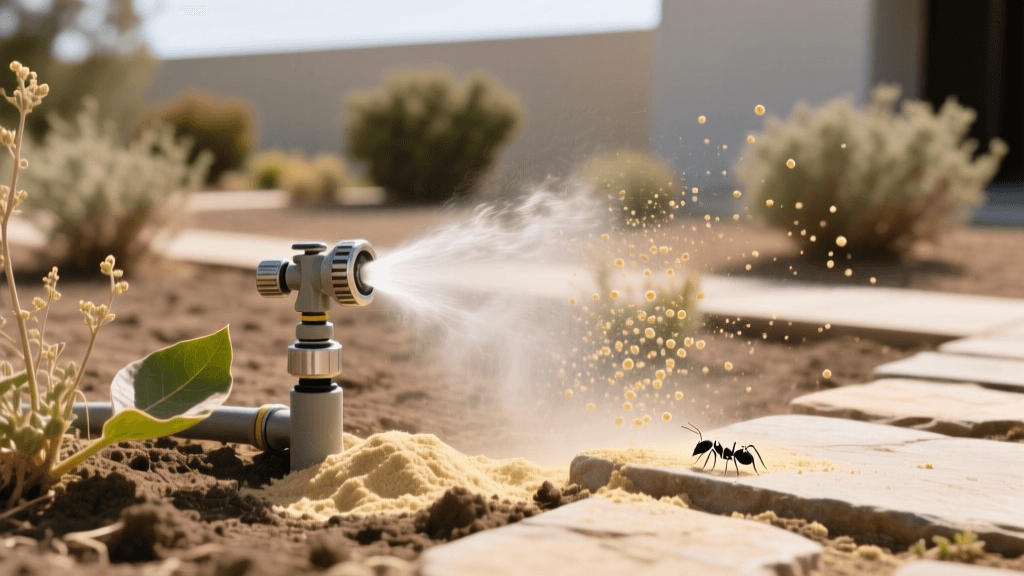
Food-Grade DE for Ant Trails: 2026 Sprinkler Management Guide
The Hidden Link Between Sprinkler Systems and Ant Infestations
If you have spent any time maintaining a lawn or garden, you have likely noticed that ant trails frequently lead directly to your sprinkler heads, valve boxes, and irrigated garden beds. Ants are relentlessly drawn to moisture, and the micro-environments created by modern irrigation systems are prime real estate for colony expansion. Leaky irrigation valves, weeping sprinkler heads, and overwatered soil provide the exact damp conditions that carpenter ants, pavement ants, and Argentine ants need to thrive. As we move through 2026, integrated pest management (IPM) strategies increasingly focus on disrupting these moisture sources while deploying organic, non-toxic barriers. The most effective organic weapon in the modern landscaping arsenal is food-grade diatomaceous earth (DE). However, applying DE in an actively irrigated landscape presents a unique challenge: water is the ultimate kryptonite to diatomaceous earth. This guide will show you how to seamlessly integrate food-grade DE applications with your smart sprinkler system to eradicate ant trails without compromising your lawn's hydration.
Why Food-Grade Diatomaceous Earth Works (and Why Water Ruins It)
Diatomaceous earth is composed of the fossilized remains of tiny, aquatic organisms called diatoms. Their skeletons are made of a natural substance called silica. Under a microscope, food-grade DE looks like a cylinder of broken glass. When ants crawl across a barrier of DE, the microscopic silica shards lacerate their waxy exoskeletons, leading to rapid dehydration and death. According to the National Pesticide Information Center (NPIC), DE is a highly effective mechanical insecticide that poses minimal risk to humans and pets when used correctly. Because it works mechanically rather than chemically, insects cannot develop a genetic resistance to it, making it a cornerstone of 2026 organic pest control protocols.
The major caveat for irrigation professionals and homeowners is that DE must remain completely dry to function. When DE gets wet, the microscopic shards clump together, losing their abrasive quality. The water also creates a surface tension that allows ants to simply walk over the damp powder without sustaining exoskeleton damage. Once the wet DE dries out, it can theoretically regain some efficacy, but the physical act of watering often washes the powder away into the soil or disperses it unevenly, breaking the continuous barrier required to stop an ant trail.
2026 Smart Irrigation Strategies for DE Application
To successfully use food-grade DE for ant trails, you must manipulate your irrigation system to create temporary or permanent 'dry zones' along the pest's pathway. In 2026, smart irrigation controllers like the Rachio 4, Orbit B-hyve Smart, and Hunter Hydrawise offer advanced zone management features that make this easier than ever.
Creating Pest Control Dry Zones
If an ant trail is originating from a specific garden bed or running along a fence line watered by a dedicated drip zone, you can use your smart controller to pause that specific zone for 48 to 72 hours. Apply the DE heavily along the trail and the perimeter of the nest. By suspending irrigation in that micro-zone, you allow the DE to remain dry and active long enough to decimate the foraging workers and force the colony to relocate.
Timing Your Sprinkler Cycles
If you cannot turn off a zone entirely because of sensitive turfgrass or high-value plants, you must time your DE application perfectly. Program your smart controller to run the affected sprinkler zone in the early morning (e.g., 4:00 AM). Wait for the sun and wind to dry the grass blades and soil surface completely, usually by 9:00 AM or 10:00 AM. Apply the food-grade DE mid-morning when the surface is bone dry. This gives the DE a full day of dry, active contact time before the next scheduled watering cycle begins the following morning.
Step-by-Step Application Guide for Ant Trails Near Sprinklers
Follow this protocol to treat ant trails around your irrigation infrastructure safely and effectively.
- Step 1: Audit and Repair Leaks. Before applying any pest control, inspect your valve boxes and sprinkler heads. A weeping head or a leaking PVC joint creates a permanent mud pit that will render DE useless. Replace worn wiper seals and fix PVC leaks first.
- Step 2: Choose the Right DE. Always select 'Food-Grade' DE, never 'Pool-Grade' or 'Filter-Grade' DE, which is heat-treated (calcined) and contains high levels of crystalline silica that are toxic to inhale. Top brands for 2026 include Harris Food Grade Diatomaceous Earth and Safer Brand Ant & Crawling Insect Killer. A 4lb bag typically costs between $15 and $20.
- Step 3: Use a Bulb Duster. Do not just dump the powder. Use a specialized bulb duster or a bellows hand duster to apply a fine, barely visible dusting. Ants will avoid large piles of white powder; a light dusting looks like natural dirt, encouraging them to walk through it.
- Step 4: Treat the Valve Boxes. Sprinkler valve boxes are notorious ant havens due to the damp soil and protective plastic cover. Open the box, let the interior dry out, and apply a light ring of DE around the interior perimeter and along the PVC risers.
- Step 5: Elevate Sprinkler Heads. If pop-up spray heads are situated in low spots where water pools, raise the risers. Keeping the immediate 6-inch radius around the sprinkler head elevated and well-drained ensures your DE barrier won't turn to mud after a cycle.
Comparison Chart: Sprinkler Types and DE Compatibility
Not all irrigation methods interact with DE in the same way. Here is how different 2026 sprinkler technologies impact your pest control efforts.
| Irrigation Type | Moisture Surface Impact | DE Compatibility | 2026 Management Recommendation |
|---|---|---|---|
| Overhead Rotors | High; widespread surface wetting and wind drift. | Poor | Apply DE only after turf is 100% dry; avoid application on windy days to prevent drift into the spray radius. |
| Fixed Spray Heads | Moderate; localized pooling near the head. | Fair | Ensure head grading slopes away from the nozzle. Apply DE in a 12-inch ring outside the immediate splash zone. |
| Subsurface Drip | Low; surface remains largely dry. | Excellent | Ideal for DE application. Surface trails can be heavily dusted without fear of wash-off from the emitter lines below. |
| Micro-Sprayers | Moderate to High; targeted but wets foliage and soil. | Poor | Convert micro-sprayers to point-source drip emitters in garden beds to maintain a dry surface for DE barriers. |
The Ultimate Solution: Converting Spray Heads to Drip Lines
If you are constantly battling ant trails in your garden beds, shrub borders, or foundation plantings, the most permanent solution is to eliminate overhead watering in those zones entirely. Converting traditional spray heads to subsurface drip irrigation or point-source emitters is a major trend in 2026 water-wise landscaping. Drip irrigation delivers water directly to the root zone beneath the soil surface or under a layer of mulch. This leaves the top layer of soil, mulch, and hardscaping completely dry. With a dry surface, you can apply food-grade DE along foundation lines, retaining walls, and garden borders, and it will remain active for weeks, only requiring reapplication after heavy rainfall. This conversion not only solves your DE wash-off problem but also reduces water evaporation and suppresses weed growth.
Safety, Pets, and Environmental Considerations
While food-grade DE is non-toxic if ingested by dogs or cats, it is a fine particulate dust that can cause respiratory irritation if inhaled in large quantities. When applying DE near sprinkler heads, always wear an N95 mask and safety goggles. Apply the dust on calm days to prevent wind from blowing it back into your face or onto neighboring properties. Furthermore, while DE is a fantastic organic tool, it is a broad-spectrum mechanical insecticide. It does not distinguish between a destructive pavement ant and a beneficial ground beetle or pollinator. To protect beneficial insects, never apply DE directly to the blooms of flowering plants or directly over the entrances of native ground-nesting bee colonies. For a comprehensive look at balancing organic treatments with local ecosystems, consult the University of California Integrated Pest Management (UC IPM) guidelines on ant management and beneficial insect preservation.
Conclusion: Mastering the Moisture Balance
Successfully utilizing food-grade diatomaceous earth against ant trails requires a fundamental shift in how you view your sprinkler system. Your irrigation system is no longer just a tool for hydration; it is a dynamic environmental control system that dictates where pests can and cannot survive. By leveraging 2026 smart controller technology to create strategic dry zones, repairing weeping valves, and transitioning garden beds to drip irrigation, you can maintain a lush, vibrant landscape while keeping destructive ant colonies firmly at bay. Master the moisture, and the DE will do the rest.