Gardening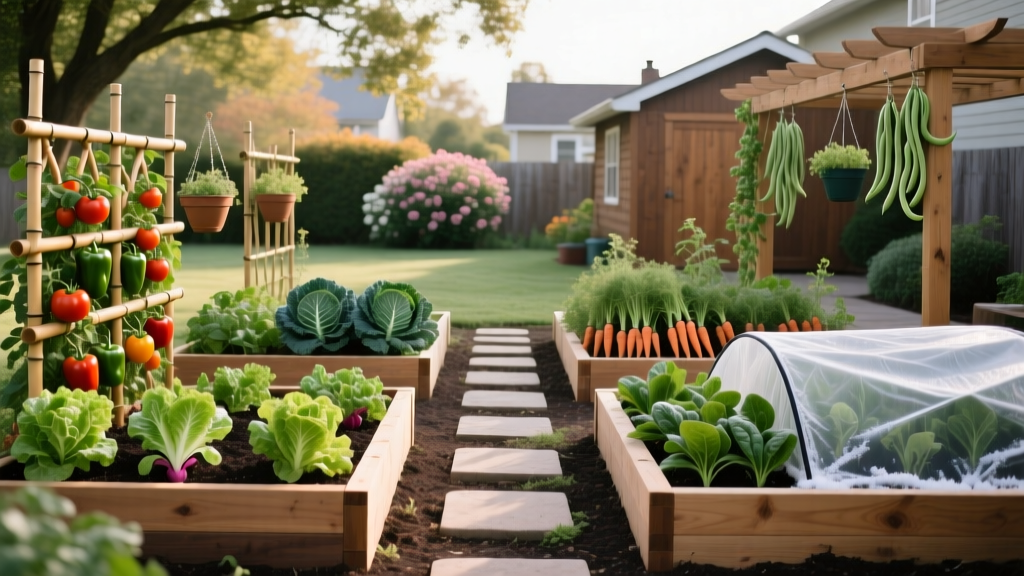
Design a Four-Season Raised Bed Kitchen Garden Layout
Anna KowalskiPublished
Mastering the Potager: Site Selection and Spatial Planning
Designing a four-season raised bed kitchen garden—often referred to as a traditional French potager—requires a delicate balance of aesthetic beauty and high-yield agricultural planning. Unlike traditional row cropping, a kitchen garden is designed for daily harvesting, visual appeal, and continuous succession planting. Before breaking ground or purchasing lumber, you must evaluate your site's microclimates, sunlight exposure, and spatial flow.
The golden rule of kitchen garden placement is the '100-step limit.' Your garden should be located within 100 steps of your kitchen door. This proximity ensures that harvesting fresh herbs for dinner or picking morning tomatoes becomes a seamless part of your daily routine rather than a chore. Furthermore, you must map the sunlight. A productive four-season garden requires a minimum of six to eight hours of direct, unfiltered sunlight daily. Pay special attention to the angle of the winter sun, which sits much lower on the horizon, to ensure that dormant trees or nearby structures do not cast long shadows over your winter crop beds.
Optimal Raised Bed Dimensions and Material Costs
The physical dimensions of your raised beds dictate both your yield and your ergonomic comfort. The industry standard width for a raised bed is four feet. This specific measurement allows an average adult to reach the exact center of the bed (two feet) from either side without ever stepping onto the soil, thereby preventing compaction and preserving soil structure.
Length can vary, but eight-foot beds are generally the most cost-effective due to standard lumber sizing. For depth, aim for a minimum of 12 inches, though 18 inches is vastly superior for deep-rooted crops like heirloom carrots, parsnips, and daikon radishes.
- Untreated Cedar or Redwood: The premium choice for natural rot resistance. Expect to spend $250 to $400 per 4x8 bed. Lasts 10-15 years.
- Galvanized Steel Troughs: Highly durable and warms up quickly in the spring. Costs range from $150 to $300 per bed. Lasts 20+ years.
- Composite Timber: Made from recycled plastics and wood fibers. Zero maintenance and rot-proof, but carries a higher upfront cost of $350 to $500 per bed.
Pathways and Hardscaping Design
Pathways in a kitchen garden are not merely transit routes; they are the negative space that defines your design. For a functional garden, pathways must be a minimum of three feet wide to accommodate a standard wheelbarrow and allow you to kneel comfortably while working the adjacent beds. If you are designing for ADA accessibility, widen the primary paths to four feet and ensure the surface is firm and stable, such as compacted crushed granite, rather than loose mulch.
For secondary paths, arborist wood chips are an excellent, often free, resource. They suppress weeds, retain soil moisture, and break down over time to feed the surrounding fungal networks. Lay down a layer of heavy-duty woven landscape fabric before applying the chips to prevent aggressive weeds like bindweed from penetrating the walkways.
The Four-Season Succession Planting Matrix
To achieve a true four-season harvest, your garden design must incorporate a succession planting strategy. This means planning for the transition between seasons before the current crop has even finished producing. Below is a design matrix for a single 4x8 raised bed divided into four distinct quadrants.
| Season | Primary Crop (Quadrant A) | Succession Crop (Quadrant B) | Vertical Element (Quadrant C) | Ground Cover (Quadrant D) |
|---|---|---|---|---|
| Spring | Sugar Snap Peas | Radishes & Spinach | Early Tomatoes (Transplants) | White Clover (Living Mulch) |
| Summer | Bush Beans | Zucchini & Cucumbers | Indeterminate Tomatoes | Sweet Alyssum |
| Fall | Garlic (Overwintering) | Kale & Swiss Chard | Pole Beans | Fall Mustards |
| Winter | Overwintering Spinach | Mache (Corn Salad) | Dormant Trellis / Frost Blanket | Cover Crop (Hairy Vetch) |
Designing Vertical Layers for Maximum Yield
A well-designed kitchen garden utilizes the Z-axis. By training vining crops upward, you save valuable square footage for sprawling plants and root vegetables. The most effective and aesthetically pleasing vertical structures are cattle panels and wooden obelisks.
Cattle panels, typically 16 feet long and 50 inches tall, can be bent into an archway over a pathway, creating a stunning 'tunnel of produce' where you can grow cucumbers, small melons, and pole beans. For individual beds, construct A-frame trellises from untreated 2x2 cedar stakes. Not only do these structures support heavy crops like butternut squash, but they also create a microclimate underneath, offering dappled shade for cool-weather crops like lettuce during the heat of late summer.
Soil Architecture: Building the Foundation
The success of a raised bed garden is entirely dependent on the soil architecture. You are not just filling a box with dirt; you are engineering a living ecosystem. According to the Cornell University Cooperative Extension, raised bed soil should be lightweight, well-draining, and rich in organic matter to support intensive planting schedules.
'A standard recommendation for raised bed mixes is one-third high-quality compost, one-third peat moss or coconut coir for moisture retention, and one-third coarse vermiculite or perlite for aeration. This mimics the structure of a natural forest floor, promoting vigorous root growth and preventing waterlogging.' — Cornell University Cooperative Extension, Department of Horticulture
When calculating volume, remember that soil settles. A 4x8 bed that is 12 inches deep holds exactly 32 cubic feet of soil. Always purchase 10% more than your mathematical calculation to account for initial settling and the creation of a slight 'mound' in the center of the bed, which improves drainage and warms the soil faster in the spring.
Companion Planting as a Design Element
In a potager, companion planting serves a dual purpose: ecological pest management and visual design. Incorporate edible flowers and trap crops along the borders of your raised beds to soften the hard edges of the wood or steel.
- Nasturtiums: Plant these trailing flowers at the corners of your beds. They act as a trap crop for aphids, drawing them away from your prized brassicas, while adding vibrant splashes of orange and yellow to the garden design.
- French Marigolds: Interplant marigolds heavily around the base of your tomato trellises. Their roots exude compounds that suppress root-knot nematodes, and their dense foliage acts as a living mulch to retain soil moisture.
- Alliums (Chives and Garlic): Border your beds with perennial chives. Their strong scent masks the aroma of vulnerable crops from foraging pests, and their purple pom-pom blooms attract essential pollinators early in the season.
Winterizing and Cold Frame Integration
To truly achieve a four-season harvest, your design must account for winter protection. Integrating cold frames into your raised bed layout allows you to harvest hardy greens even when snow is on the ground. Designate at least one 4x4 bed specifically for winter production. Build a simple hoop house using half-inch PVC pipes bent over the bed and covered with 6-mil greenhouse plastic.
For a more permanent and elegant design solution, install hinged polycarbonate window sashes on the back edge of a designated bed. This creates a traditional cold frame that can be propped open on warm winter days to prevent crops from overheating. By combining spatial planning, structural engineering, and ecological companion planting, your raised bed kitchen garden will transform from a simple vegetable patch into a highly productive, year-round culinary landscape.
