Pest Control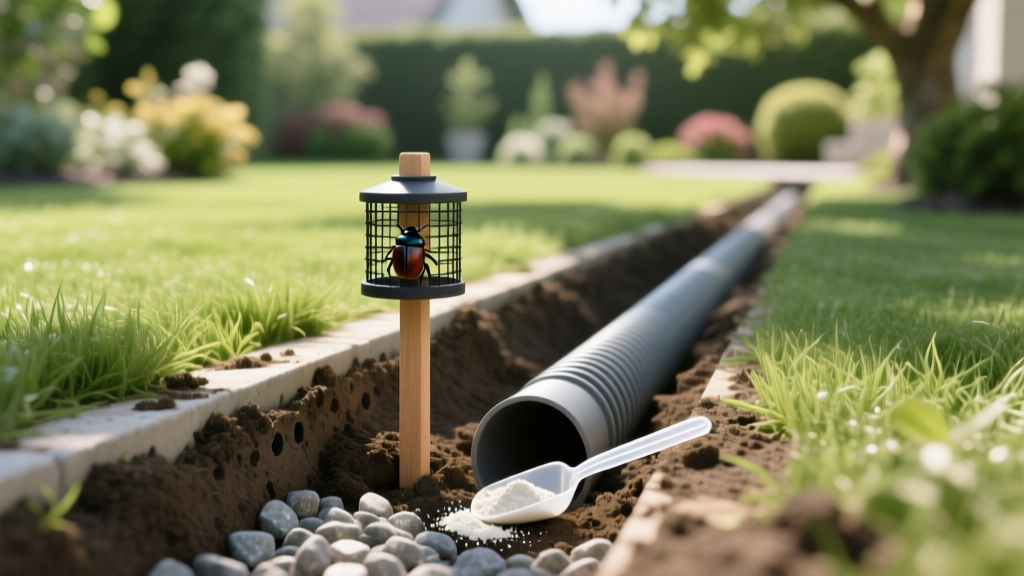
French Drain Grub Control: Milky Spore & Traps 2026
Anna KowalskiPublished
The Intersection of Lawn Drainage and Japanese Beetle Grubs
For homeowners and landscaping contractors dealing with chronically waterlogged lawns, installing a French drain is often the only reliable solution to protect foundations and restore turf health. However, the very conditions that necessitate a French drain—excessive soil moisture and poor percolation—are also the ideal breeding grounds for one of the most destructive turf pests in North America: the Japanese beetle (Popillia japonica). As we navigate the 2026 landscaping season, heavier and more erratic spring rainfall patterns have exacerbated both drainage issues and grub populations.
Integrated Pest Management (IPM) dictates that we should look for synergies in our lawn care routines. Excavating a trench for a French drain presents a rare, highly strategic opportunity to implement long-term biological grub control. By combining French drain installation with targeted milky spore application and strategic Japanese beetle trap placement, you can solve your water management issues while simultaneously inoculating your soil against future grub damage. This guide details exactly how to execute this dual-purpose infrastructure and pest control project in 2026.
Why French Drain Excavation is the Perfect Time for Milky Spore
Milky spore disease, caused by the bacterium Paenibacillus popilliae, is a naturally occurring biological control agent that specifically targets Japanese beetle grubs. When grubs ingest the spores while feeding on grassroots, the bacteria multiply inside their hemolymph, eventually killing them and releasing billions of new spores back into the soil. According to the Clemson University Home & Garden Information Center, once established, milky spore can persist in the soil for 10 to 15 years, providing long-term suppression of grub populations.
Traditionally, applying milky spore to an established lawn is challenging. The spores must reach the root zone where grubs feed, but heavy thatch layers, compacted clay, and dry surface soils often prevent the spores from penetrating deeply enough. This is where French drain installation becomes a massive advantage. By excavating a trench that is typically 12 to 18 inches deep, you are directly accessing the exact overwintering depth of Japanese beetle grubs.
The Trenching Advantage
During the winter months, grubs burrow deep into the soil profile (often 12 to 18 inches down) to escape freezing temperatures. In the spring, they migrate back up to the root zone to feed before pupating. When you install a French drain, you are creating a permanent subterranean pathway. By mixing milky spore powder directly into the backfill soil and the gravel matrix surrounding the perforated pipe, you ensure the spores are distributed precisely where the grubs overwinter and travel. The constant, gentle moisture flow managed by the French drain also keeps the soil environment optimal for the survival and spread of the Paenibacillus popilliae bacteria.
Step-by-Step: Applying Milky Spore During Trenching
To maximize the efficacy of your biological control during a 2026 French drain installation, follow this integrated excavation and application protocol:
- Step 1: Excavation and Soil Staging. Dig your trench to the required depth (usually 18 inches) and slope. Separate the topsoil and turf from the heavy subsoil clay on your tarps.
- Step 2: Pipe and Gravel Base. Lay your landscape fabric, place the perforated PVC or corrugated pipe, and cover it with the initial layer of washed drainage gravel.
- Step 3: Spore Integration. Before adding the final layers of gravel and topsoil backfill, apply milky spore powder. Instead of the traditional 1-teaspoon grid method used on established lawns, you will broadcast the spores directly into the trench and mix it into the staged topsoil backfill.
- Step 4: Backfill and Sod Replacement. Fold the landscape fabric over the gravel, add the spore-inoculated topsoil, and replace your sod or seed. Water the area deeply to activate the spores and settle the French drain bed.
2026 Milky Spore Product Guide and Application Rates
Pricing and formulations for milky spore have been updated for the 2026 market. Below is a comparison of the most reliable products for trench-integration applications.
| Product Name | Formulation | Coverage Area | 2026 Avg. Cost | Best Use Case |
|---|---|---|---|---|
| St. Gabriel Organics Milky Spore Powder | Concentrated Powder | 400 sq ft (2.2 oz) | $48.99 | Targeted trench lines and garden beds |
| St. Gabriel Organics Milky Spore Spreaders | Granular w/ Spreader | 10,000 sq ft (20 lbs) | $114.50 | Broad lawn application post-drain backfill |
| Monterey Milky Spore Disease | Concentrated Powder | 2,500 sq ft (10 oz) | $159.00 | Large-scale commercial drainage projects |
Strategic Japanese Beetle Trap Placement Near Drainage Zones
While milky spore handles the subterranean grub threat, adult Japanese beetles will still attempt to feed on your landscape ornamentals and lay eggs in your turf during the summer months. This is where Japanese beetle traps come into play, but their placement requires extreme caution, especially near newly installed French drains.
Japanese beetle traps utilize a combination of floral lures (like geraniol and eugenol) and a female sex pheromone to attract adult beetles. Research highlighted by the University of Kentucky Department of Entomology demonstrates that these traps are incredibly potent and can draw beetles from hundreds of feet away. The critical flaw of these traps is that they often attract more beetles than they actually catch. This results in a localized concentration of beetles that will mate and lay eggs in the nearest available soil.
The Danger of Traps Near French Drain Outlets
When you install a French drain, the excavation zone and the discharge outlet feature freshly disturbed, loose, and highly aerated soil. Female Japanese beetles strongly prefer laying their eggs in soft, moist, easily penetrable soil. If you place a pheromone trap anywhere near your newly installed French drain trench, the discharge area, or the newly laid sod used to patch the excavation, you are effectively inviting thousands of beetles to lay their eggs directly on top of your expensive drainage infrastructure.
While the milky spore in the trench will eventually kill the resulting grubs, a massive, concentrated hatching event can overwhelm the biological control agent before it has time to establish and spread, potentially leading to localized turf death right above your drain line.
Proper Trap Placement Guidelines for 2026
To protect your French drain investment and your turf, adhere to these strict trap placement rules:
- The 50-Foot Buffer Rule: Never place a Japanese beetle trap within 50 feet of a French drain excavation zone, a drainage swale, or a discharge outlet.
- Downwind Positioning: Identify the prevailing summer wind direction in your yard. Place traps on the downwind edge of your property, pulling the beetles away from your home, your ornamental trees, and your newly graded drainage zones.
- Property Line Strategy: If you have a large property, place traps near the perimeter, ideally in an area where the soil is heavily compacted or shaded, making it less desirable for egg-laying.
- Community Coordination: Traps are most effective when used as a neighborhood-wide diversion strategy. Encourage neighbors to place traps on the outer edges of the community, creating a defensive perimeter rather than individual yard traps that simply pull beetles from neighboring properties into yours.
Post-Installation Lawn Recovery and Grub Monitoring
After the French drain is buried and the milky spore is integrated into the soil profile, the focus shifts to turf recovery and monitoring. The newly replaced sod over the drain line will require consistent moisture to establish roots. Fortunately, this necessary watering also helps activate the milky spore, encouraging the bacteria to bind to soil particles and organic matter within the gravel matrix.
It is important to remember that milky spore is a long-term biological solution, not an instant chemical knockdown. In the first year following your 2026 installation, you may still see some adult beetle activity and minor grub presence. The spore count in the soil needs time to build up to a lethal threshold. Avoid the temptation to apply broad-spectrum chemical grubicides (such as chlorantraniliprole or imidacloprid) over the French drain line, as these chemicals can harm beneficial soil nematodes and disrupt the delicate biological balance required for milky spore to thrive.
By viewing your French drain installation not just as a water management project, but as a strategic opportunity for deep-soil pest inoculation, you transform a disruptive landscaping chore into a foundational pillar of your lawn's long-term Integrated Pest Management strategy. Proper drainage eliminates the stagnant moisture that favors certain fungal diseases, while the simultaneous application of milky spore and the intelligent diversion of adult beetles via perimeter traps ensures your newly restored lawn remains vibrant, resilient, and grub-free for the next decade.