Lawn Care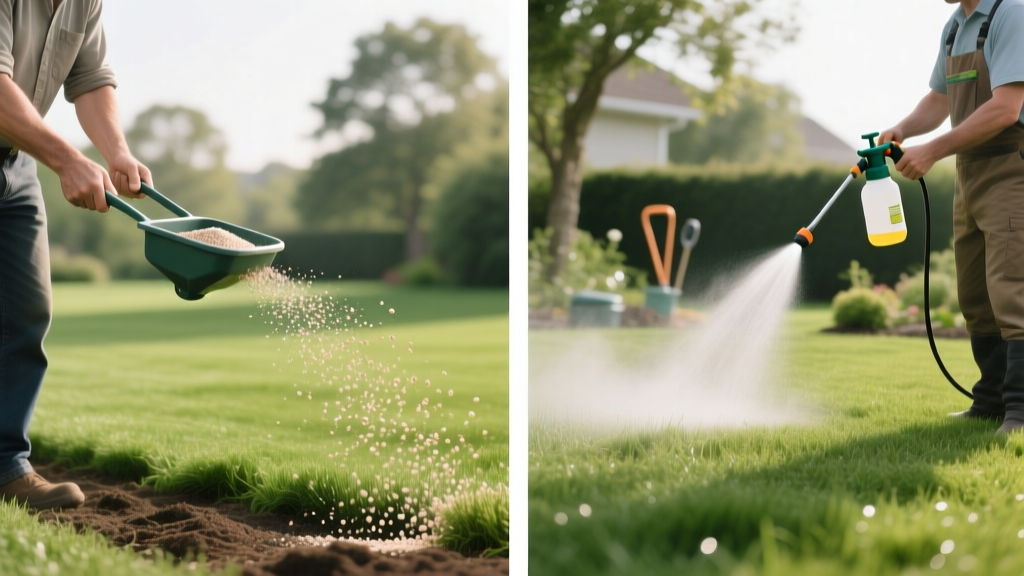
Granular vs Liquid Fertilizer: 2026 Lawn Application Guide
Emily WatsonPublished
The Great Lawn Care Debate: Granular vs. Liquid Fertilizer in 2026
As we navigate the 2026 lawn care season, achieving a thick, vibrant, and weed-free turf requires a highly strategic approach to nutrition. The foundation of any successful lawn care program lies in proper fertilization. However, a common dilemma faces both weekend warriors and professional turf managers: should you use granular or liquid fertilizer? Both delivery methods have distinct advantages, cost structures, and application techniques. In this comprehensive 2026 guide, we will break down the science, economics, and practical application of granular versus liquid fertilizers, helping you make the best choice for your specific grass type, soil condition, and budget.
Understanding Granular Fertilizer
Granular fertilizers consist of solid, pellet-like nutrients that are broadcast across the lawn using a rotary or drop spreader. In 2026, advancements in polymer-coated slow-release technologies have made granular options more efficient and environmentally friendly than ever before. When applied, these pellets require moisture—either from rainfall or manual irrigation—to break down and release their nutrients into the soil profile where the root system can access them.
Pros of Granular Fertilizer
- Long-Lasting Results: Modern slow-release formulations (such as methylene urea or polymer-coated prills) can feed your lawn steadily for 8 to 12 weeks, reducing the number of annual applications required.
- Cost-Effective for Large Lawns: Purchasing 50-pound bags of granular fertilizer remains the most economical way to treat properties larger than 5,000 square feet. In 2026, premium brands like Scotts Turf Builder or Lesco Professional average between $35 and $55 per bag, covering up to 15,000 square feet.
- Lower Burn Risk: Because the nutrients are encased in a solid coating and released slowly into the soil, granular fertilizers are far less likely to cause foliar (leaf) burn, even if applied during warmer spring afternoons.
- Easy Storage: Granular products have an exceptionally long shelf life and do not separate or degrade when stored in a dry garage or shed.
Cons of Granular Fertilizer
- Requires Watering In: You must irrigate the lawn immediately after application to activate the pellets and wash them off the grass blades to prevent localized burning.
- Application Inconsistencies: Improper spreader calibration or overlapping errors can lead to visible striping—alternating bands of dark green and pale grass.
- Slower Initial Greening: It can take 7 to 14 days to see a visual response, as the pellets must dissolve and the roots must uptake the nutrients.
Understanding Liquid Fertilizer
Liquid fertilizers are concentrated solutions or suspensions mixed with water and applied via hose-end sprayers, watering cans, or battery-powered backpack sprayers. The 2026 market has seen a massive surge in liquid fertilizer adoption among DIYers, driven by the desire for instant gratification and the ease of foliar feeding. Liquid nutrients are immediately available to the grass plant, often showing visible greening within 48 to 72 hours of application.
Pros of Liquid Fertilizer
- Rapid Absorption: Nutrients are absorbed directly through the grass blades (foliar feeding) and the soil surface, providing an immediate color boost and growth response.
- Uniform Coverage: When sprayed correctly, liquid fertilizers eliminate the risk of spreader striping, ensuring every square inch receives an identical dose of nutrition.
- Excellent for Micronutrients: Liquid formulations are highly effective for delivering vital micronutrients like iron, manganese, and zinc, which are crucial for deep greening without excessive top growth.
- Precise Spoon-Feeding: Professionals favor liquids for 'spoon-feeding'—applying small, frequent doses of nutrients to maintain steady, manageable growth without surging the lawn.
Cons of Liquid Fertilizer
- Shorter Longevity: Liquid fertilizers are typically fast-release, meaning they are quickly depleted. You will need to reapply every 2 to 4 weeks during the peak 2026 growing season.
- Higher Cost Per Square Foot: High-quality liquid concentrates, such as Simple Lawn Solutions 16-4-8 or PetraTools Liquid Fertilizer, cost roughly $30 to $40 per 32-ounce bottle, which only treats 3,000 to 4,000 square feet.
- High Burn Risk: Applying liquid nitrogen during the heat of a summer afternoon or failing to properly dilute the concentrate can severely scorch the turf.
Head-to-Head Comparison: Granular vs. Liquid
| Feature | Granular Fertilizer | Liquid Fertilizer |
|---|---|---|
| Absorption Rate | Slow (7-14 days) | Fast (24-72 hours) |
| Longevity | 8-12 weeks | 2-4 weeks |
| Cost per 1,000 sq ft | $1.50 - $3.50 | $4.00 - $8.00 |
| Equipment Needed | Broadcast or Drop Spreader | Hose-end or Backpack Sprayer |
| Burn Risk | Low | Moderate to High |
| Best Use Case | Base feeding, large lawns, fall prep | Quick green-up, micronutrients, spot treatments |
2026 Fertilization Schedules
Choosing between granular and liquid isn't always an 'either/or' decision. The most successful lawn care programs in 2026 utilize a hybrid approach, leveraging the strengths of both delivery methods based on the season and the grass type.
Cool-Season Grasses (Kentucky Bluegrass, Fescue, Ryegrass)
- Early Spring (April): Apply a liquid iron and micronutrient blend to wake up the lawn and provide a rapid green-up without pushing excessive, vulnerable top growth.
- Late Spring (May): Use a slow-release granular fertilizer with pre-emergent crabgrass control. The granular format ensures the pre-emergent barrier is properly watered into the soil.
- Summer (June - August): Keep feeding minimal. If the lawn shows stress, use a gentle liquid kelp or humic acid application to build drought resistance. Avoid heavy nitrogen.
- Early Fall (September): Apply a high-nitrogen granular fertilizer (e.g., 24-0-8) to promote deep root growth and winter carbohydrate storage.
- Late Fall (November): A final liquid nitrogen application (like urea) right before dormancy ensures the lawn stores energy for an explosive spring return.
Warm-Season Grasses (Bermuda, Zoysia, Centipede, St. Augustine)
- Spring Green-Up (April/May): Once soil temperatures consistently hit 65°F, apply a liquid nitrogen and potassium blend to support rapid stolon and rhizome expansion.
- Peak Summer (June - August): This is the prime growing season. Apply a balanced granular fertilizer (e.g., 16-4-8) every 6 to 8 weeks. The slow-release nature of granular products prevents the lawn from outgrowing your mowing schedule.
- Early Fall (September): Transition to a granular 'winterizer' formula high in potassium (e.g., 5-10-15) to increase cold tolerance and protect against winter kill.
Environmental Considerations and Soil Testing
Regardless of whether you choose granular or liquid, responsible fertilization in 2026 requires an understanding of your local ecosystem and soil chemistry. Over-application of nitrogen and phosphorus contributes heavily to watershed pollution and algae blooms. According to the University of Minnesota Extension, over-fertilization not only harms local waterways but also promotes thatch buildup and increases the turf's susceptibility to disease and insect pressure. Always adhere to local municipal guidelines regarding phosphorus applications, as many regions have strictly banned phosphorus in lawn fertilizers unless a soil test proves a deficiency.
Furthermore, experts at Clemson University's Home & Garden Information Center strongly recommend conducting a comprehensive soil test before purchasing any fertilizer. A soil test will reveal your lawn's exact pH level and baseline nutrient profile. If your soil pH is too acidic (below 6.0) or too alkaline (above 7.5), the grass roots will be unable to absorb the expensive granular or liquid nutrients you are applying, rendering your efforts useless. By testing your soil every two to three years, you can amend your lawn with liquid lime or sulfur precisely when needed, ensuring maximum ROI on your fertilization schedule.
Final Verdict for 2026
Ultimately, the choice between granular and liquid fertilizer depends on your lawn's size, your budget, and the amount of time you wish to spend on maintenance. For the average homeowner with a quarter-acre lot looking for a low-maintenance, budget-friendly routine, granular fertilizer remains the undisputed champion. It provides reliable, long-lasting nutrition with minimal equipment requirements. However, for turf enthusiasts, sports field managers, or those dealing with stubborn nutrient deficiencies who demand precise control and rapid visual results, liquid fertilizer is an indispensable tool. By combining the sustained feeding power of granular products with the targeted, rapid-response benefits of liquids, you can achieve a championship-caliber lawn in 2026 and beyond.