
Landscaping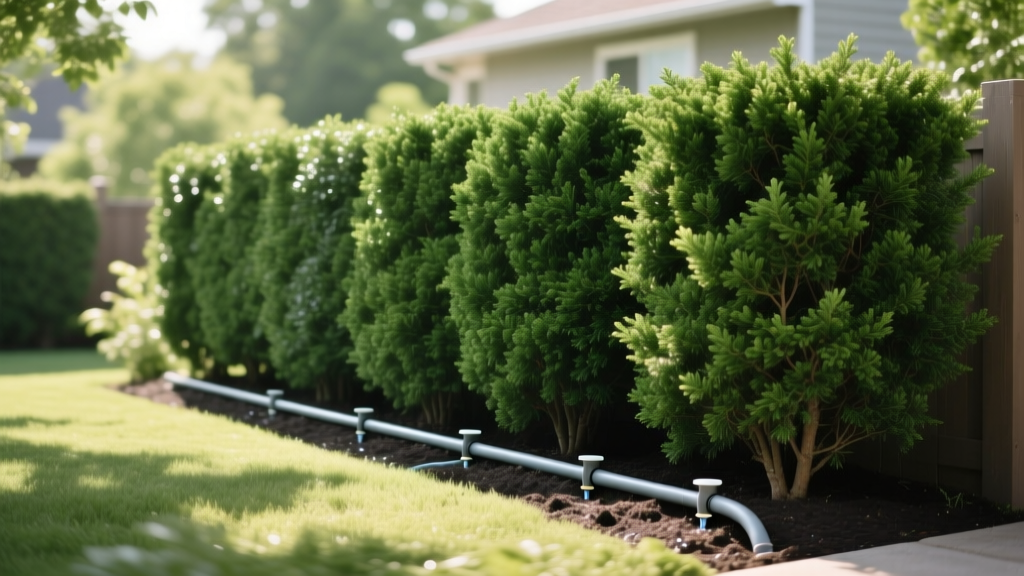
Irrigating Green Giant Arborvitae Privacy Screens in 2026
Robert HayesPublished
The Rise of the Green Giant Privacy Screen in 2026
When homeowners and landscape architects in 2026 look to establish a lush, fast-growing backyard privacy screen, the Green Giant arborvitae (Thuja standishii x plicata 'Green Giant') remains the undisputed champion. Capable of growing up to three feet per year under optimal conditions, these robust evergreens provide rapid seclusion, windbreaking, and noise reduction. However, their explosive growth rate comes with a significant demand for consistent, deep moisture, particularly during their critical establishment phase. Relying on manual watering or outdated sprinkler heads is no longer sufficient for modern landscape management. To ensure your Green Giant hedge thrives and maintains its vibrant emerald foliage, integrating a dedicated, smart drip irrigation system is an absolute necessity.
Why Drip Irrigation Outperforms Traditional Sprinklers
While traditional rotary and spray head sprinklers are excellent for broad turfgrass coverage, they are highly inefficient and potentially harmful when applied to dense evergreen hedging. Overhead sprinklers suffer from severe wind drift and evaporation losses, meaning a significant percentage of your water never reaches the root zone. More importantly, Green Giant arborvitae are susceptible to fungal pathogens and foliar diseases when their dense canopy remains wet for extended periods. By utilizing a subsurface or mulch-covered drip irrigation system, you deliver water directly to the root ball and surrounding soil.
According to the EPA WaterSense program, drip irrigation systems can achieve up to 90 percent water use efficiency compared to the 50 to 70 percent efficiency of traditional spray sprinklers. This targeted approach not only conserves water but also keeps the foliage completely dry, drastically reducing the risk of blight and canker diseases that frequently plague improperly watered privacy hedges.
Designing Your 2026 Smart Irrigation Zone
Choosing the Right Drip Tubing and Emitters
For a linear privacy hedge planted at the standard five-to-six-foot spacing, running individual button emitters to each tree can be tedious and prone to clogging. Instead, the industry standard in 2026 is to use inline drip tubing, such as 1/2-inch polyethylene tubing with factory-installed pressure-compensating emitters spaced every 12 inches. This creates a continuous, uniform moisture zone along the entire length of the privacy screen. Because Green Giants have expansive root systems that widen as the tree matures, inline drip tubing ensures that water is distributed evenly across the entire root mass, not just at the base of the trunk. You will need a pressure regulator to drop your home's water pressure to the 25-30 PSI required for drip systems, as well as a mesh filter to prevent sediment from clogging the micro-emitters.
Integrating Smart Controllers and Soil Sensors
The irrigation landscape in 2026 is dominated by smart, Wi-Fi-enabled controllers that utilize hyper-local weather data and evapotranspiration (ET) rates to automatically adjust watering schedules. Pairing a smart controller with a wireless soil moisture sensor buried in the root zone of your arborvitae hedge is the ultimate setup. The University of Minnesota Extension emphasizes that deep, infrequent watering is critical for developing drought-tolerant, deep root systems in trees and shrubs. A smart controller equipped with a soil moisture sensor will override scheduled watering if the soil already holds adequate moisture, preventing the deadly sin of overwatering, which leads to root rot in poorly draining soils.
Step-by-Step Installation Guide for Your Privacy Screen
Installing a dedicated drip zone for your Green Giant arborvitae is a straightforward weekend project if you follow these structured steps:
- Run the Mainline: Tap into your existing irrigation valve manifold or run a new 3/4-inch PVC or poly mainline to the start of your privacy hedge.
- Install the Head Assembly: At the beginning of the drip zone, install a vacuum breaker, a 200-mesh filter, and a 30 PSI pressure regulator. This assembly is non-negotiable for the longevity of your drip emitters.
- Lay the Inline Drip Tubing: Unroll the 1/2-inch inline drip tubing and let it sit in the sun for an hour to become pliable. Lay it in a gentle zigzag or serpentine pattern along the base of the hedge, keeping the tubing about 12 to 18 inches away from the main trunk to encourage outward root growth.
- Secure the Tubing: Use landscape drip staples every 3 to 4 feet to pin the tubing firmly to the soil. This prevents the tubing from shifting or popping up through the mulch over time.
- Flush the System: Before capping the ends of the tubing, turn on the valve and let the water run through the open ends for two minutes to flush out any dirt or manufacturing debris.
- Apply Mulch: Cover the drip tubing with 2 to 3 inches of organic hardwood mulch. This hides the tubing, protects it from UV degradation, and further reduces soil surface evaporation.
Seasonal Watering Schedule and Maintenance
Green Giant arborvitae require different watering volumes depending on their age, the season, and your local soil composition. Clay soils retain moisture longer and require less frequent watering, while sandy soils drain rapidly and demand more frequent irrigation cycles. The table below outlines the general baseline schedule for a smart drip system utilizing 1.0 GPH (gallons per hour) emitters.
| Establishment Phase | Watering Frequency | Duration per Zone | Target Soil Moisture |
|---|---|---|---|
| Year 1 (New Planting) | 2-3 times per week | 45-60 minutes | Moist to 12 inches deep |
| Year 2 (Establishing) | 1-2 times per week | 60-90 minutes | Moist to 18 inches deep |
| Year 3+ (Mature Hedge) | Once a week (or as needed) | 90-120 minutes | Deep saturation to 24 inches |
During the late fall and winter months, do not assume your evergreens are dormant and stop watering entirely. Winter desiccation—where the foliage loses moisture to dry, freezing winds faster than the frozen roots can replace it—is a leading cause of spring browning in arborvitae. Continue to run your drip system once a month during dry winter spells when the ambient temperature is above 40 degrees Fahrenheit.
Common Irrigation Mistakes to Avoid
Even with a state-of-the-art 2026 smart irrigation system, homeowner errors can compromise the health of a Green Giant privacy screen. Avoid these common pitfalls:
- Watering Directly Against the Trunk: Piling water and mulch directly against the bark of the arborvitae invites crown rot and rodent damage. Always keep the immediate base of the trunk dry and maintain a mulch-free gap of a few inches around the stem.
- Ignoring Emitter Clogs: While inline drip tubing is durable, mineral buildup from hard water can eventually clog emitters. Inspect your filter monthly and flush the lines at the start of every spring season to ensure uniform water distribution.
- Over-relying on Rain Sensors: Standard rain sensors only measure precipitation that has already fallen and often shut off the system after a light, ineffective drizzle. Upgrading to a soil moisture sensor or a predictive smart controller ensures the system only waters when the root zone actually requires it, regardless of superficial rain events.
Conclusion
Investing in a Green Giant arborvitae privacy screen is a significant landscape upgrade that yields incredible returns in curb appeal and backyard seclusion. By pairing these vigorous evergreens with a modern, smart drip irrigation system, you eliminate the guesswork from watering, protect your plants from foliar diseases, and conserve vital water resources. Follow these 2026 best practices, and your living fence will grow thick, green, and impenetrable for decades to come.

