
Landscaping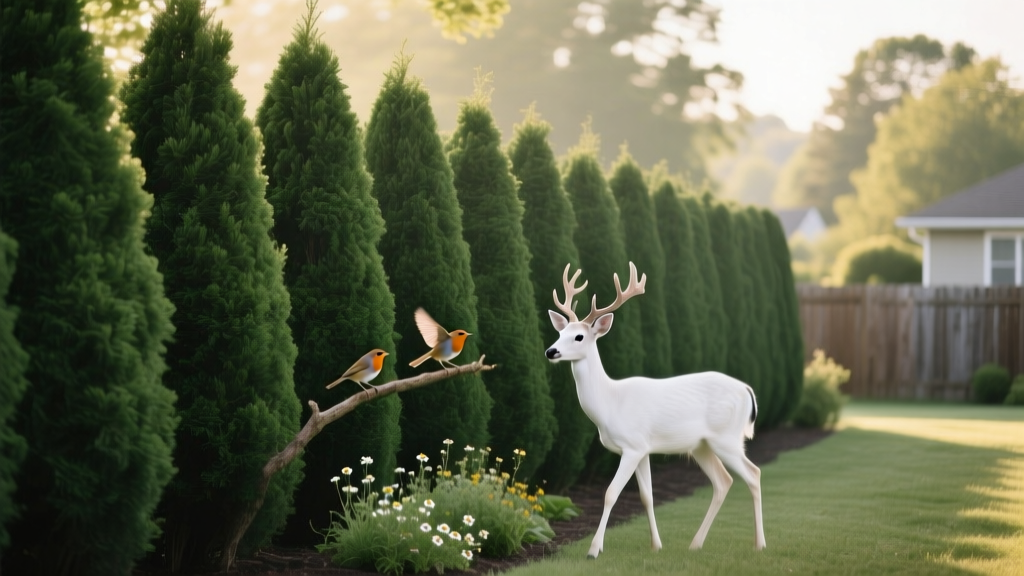
2026 Green Giant Arborvitae Privacy Screen Wildlife Guide
Robert HayesPublished
The Intersection of Privacy and Wildlife Management in 2026
As homeowners in 2026 continue to prioritize outdoor living spaces, the demand for robust, fast-growing privacy screens has reached new heights. Among the most popular choices for backyard hedging is the Green Giant arborvitae (Thuja standishii x plicata 'Green Giant'). Known for its rapid growth, disease resistance, and lush evergreen foliage, it creates an impenetrable visual barrier. However, from a wildlife and yard animal management perspective, installing a massive evergreen hedge fundamentally alters the local ecosystem. Understanding how this specific hybrid interacts with deer, birds, small mammals, and local insect populations is crucial for maintaining a balanced, thriving yard.
Deer Resistance: A Major Advantage for Yard Animal Management
One of the most significant challenges in suburban landscaping is deer browsing. Traditional privacy trees like the Eastern arborvitae (Thuja occidentalis) or Leyland cypress are often decimated by hungry deer, turning expensive privacy screens into unsightly, half-eaten fences. The Green Giant arborvitae, however, boasts a genetic advantage. Because it is a hybrid of the Western redcedar (Thuja plicata), it inherits a high level of natural deer resistance. According to landscape management data published by Penn State Extension, plants with the genetic lineage of Western redcedar are rarely severely damaged by deer except in times of extreme winter starvation.
For homeowners managing heavy deer pressure, the Green Giant is a strategic choice. While no plant is entirely deer-proof, the aromatic compounds and tougher foliage of the Green Giant make it highly unpalatable compared to other evergreens. This means you can establish a perimeter screen without the need for constant chemical repellents or expensive physical deer fencing, allowing for a more natural, unobstructed yard environment.
Avian Habitats: Nesting and Predator Protection
From an avian wildlife perspective, a mature Green Giant privacy screen acts as a vital sanctuary. The dense, overlapping scale-like foliage provides exceptional cover from aerial predators such as hawks and owls. In 2026, as urban sprawl continues to reduce natural forest edges, backyard evergreen hedges serve as critical substitute habitats. The National Audubon Society emphasizes that dense evergreens are essential for backyard bird habitats, offering secure nesting sites and thermal cover during harsh winter months.
Species such as American robins, mourning doves, house finches, and even larger birds like Cooper's hawks frequently utilize the thick outer branches of arborvitae hedges for nesting. The structural integrity of the Green Giant, which maintains its lower branches well when properly spaced, ensures that ground-level and mid-canopy nesting sites remain available. However, it is important to note that while Green Giants provide excellent shelter, they do not produce the fleshy berries or seeds that native shrubs do, meaning they serve primarily as a habitat structure rather than a food source.
2026 Privacy Tree Comparison Chart
When selecting a privacy screen, it is helpful to compare the Green Giant against other popular hedging plants regarding their impact on local wildlife and their growth characteristics.
| Tree Species | Deer Resistance | Bird Nesting Value | Wildlife Food Value | 2026 Avg. Growth Rate |
|---|---|---|---|---|
| Green Giant Arborvitae | High | Excellent | Low (Minimal seeds) | 3-5 ft/year |
| Leyland Cypress | Moderate | Good | None | 3-4 ft/year |
| Eastern Redcedar | Moderate | Excellent | High (Berry-like cones) | 1-2 ft/year |
| Skip Laurel | High | Moderate | Moderate (Toxic berries) | 2-3 ft/year |
| Eastern Arborvitae | Very Low | Good | Low | 2-3 ft/year |
The Understory Challenge: Small Mammals and Soil Health
A common issue with dense evergreen privacy screens is the creation of a "dead zone" beneath the canopy. The thick foliage of a Green Giant hedge intercepts a significant amount of rainfall and sunlight, often leaving the soil directly underneath dry, acidic, and barren. This environment can inadvertently become a hiding spot for unwanted yard animals, such as voles, which may use the dry, protected base to tunnel and chew on the tree's root crown or the bark of nearby ornamental plants.
To manage small mammal activity and promote a healthier ecosystem, proper base maintenance is required. In 2026, best practices dictate keeping mulch pulled at least 4 to 6 inches away from the central trunk of each arborvitae to prevent vole habitation and root rot. Furthermore, lightly "limbing up" the lowest branches by 12 to 18 inches allows sunlight to penetrate the soil, encouraging ground cover growth that supports beneficial insects while discouraging vole tunneling networks.
Step-by-Step Planting Guide for Maximum Privacy and Ecology
To establish a Green Giant privacy screen that serves both your need for seclusion and the local wildlife, follow these actionable planting steps tailored for the 2026 growing season:
- Spacing: Plant trees 6 to 8 feet apart. Closer spacing (4-5 feet) creates a faster screen but increases competition for water and limits the inner-branch density that birds need for secure nesting.
- Site Preparation: Dig a hole twice as wide as the root ball but no deeper. Green Giants require well-draining soil; waterlogged roots will quickly lead to phytophthora root rot.
- 2026 Nursery Pricing: Expect to pay between $65 and $95 for a healthy 5-gallon container tree, or $160 to $250 for a 15-gallon balled-and-burlapped (B&B) specimen. Investing in larger B&B trees provides immediate privacy and instant bird habitat.
- Watering: Install a drip irrigation line along the hedge. Deep, infrequent watering encourages deep root growth, making the trees more resilient to summer droughts and less susceptible to spider mite infestations.
- Soil Amendment: Avoid heavy peat moss, which can hydrophobe when dry. Instead, backfill with native soil mixed with 20% organic compost to support the mycorrhizal fungi essential for tree health.
Underplanting Strategies to Boost Wildlife Value
Because the Green Giant arborvitae offers shelter but lacks a food source, the most ecologically sound landscaping strategy is to underplant the sun-facing side of your privacy screen with native, wildlife-friendly shrubs. By creating a staggered, multi-layered hedge, you mimic natural forest edges.
Consider planting native viburnums, serviceberry (Amelanchier), or winterberry holly (Ilex verticillata) about 4 to 5 feet in front of the arborvitae line. This not only softens the rigid, linear look of a privacy fence but also provides the berries and nectar that local birds and pollinators desperately need. The Green Giant acts as the windbreak and winter shelter, while the native understory provides the spring and summer foraging grounds.
Pest Monitoring: Bagworms and Spider Mites
Wildlife management also includes monitoring insect populations that can devastate your screen. While Green Giants are largely disease-resistant, they are not immune to pests. Bagworms (Thyridopteryx ephemeraeformis) are a primary threat. These insects construct protective cases out of the arborvitae's own foliage, blending in perfectly with the hedge. If left unchecked, they can defoliate and kill entire sections of your privacy screen.
From an ecological management standpoint, encourage natural predators like parasitic wasps and birds by avoiding broad-spectrum insecticides. Inspect your hedge in late fall and early spring, hand-picking and destroying any bagworm cases you find. For spider mites, which thrive in hot, dusty conditions on the interior of the hedge, a strong blast of water from a hose is often enough to disrupt their life cycle without harming beneficial insects. For more detailed integrated pest management strategies, resources provided by Trees Are Good offer excellent guidance on maintaining tree health without resorting to harsh chemicals.
Conclusion
The Green Giant arborvitae remains an undisputed champion for backyard privacy screens in 2026. Its towering height, rapid growth, and formidable deer resistance make it an invaluable asset for homeowners dealing with browsing animals. By understanding its role in the broader ecosystem—providing critical nesting sites for birds while requiring careful understory management to deter voles—you can cultivate a privacy hedge that is both highly functional and ecologically responsible. Pairing your Green Giants with native, berry-producing shrubs will ultimately transform your yard's perimeter into a thriving, private sanctuary for both your family and local wildlife.

