Pest Control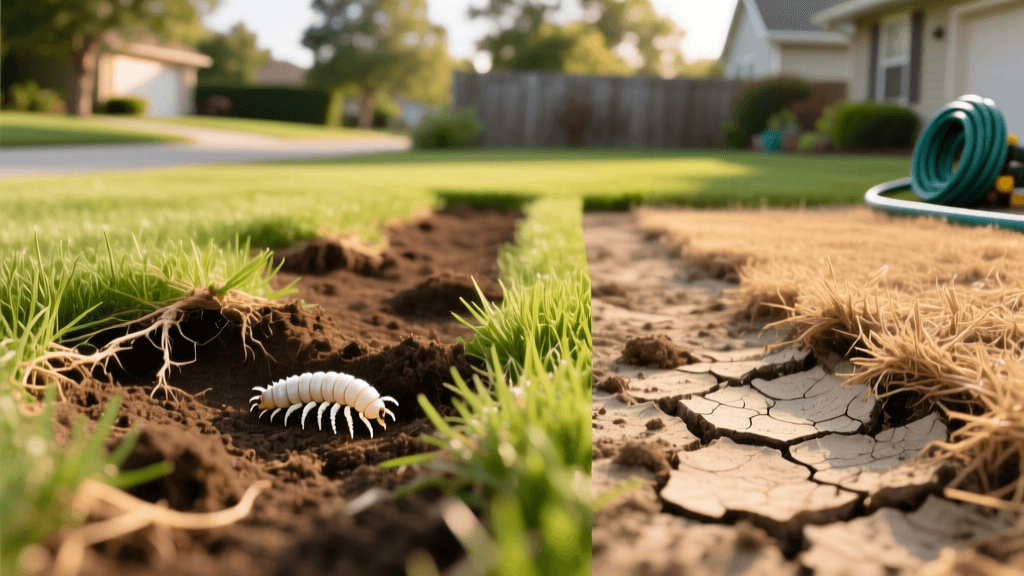
Grub Damage vs Drought Stress: Diagnosing Brown Patches
The Diagnostic Dilemma: Grubs vs. Drought
When late summer and early autumn arrive, many homeowners step outside to discover unsightly brown patches spreading across their once-lush lawns. The immediate instinct is often to increase irrigation, assuming the turf is simply suffering from late-season heat and drought stress. However, applying water to a lawn suffering from a white grub infestation will not solve the problem and will only waste resources while the pests continue to destroy your turf's root system.
White grubs—the larval stage of beetles such as the Japanese beetle (Popillia japonica), masked chafers, and June beetles—feed aggressively on grass roots just below the soil surface. Because the damage occurs underground, the above-ground symptoms mimic drought stress almost perfectly. Accurate problem diagnosis is the cornerstone of Integrated Pest Management (IPM). Before spending hundreds of dollars on curative insecticides or overwatering your lawn, you must troubleshoot the root cause. According to University of Kentucky Entomology, misdiagnosis is the leading cause of unnecessary pesticide applications in residential turfgrass management.
Comparison Chart: Grub Damage vs. Drought Stress
Use the following troubleshooting matrix to compare the visual and physical symptoms of your lawn. While both issues cause browning, the structural integrity of the turf and the surrounding environmental clues will reveal the true culprit.
| Symptom / Indicator | Grub Damage | Drought Stress |
|---|---|---|
| The Tug Test | Turf rolls back like a loose carpet due to severed roots. | Turf remains firmly anchored; roots hold tight to the soil. |
| Soil Moisture | Soil beneath the brown patch is often moist and cool. | Soil is dry, hard, and cracked; hydrophobic in severe cases. |
| Root Appearance | Roots are chewed off, stubby, or completely missing. | Roots are intact but may be shriveled or shallow. |
| Patch Shape | Irregular, spongy patches that expand rapidly. | Uniform browning, often starting in high-heat or sandy areas. |
| Wildlife Activity | Presence of digging birds, skunks, or raccoons foraging. | No unusual animal digging activity. |
| Footprinting | Grass blades do not spring back, but sponginess is felt. | Grass blades fold and leave visible footprints for hours. |
Step-by-Step Troubleshooting: How to Confirm Grub Activity
If your lawn fails the tug test or you notice secondary signs like animal digging, it is time to perform a physical soil inspection. The Michigan State University Extension recommends the following diagnostic protocol to quantify grub populations and determine if treatment thresholds have been met.
- Locate the Margin: Do not dig in the center of a dead brown patch; the grubs have likely already moved on or pupated. Instead, dig at the outer edge where the green grass meets the brown, dying turf.
- Cut a Sample: Use a flat-edged spade or a specialized turf cup cutter to remove a 1-foot by 1-foot square of sod, about 3 to 4 inches deep.
- Inspect the Soil: Break apart the soil and thatch layer. White grubs are C-shaped, cream-colored, and have distinct brown head capsules. They will be located in the top 2 inches of the soil profile during late summer.
- Count and Replace: Count the number of grubs in that one-square-foot area. Replace the sod and water it immediately to prevent further stress.
- Evaluate the Threshold: A healthy lawn can tolerate a low population of grubs. Treatment is generally only recommended if you find 5 to 10 or more grubs per square foot. If you find fewer than 5, your lawn's root system can likely outgrow the damage, and natural predators will manage the population.
Actionable Treatment Plans Based on Diagnosis
Once you have completed your troubleshooting, implement the appropriate IPM strategy. Applying chemicals without confirming the pest violates core IPM principles and harms local ecosystems.
Scenario A: Troubleshooting Drought Stress (Irrigation Audit)
If the roots are intact and the soil is bone-dry, your issue is environmental. Before turning on the sprinklers, audit your system. Place flat-bottomed tuna cans in various zones of your lawn and run the system for 20 minutes. Measure the water depth to calculate your precipitation rate. Most cool-season and warm-season grasses require 1 to 1.5 inches of water per week. If the soil is hydrophobic (repelling water), apply a liquid soil surfactant or wetting agent (such as products containing alkylpolyglycoside) to break the surface tension and allow deep moisture penetration.
Scenario B: Curative Grub Control (Late Summer / Early Fall)
If you confirm an active infestation of 8+ grubs per square foot in August or September, you must use a fast-acting curative insecticide. Preventative products will not work at this stage because the grubs are too large and have stopped feeding heavily before pupation.
- Active Ingredient: Trichlorfon (commonly sold as Dylox 6.2G).
- Application Rate: 1.5 to 2 lbs per 1,000 square feet.
- Cost: Approximately $25 to $35 for a 30lb bag covering up to 10,000 sq ft.
- Crucial Step: Trichlorfon degrades rapidly in high-pH soils and under UV light. You must water it in immediately with at least 0.25 to 0.5 inches of irrigation to move the chemical into the root zone where the grubs are feeding. Mow the lawn before application to reduce the risk of granules getting stuck on grass blades.
Scenario C: Preventative Grub Control & Organic IPM
If you missed the curative window or prefer an environmentally conscious IPM approach, plan for the following year using preventatives or biological controls.
- Chemical Preventatives: Products containing Chlorantraniliprole (e.g., Acelepryn) or Imidacloprid (e.g., Merit) should be applied in April or May. These systemic insecticides are absorbed by the roots and kill young grubs as they hatch and begin feeding in mid-summer. Acelepryn is highly regarded for its low toxicity to bees and earthworms.
- Biological Control (Beneficial Nematodes):strong> Apply Heterorhabditis bacteriophora (Hb) nematodes in late August. These microscopic worms actively seek out and infect grubs with fatal bacteria.
- Cost: $35 to $50 per 10 million nematodes (covers ~2,000 sq ft).
- Application Rules: Apply in the early evening to avoid UV degradation. Soil temperature must be above 60°F. Water heavily before and after application to wash the nematodes into the soil profile.
- Milky Spore (Paenibacillus popilliae): Best for long-term, multi-year management of Japanese beetle grubs. Applied via a grid pattern across the lawn, it takes 2 to 4 years to establish in the soil but provides decades of organic suppression.
Repairing the Damage: Post-Troubleshooting Recovery
Whether you resolved a severe drought or eradicated a grub colony, the resulting brown patches require active rehabilitation. According to Penn State Extension, dead turf will not miraculously turn green; the plant's growing points have been destroyed.
For localized damage less than three feet in diameter, utilize a turf repair strategy: rake out the dead thatch, loosen the top inch of soil with a hand cultivator, and overseed with a matching grass cultivar. Topdress with a 1/4-inch layer of compost to retain moisture and provide a seedbed. For warm-season grasses like Bermudagrass or Zoysia, applying a high-nitrogen fertilizer (e.g., 24-0-6) will encourage the surrounding healthy stolons and rhizomes to aggressively fill in the voids before winter dormancy.
Expert IPM Tip: Never apply a preventative grub control product 'just in case.' A healthy, organically managed lawn with deep roots and a diverse soil microbiome can naturally withstand low-level grub feeding. Reserve chemical interventions only for when diagnostic thresholds are breached, protecting both your wallet and local pollinator populations.
Troubleshooting lawn pests requires patience and observation. By mastering the tug test, auditing your irrigation, and understanding the life cycles of turf-destroying insects, you can transition from reactive guessing to proactive, scientific lawn care.