Pest Control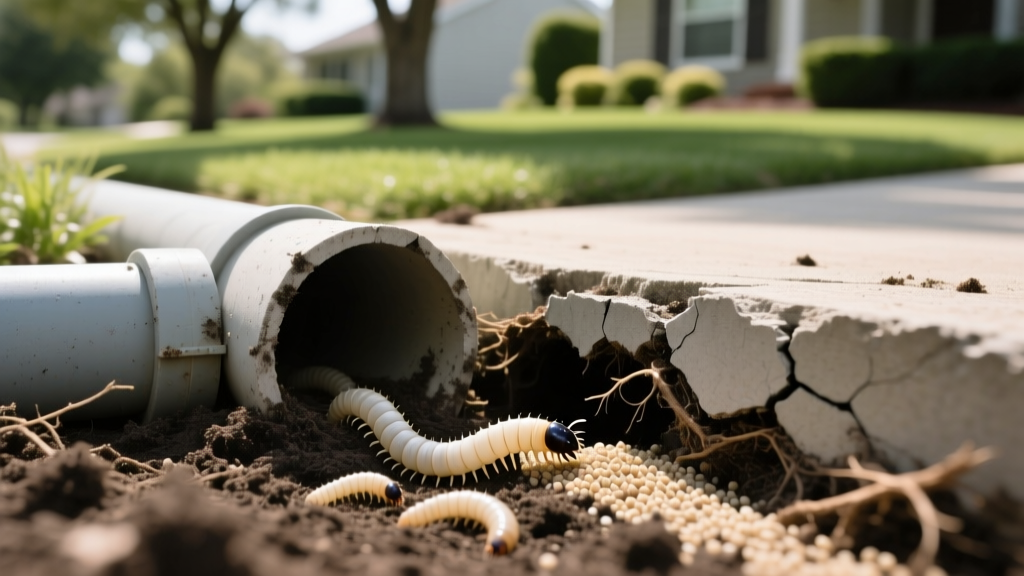
Grub ID & Bayer 24-Hour Treatment Near Drain Pipes 2026
Sarah ChenPublished
The Hidden Connection: Grub Worms and Landscape Drainage Pipes
When homeowners think of lawn pests, they rarely consider the infrastructure buried beneath their turf. However, in 2026, with shifting climate patterns bringing heavier, more erratic spring and summer rains, landscape drainage pipes—such as French drains, corrugated downspout extensions, and dry wells—have become unintentional havens for white grubs. Female beetles, including Japanese Beetles and June Bugs, actively seek out moist, well-aerated soil to lay their eggs. The soil directly above and adjacent to landscape drainage pipes retains subsurface moisture longer than surrounding areas, creating an ideal microclimate for egg survival and larval development.
If you are dealing with a grub infestation concentrated around your yard's drainage infrastructure, standard pest control advice can actually backfire. Applying a fast-acting chemical requires careful water management, which is inherently complicated by the very pipes designed to move water away. This guide will walk you through precise grub worm identification, the unique challenges of treating drainage zones, and how to properly execute the Bayer Advanced 24-Hour treatment (now widely packaged under the BioAdvanced label in 2026) without washing the product into your storm sewers.
Grub Worm Identification in Drainage Zones
Before applying any treatment, you must confirm that grubs are the culprits. Damage near drainage pipes often mimics fungal issues or localized drought stress because the soil structure above the pipes can dry out rapidly at the surface while remaining wet below. Look for spongy turf that rolls back like a loose carpet, and pay close attention to increased activity from foraging animals like skunks, raccoons, and crows, which will tear up the soil above drainage trenches to feed on the protein-rich larvae.
To confirm, use a flat-edged shovel to cut a one-foot square of sod about three inches deep, specifically over the suspected drainage line, and peel it back. According to Penn State Extension, a threshold of more than five to seven grubs per square foot warrants immediate chemical intervention. When examining the grubs, note their physical characteristics: they will be plump, white, C-shaped larvae with brown heads and six legs near the head capsule.
| Grub Species | Identifying Feature (Raster Pattern) | Drainage Zone Preference |
|---|---|---|
| Japanese Beetle | V-shaped, zipper-like | High moisture; near shallow surface drains |
| June Bug (May Beetle) | Parallel rows of spines | Deep soil; near deep French drains |
| European Chafer | Y-shaped anal slit | Moderate moisture; trench edges |
Why Landscape Drainage Complicates the Bayer Advanced 24-Hour Treatment
The Bayer Advanced 24-Hour Grub Killer (active ingredient: Trichlorfon, commonly known as Dylox) is the gold standard for rapid curative grub control. Unlike preventative treatments that take weeks to build up in the soil, Trichlorfon works on contact and ingestion, killing active grubs within 24 hours. However, Trichlorfon is highly water-soluble and degrades rapidly in alkaline soils. To be effective, it must be watered into the root zone immediately after application.
This is where landscape drainage pipes create a massive headache. The standard recommendation is to apply 0.25 to 0.5 inches of water immediately after spreading the granules. If you apply this much water all at once over a French drain or a perforated corrugated pipe, the soil's percolation rate will be overwhelmed. The drainage pipe will activate, capturing the water—and the dissolved Trichlorfon—and funneling it directly out of your yard into municipal storm drains or local waterways. This not only renders the treatment useless by pulling the chemical away from the grubs, but it also constitutes an environmental hazard and a violation of federal pesticide runoff regulations.
Step-by-Step: Applying Bayer Advanced 24-Hour Near Drainage Systems
To successfully treat grub-infested drainage zones in 2026 without triggering chemical runoff, you must use a strategic, pulsed application method. Here is how to execute the treatment safely and effectively.
Step 1: Map Your Drainage and Outflow
Before opening the bag, locate the exact path of your subsurface drainage pipes and identify the outflow grates or pop-up emitters. You must establish a 10-foot buffer zone around any storm drain grates, creek beds, or drainage outflows. Do not apply granular Trichlorfon inside this buffer zone; instead, rely on targeted beneficial nematodes in these high-risk runoff areas.
Step 2: Calibrate Your Spreader for the Pipe Trench
Grubs congregate heavily in the loose, backfilled soil of drainage trenches. Set your rotary or drop spreader to the rate specified on the 2026 BioAdvanced/Bayer Advanced label (typically around 1.5 to 2 pounds per 1,000 square feet for curative control). Walk at a steady pace, ensuring an even distribution over the trench line. Avoid overlapping passes directly over the pipe, as a double dose of chemical increases the risk of turf burn and runoff.
Step 3: The 'Pulsed Watering' Technique
This is the most critical step for properties with landscape drainage. Instead of blasting the lawn with a half-inch of water all at once, you must use a pulsed watering schedule to allow the soil to absorb the chemical before it reaches the pipe's gravel bed.
- Pulse 1: Apply 0.1 inches of water (about 5-7 minutes with a standard oscillating sprinkler). This dissolves the granule and begins moving it into the thatch.
- Wait: Allow 45 minutes for the moisture to percolate through the topsoil without triggering the drainage pipe's flow.
- Pulse 2: Apply another 0.1 inches of water. This pushes the active ingredient down into the upper root zone where the grubs are actively feeding.
- Wait: Allow another 45 minutes.
- Pulse 3: Apply a final 0.05 to 0.1 inches of water to ensure the chemical is fully off the grass blades and into the soil profile.
By breaking the watering process into three distinct pulses, you satisfy the product's requirement for immediate incorporation while respecting the percolation limits of your landscape drainage system.
Environmental Safety and Runoff Prevention
Trichlorfon is highly toxic to aquatic invertebrates. The University of California Statewide IPM Program explicitly warns against allowing pesticides to enter surface waters or storm drains. When managing pests near engineered drainage systems, the homeowner assumes the liability for any chemical that exits the property via the pipe outflow.
Never sweep stray granules off your driveway or patio into the street, where they will wash into the storm drain. Instead, sweep them back onto the lawn. Furthermore, avoid treating drainage zones if the soil is already saturated from a recent rainstorm or if the water table is high enough that your drainage pipes are actively flowing. Trichlorfon will not bind to waterlogged soil and will immediately be flushed out of the system.
Long-Term Drainage and Grub Prevention Strategies
While the Bayer Advanced 24-Hour treatment is an excellent curative tool for late-summer and early-fall infestations, long-term management requires addressing the root cause: the moist soil environment created by the drainage pipes. According to the University of Minnesota Extension, promoting deep, infrequent watering and improving overall soil structure can make your lawn less attractive to egg-laying beetles.
Consider the following preventative measures for your drainage zones in 2026 and beyond:
- Soil Aeration over Trenches: Over time, the soil above landscape drainage pipes can become compacted or settle, creating depressions that pool water. Core aerate these specific lines in the spring to improve surface drainage and reduce the topsoil moisture that attracts beetles.
- Beneficial Nematodes (Heterorhabditis bacteriophora): For areas immediately adjacent to drainage outflows or dry wells where chemical runoff is a major concern, apply beneficial nematodes in late August. These microscopic worms actively hunt grubs in the moist soil near the pipes and pose zero risk to water quality or drainage infrastructure.
- Grading Corrections: Ensure that the surface grade above your French drains slopes slightly away from the center of the trench to prevent surface water from funneling directly into the backfill, thereby keeping the immediate root zone drier and less hospitable to Japanese Beetle eggs.
By understanding the intersection of subsurface water management and turfgrass pests, you can effectively deploy fast-acting treatments like the Bayer Advanced 24-Hour formula while protecting your landscape infrastructure and the local environment.