Pest Control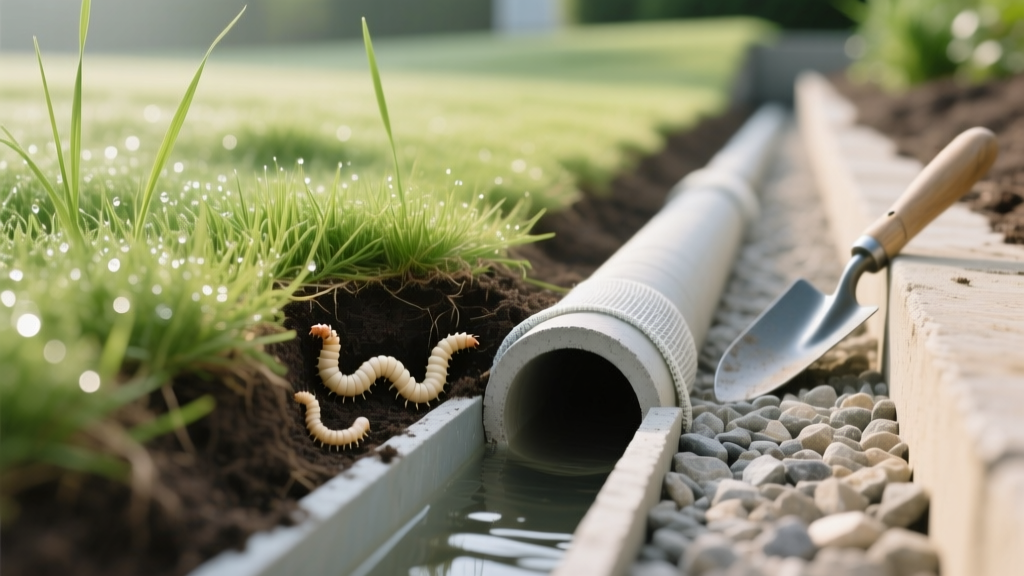
Grub Worm ID & Bayer Advanced 24-Hour Fix: 2026 Drainage Guide
Emily WatsonPublished
The Intersection of Lawn Drainage and Grub Infestations
As a French drain installation specialist, I spend my days digging up ruined lawns, diagnosing soggy soil, and restoring proper yard grading. In 2026, shifting weather patterns have brought heavier, more concentrated spring downpours to many regions, resulting in severely waterlogged lawns. However, when homeowners call me to fix a spongy, yellowing lawn that they assume is a drainage failure, I frequently uncover a secondary, more destructive culprit: white grub worms. Grubs thrive in consistently moist, poorly drained soil. Furthermore, when a lawn is heavily infested, the turf roots are severed. If the soil is simultaneously waterlogged due to poor drainage, the severed turf turns to mush and rots, making lawn recovery impossible even after the pests are eradicated. To save the yard, we must deploy an immediate chemical intervention—specifically the Bayer Advanced 24-Hour Grub Killer Plus—before we can safely execute a French drain installation to permanently alter the soil moisture profile.
Grub Worm Identification: Is It Grubs or Poor Drainage?
Before we break ground on any drainage trench, we must accurately diagnose the lawn. Both poor drainage and grub damage cause the turf to feel spongy underfoot, but the underlying mechanics are entirely different. Grub worms are the C-shaped, white larvae of scarab beetles, including Japanese beetles, June bugs, and European chafers. They live just beneath the soil surface, feasting on grassroots. According to Penn State Extension, a healthy lawn can tolerate a few grubs, but populations exceeding 8 to 10 grubs per square foot will cause rapid, catastrophic turf failure.
To differentiate between a drainage issue and a grub infestation, I always perform the 'Tug Test' and a soil core inspection. If the grass pulls up like a loose carpet with no roots attached, and you spot white, C-shaped larvae in the top two inches of soil, you have grubs. If the grass is firmly rooted but the soil beneath is saturated, foul-smelling, and anaerobic, you have a drainage failure. Often, in 2026's wet climate, it is a combination of both.
| Symptom | Grub Worm Damage | Poor Drainage / Waterlogging |
|---|---|---|
| Turf Texture | Spongy, rolls back like carpet | Mushy, squelches underfoot |
| Root System | Severed, missing entirely | Intact but rotting, shallow |
| Soil Condition | Loose, dry or moderately moist | Saturated, anaerobic, smells like sulfur |
| Visible Pests | White C-shaped larvae present | No pests, possible fungus or algae |
| Animal Activity | Birds, skunks, or raccoons digging | Mosquitoes, standing water |
Bayer Advanced 24-Hour Grub Killer Plus: The 2026 Protocol
When an active grub infestation is confirmed in a waterlogged yard, we cannot immediately install a French drain. Trenching through active grub zones spreads the larvae, and rolling back sod that has no root structure will destroy the remaining turf. We must eradicate the pests first. For rapid knockdown, the industry standard is Bayer Advanced 24-Hour Grub Killer Plus. The active ingredient is Dylox (Trichlorfon), a fast-acting contact and stomach poison that paralyzes and kills grubs within 24 hours of application.
As noted by Michigan State University Extension, Trichlorfon is uniquely suited for curative treatment when grubs are already large and actively damaging the root zone. Unlike preventative products that take weeks to build up in the soil, Dylox works on contact. In 2026, a standard 10-pound bag of Bayer Advanced 24-Hour Grub Killer Plus costs approximately $32 to $38 and covers up to 5,000 square feet, making it a highly cost-effective emergency intervention.
Application Steps for Drainage Prep
- Measure and Map: Identify the exact square footage of the infested area. Do not treat the entire yard if the infestation is localized to the low-lying, poorly drained zones.
- Calibrate the Spreader: Set your rotary spreader to the setting specified on the 2026 Bayer Advanced packaging for Dylox granules (typically around setting 'G' or 'H' depending on the brand).
- Apply Evenly: Broadcast the granules uniformly over the affected turf.
- The Critical Watering Step: Trichlorfon degrades rapidly in sunlight and must be washed into the root zone immediately. Apply 0.5 inches of water. Drainage Expert Tip: This mandatory deep watering is the perfect opportunity to observe exactly where water pools and where it drains, helping you map the precise trench line for your upcoming French drain installation.
Integrating Grub Treatment with French Drain Installation
Once the Bayer Advanced 24-Hour treatment has been watered in and 48 hours have passed, the grubs are dead, and the soil moisture profile is primed for earthmoving. Here is how we transition from pest control to hardscape drainage installation without ruining the yard.
Step 1: Sod Cutting and Removal
Using a motorized sod cutter, we slice the turf in the designated trench line. Because the grubs have been eliminated, the remaining root mass—even if damaged—holds the soil together just enough to prevent the trench walls from collapsing into a muddy trench during excavation.
Step 2: Trenching and Grading
We dig a trench 18 to 24 inches deep, ensuring a minimum 1% slope (1 inch of drop per 8 feet of run) toward the discharge point or dry well. In heavy clay soils that retain the moisture grubs love, we widen the trench to 12 inches to accommodate more drain rock.
Step 3: Pipe and Gravel Installation
We line the trench with non-woven geotextile filter fabric to prevent soil infiltration. Next, we lay a 4-inch perforated corrugated pipe (or rigid PVC for heavy-load areas), ensuring the holes face downward to maximize water entry from the saturated soil table. We then fill the trench with 3/4-inch washed drain gravel, wrapping the fabric over the top to create a 'gravel burrito' that prevents silt clogging.
Step 4: Sod Replacement and Recovery
The original sod is rolled back over the trench. Because the grubs were eradicated 48 hours prior, the turf will not suffer secondary pest attacks while it is in a vulnerable, re-rooting state. The newly installed French drain immediately begins pulling excess water away from the root zone, eliminating the damp environment that attracted the scarab beetles in the first place.
Long-Term IPM: Moisture Control as Pest Prevention
Integrated Pest Management (IPM) relies on altering the environment to make it inhospitable to pests. Scarab beetles seek out consistently moist, spongy soil to lay their eggs in mid-summer. If your yard suffers from a high water table, compacted clay, or negative grading, it acts as a beacon for egg-laying females. By installing a French drain, you fundamentally change the hydrology of your lawn. The perforated pipe intercepts subsurface water, lowering the moisture content in the top 6 inches of soil where grubs feed and develop. While products like Bayer Advanced 24-Hour Grub Killer Plus are essential for emergency curative control, permanent drainage solutions are the ultimate long-term preventative measure. Protect your investment in 2026 by combining rapid chemical eradication with professional-grade water management.