Pest Control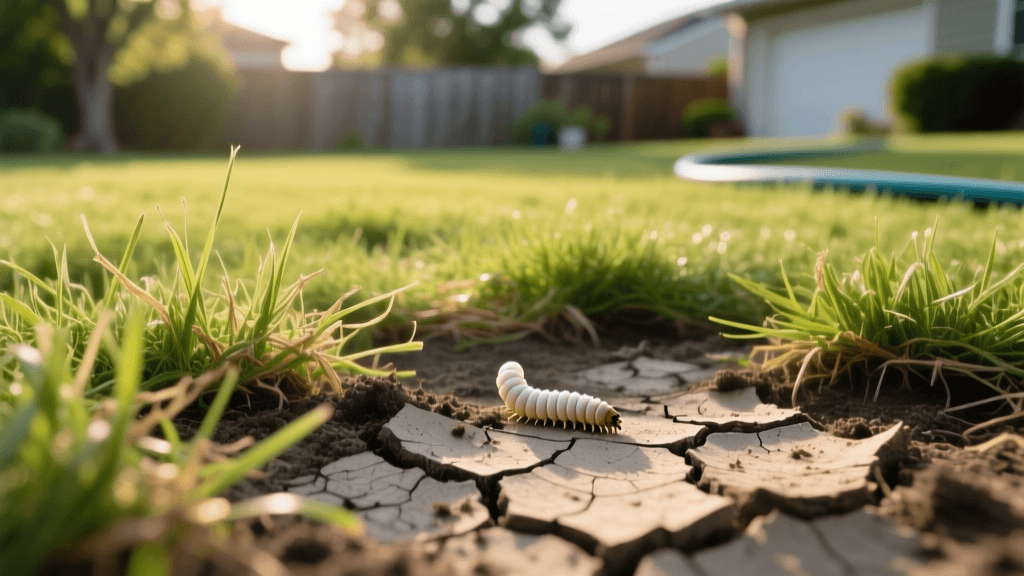
Diagnosing Lawn Grubs vs. Drought Stress: A Troubleshooting Guide
The Brown Patch Dilemma: Grubs or Drought?
As a homeowner, few sights are more disheartening than waking up to irregular brown patches spreading across your once-lush lawn during the peak of summer. Your immediate instinct might be to crank up the sprinklers, assuming the heat has simply baked your turf. However, throwing water at a grub infestation will not save your grass; it will only waste your time, inflate your water bill, and potentially encourage fungal diseases. Conversely, applying harsh chemical insecticides to a drought-stressed lawn can further burn the foliage and damage the fragile soil ecosystem. Accurate problem diagnosis and troubleshooting are the cornerstones of effective Integrated Pest Management (IPM).
Both white grubs and severe drought stress deprive the grass of its ability to take up water and nutrients, leading to nearly identical above-ground symptoms: wilting, browning, and eventual turf death. To troubleshoot this issue effectively, you must look below the surface. This comprehensive guide will walk you through the exact diagnostic steps, comparison metrics, and targeted treatment protocols to rescue your lawn.
Step-by-Step Diagnosis: The Tug Test and Soil Inspection
Before purchasing any products from the garden center, you must confirm the root cause of the damage. According to turfgrass experts at the University of Minnesota Extension, relying solely on visual symptoms from the driveway is a recipe for misdiagnosis. You need to perform two simple field tests.
1. The Tug Test
Walk to the edge of a brown patch where it meets the green, healthy grass. Grab a handful of the turf and pull gently but firmly.
- If the grass pulls up easily like a loose carpet, and you notice the roots have been cleanly sheared off, you likely have a grub problem. The larvae have eaten the root system, detaching the grass from the soil.
- If the grass resists, breaks off at the blade, or requires significant force to uproot, the roots are likely intact. This points toward drought stress, dormancy, or a fungal disease rather than root-feeding insects.
2. The Shovel Test (Soil Inspection)
If the tug test indicates root loss, or if you want to be absolutely certain, perform a shovel test. Use a flat-edged spade to cut a 1-foot by 1-foot square of sod, about 2 to 3 inches deep, at the margin of the damaged area. Peel the sod back like a page in a book and examine the soil and the underside of the turf.
- Look for C-shaped, creamy-white larvae with brown heads and six legs near the soil surface.
- Count the number of grubs in that one-square-foot area.
- The treatment threshold is generally 5 to 10 grubs per square foot for healthy lawns, and slightly lower for heavily shaded or stressed turf. If you find zero grubs, your issue is environmental (drought) or pathological (fungus).
3. Check for Secondary Pest Activity
Grubs are a primary food source for foraging wildlife. If you notice your lawn has been torn up by skunks, raccoons, or flocks of starlings and crows pecking at the soil, this is a massive red flag for a grub infestation. Drought stress does not attract digging animals.
Grub Damage vs. Drought Stress: Comparison Chart
Use this troubleshooting matrix to quickly compare your lawn's symptoms against the two most common culprits for late-summer browning.
| Symptom / Indicator | White Grub Damage | Drought Stress |
|---|---|---|
| Turf Feel (Footprinting) | Spongy, loose underfoot | Crunchy, brittle, or leaves lasting footprints |
| Root System | Severed, missing, or chewed | Intact, but may be dry or shallow |
| Soil Moisture | Soil may be moist, but grass is wilting | Soil is hard, dry, and hydrophobic |
| Animal Activity | Digging by skunks, birds, moles | None related to turf damage |
| Color Progression | Green to yellow/brown rapidly | Bluish-gray tint, then straw-brown |
| Response to Watering | No improvement after deep watering | Recovers within 24-48 hours of deep soaking |
Troubleshooting Grub Infestations: Treatment Protocols
Once you have positively identified a grub infestation exceeding the threshold, immediate action is required to save the remaining turf. The timing of your discovery dictates the chemical or organic controls you can use.
Curative Treatments (Late Summer / Early Fall)
If you are diagnosing the problem in late August or September, the grubs are large, actively feeding, and causing rapid damage. You need a fast-acting curative insecticide.
- Active Ingredient: Trichlorfon (commonly sold under the brand name Dylox).
- Application Rate: Follow the label precisely, typically around 1.5 to 2 lbs of product per 1,000 square feet.
- Cost: Approximately $15 to $25 for a bag covering 5,000 square feet.
- Crucial Step: Trichlorfon degrades rapidly in high pH water and sunlight. You must water it into the soil immediately with at least 1/4 inch of irrigation to move the chemical into the root zone where the grubs are feeding.
Preventative Treatments (Spring / Early Summer)
If you are troubleshooting a lawn that suffered grub damage last year and want to prevent a recurrence, use a long-residual preventative.
- Active Ingredients: Chlorantraniliprole (e.g., Scotts GrubEx) or Imidacloprid.
- Timing: Apply between June 1 and July 15. These products take weeks to move into the soil and require the grubs to be in their early, vulnerable instar stages.
- Cost: Roughly $20 to $30 per 5,000 square feet.
Organic and Biological Controls
For those practicing strict organic IPM, beneficial nematodes are a highly effective troubleshooting tool. Specifically, the species Heterorhabditis bacteriophora (Hb nematodes) actively hunt and infect white grubs.
- Application: Mix the nematodes with water and apply via a hose-end sprayer in the late afternoon to avoid UV degradation.
- Cost: Around $40 for a package of 10 million nematodes, treating roughly 3,000 square feet.
- Requirement: The soil must remain consistently moist for at least two weeks post-application for the nematodes to survive and locate their hosts.
Troubleshooting Drought Stress: Remediation Strategies
If your shovel test revealed healthy roots, intact soil structure, and zero grubs, your brown patches are the result of drought stress or localized dry spots (often caused by hydrophobic soil). According to the EPA WaterSense program, efficient watering is critical for turf survival without wasting municipal resources.
Proper Watering Techniques
Drought-stressed lawns need deep, infrequent watering to encourage deep root growth. Shallow, daily watering only promotes shallow roots that are highly susceptible to heat stress.
- Target Volume: Lawns require 1 to 1.5 inches of water per week, including rainfall.
- Measurement: Place empty tuna cans or rain gauges in different zones of your lawn. Run your sprinklers until the cans collect 1/2 inch of water, then wait a few days before repeating.
- Timing: Always water between 4:00 AM and 8:00 AM. Watering in the evening leaves the grass blades wet overnight, inviting fungal pathogens like Pythium blight or Brown Patch disease.
Dealing with Hydrophobic Soil and Localized Dry Spots
Sometimes, a specific patch of lawn turns brown despite the sprinklers running. This is often due to hydrophobic (water-repellent) soil, common in sandy soils or lawns with heavy thatch buildup. The water simply beads up and runs off into the street or storm drain.
- The Fix: Apply a soil wetting agent or penetrant (such as Aqua-Aid or a generic agricultural surfactant). These products break the surface tension of the water, allowing it to penetrate deep into the soil profile.
- Cost: Liquid wetting agents cost about $25 to $35 for a hose-end bottle that treats 5,000 square feet.
- Core Aeration: In the fall, perform core aeration to physically break up compacted, dry soil and allow water, oxygen, and nutrients to reach the root zone.
When to Call a Professional
While the tug test and shovel test solve 90% of homeowner diagnostic dilemmas, some situations require professional intervention. If your lawn is failing to respond to deep watering, shows no signs of insect activity, and continues to spread in irregular, water-soaked, or smoke-ring patterns, you may be dealing with a complex turfgrass disease like Summer Patch or Dollar Spot. Fungicides are highly specific, and misapplication can lead to chemical resistance and environmental harm. A licensed turfgrass professional or your local university extension office can perform laboratory soil and tissue tests to identify the exact pathogen and recommend a targeted remediation plan.
'The foundation of Integrated Pest Management is accurate identification. Treating a drought-stressed lawn with insecticides, or a grub-infested lawn with extra water, not only fails to solve the problem but introduces unnecessary chemicals and wastes vital water resources.' — Principles of Turfgrass IPM
By mastering these diagnostic troubleshooting steps, you can confidently identify the true enemy of your lawn, apply the correct treatment at the right time, and maintain a resilient, vibrant landscape year after year.