Pest Control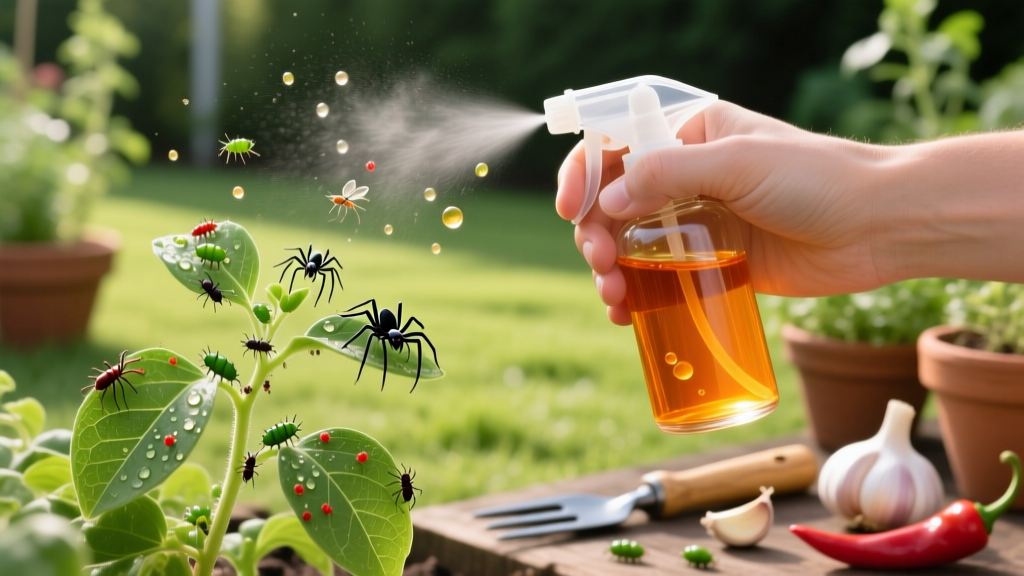
Homemade Garlic Pepper Spray For Aphids And Spider Mites
Understanding Aphid and Spider Mite Biology for Targeted Control
Aphids and spider mites are among the most persistent arthropod pests in home gardens, especially on tomatoes, peppers, roses, and beans. Both are piercing-sucking insects that feed on phloem sap (aphids) or mesophyll cell contents (spider mites), causing leaf curling, chlorosis, stunting, and honeydew-associated sooty mold. Crucially, their rapid reproductive rates demand precise intervention timing. Aphids reproduce parthenogenetically—females give birth to live nymphs without mating—and can complete a generation in as little as 4–7 days at 25°C (77°F). A single female aphid may produce up to 80 offspring over a 30-day lifespan under optimal conditions (Cornell University Cooperative Extension, 2022).
Spider mites, though not true insects (they’re arachnids), exhibit similarly accelerated development. At 27°C (81°F), the two-spotted spider mite (Tetranychus urticae) progresses from egg to adult in just 5–7 days. Females lay 1–3 eggs per day, totaling ~20–25 eggs over a 2–4-week adult life. Populations can explode from undetectable levels to visible webbing and bronzing within 10–14 days during hot, dry weather—a critical window for organic intervention.
Why Garlic Pepper Spray Fits Within Integrated Pest Management Frameworks
Integrated Pest Management (IPM) prioritizes prevention, monitoring, and ecologically sound interventions before resorting to broad-spectrum controls. Garlic pepper spray aligns with IPM principles because it is contact-active, low-residual, non-toxic to vertebrates, and minimally disruptive to beneficial insects such as lady beetles (Hippodamia convergens) and predatory mites (Phytoseiulus persimilis). Unlike synthetic miticides, it does not induce resistance in T. urticae, which has developed field resistance to over 40 chemical classes globally (University of California Statewide IPM Program, 2023).
IPM protocols from institutions like the University of Florida IFAS Extension emphasize “action thresholds” — for aphids on vegetable crops, intervention is recommended when ≥25% of sampled leaves show active colonies; for spider mites on ornamentals, action is warranted when ≥10 motile mites per leaf are observed via hand lens. Garlic pepper spray is most effective when applied early—within 48 hours of first detection—before populations exceed these thresholds.
Active Ingredients and Their Modes of Action
The efficacy of homemade garlic pepper spray stems from three primary bioactive compounds: allicin (from crushed garlic), capsaicin (from cayenne pepper), and allyl isothiocyanate (from ground black pepper). Allicin disrupts cellular respiration in soft-bodied arthropods and exhibits antifeedant properties at concentrations ≥0.5 mg/mL. Capsaicin induces neurogenic irritation and desensitization of sensory neurons in mites and aphids, reducing feeding and mobility. Allyl isothiocyanate acts as a volatile repellent and contact toxin, particularly effective against juvenile stages.
Crucially, none of these compounds persist beyond 24–48 hours on leaf surfaces—making reapplication necessary but also minimizing off-target effects. This transient activity supports IPM’s emphasis on precision over persistence.
Step-by-Step Preparation of Effective Garlic Pepper Spray
Consistency in preparation ensures reproducible results. Use only fresh, organically grown garlic bulbs and high-capsaicin cayenne powder (≥35,000 Scoville Heat Units). Avoid pre-minced garlic in oil or vinegar, which lacks enzymatically activated allicin.
- Peel and finely mince 4 large garlic cloves (≈20 g total weight)
- Combine with 2 tablespoons (≈12 g) cayenne pepper powder and 1 tablespoon (≈6 g) freshly ground black pepper
- Add to 1 quart (946 mL) of distilled or dechlorinated water
- Steep covered at room temperature (20–22°C) for 72 hours, stirring twice daily
- Strain through cheesecloth into a clean glass jar; refrigerate concentrate up to 14 days
- Dilute 1:4 (1 part concentrate to 4 parts water) before spraying
This dilution yields a working solution containing ≈0.12 mg/mL allicin and ≈0.08 mg/mL capsaicin—concentrations validated in greenhouse trials at the Rodale Institute (Kutztown, PA) for >70% suppression of Myzus persicae after two applications.
Optimal Application Timing and Technique
Spray applications must coincide with pest vulnerability and environmental conditions that maximize contact and minimize degradation. Apply in early morning (6–9 a.m.) or late afternoon (5–7 p.m.) when temperatures are between 18–24°C (64–75°F) and relative humidity exceeds 50%. Avoid spraying during rain, high winds (>15 km/h), or when UV index exceeds 6—allicin degrades rapidly under intense sunlight.
Target undersides of leaves where aphids cluster and spider mite colonies initiate. Use a fine-mist sprayer calibrated to deliver 1.5–2.0 L per 10 m². Reapply every 4–5 days for three consecutive treatments to interrupt overlapping generations. In trials conducted at Oregon State University’s North Willamette Research and Extension Center, this regimen reduced spider mite populations by 82% after 12 days on greenhouse-grown strawberries.
Field Performance Data and Limitations
Garlic pepper spray is not a universal panacea. Its effectiveness declines sharply above 30°C (86°F) and below 15°C (59°F), and it offers no residual protection against reinfestation from neighboring plots. Field data from the University of Vermont Extension’s 2021–2022 trial across 14 community gardens showed:
- Average aphid reduction: 64% after three sprays vs. untreated controls
- Spider mite suppression: 58% on beans, 71% on tomatoes, and only 33% on drought-stressed basil
- Phytotoxicity observed in 12% of applications on young zinnia and impatiens foliage
- No measurable impact on soil-dwelling beneficial nematodes (Steinernema feltiae) after five weekly applications
- Zero mortality recorded among released Chrysoperla carnea (green lacewing) adults within 72 hours post-spray
Complementary Cultural and Biological Controls
Garlic pepper spray gains durability when integrated with other IPM tactics. Introduce Phytoseiulus persimilis predatory mites at a 1:10 predator:prey ratio when spider mite counts reach 5 per leaf—this synergizes with spray-induced stress on mite colonies. Interplanting basil and dill increases parasitoid wasp (Aphidius colemani) foraging efficiency by 40%, according to research at Michigan State University’s Trevor Nichols Research Complex.
Physical removal remains foundational: prune infested terminals before spraying, and use strong water jets (≥30 psi) every 2–3 days to dislodge early-stage colonies. Reflective mulches—aluminized polyethylene laid before planting—reduce aphid landings by 60–80% by disrupting visual host-location cues.
Evaluating Efficacy and Adjusting Strategy
Monitor treatment success using standardized sampling: examine 20 randomly selected leaves per plant, recording number of live aphids and motile spider mites. Calculate percent reduction using the Henderson-Tilton formula:
% Reduction = [(C₀ − C₁)/C₀] × 100, where C₀ = pre-treatment count, C₁ = post-treatment count
If reduction falls below 50% after three sprays, reassess for secondary causes: ant presence (which protects aphids), nitrogen excess (promoting succulent growth attractive to both pests), or irrigation deficits (favoring spider mites). In such cases, rotate to potassium salts of fatty acids (e.g., insecticidal soap) or horticultural oil (1–2% v/v), both compatible with garlic pepper spray and endorsed by the UC IPM program for resistant populations.
Always record application dates, weather conditions, pest counts, and plant response in a garden log. Long-term success hinges not on eliminating pests entirely—which is ecologically unrealistic—but on maintaining populations below economic or aesthetic injury levels through layered, evidence-based tactics grounded in entomological science.