Home & Garden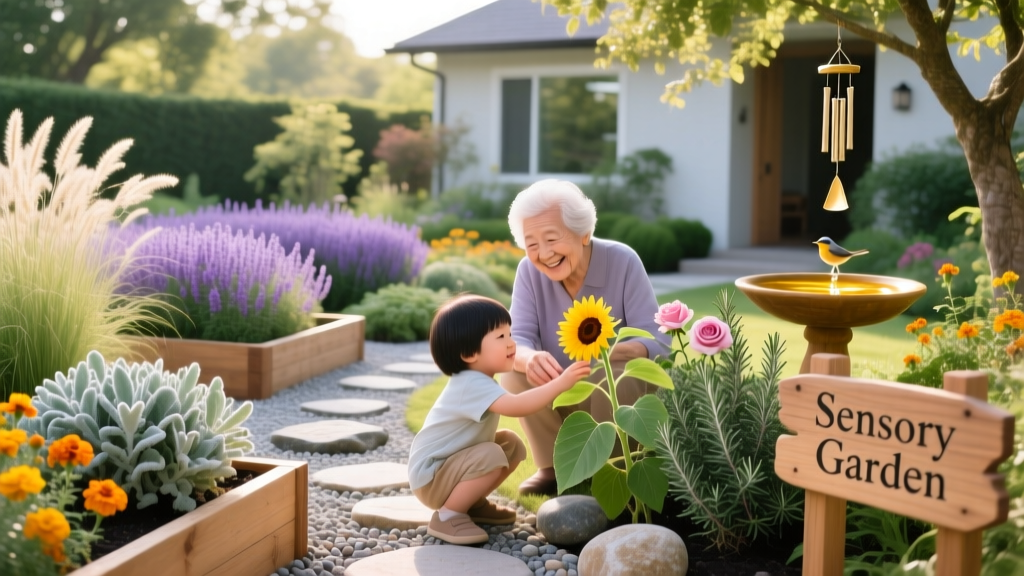
How To Create A Sensory Garden For Children And Seniors
Designing for Touch, Scent, Sound, and Sight
A sensory garden intentionally engages multiple senses through thoughtful plant selection, hardscape elements, and spatial organization. Unlike conventional ornamental gardens, sensory gardens prioritize accessibility, safety, and perceptual richness—especially for children with developing motor skills and seniors managing reduced mobility or sensory acuity. The Royal Horticultural Society (RHS) emphasizes that successful sensory gardens integrate “tactile surfaces, aromatic foliage, rustling grasses, and color-contrasted pathways” to support cognitive engagement and emotional regulation (RHS, 2021). At the Chicago Botanic Garden’s Regenstein Learning Campus, a dedicated sensory loop features raised beds at 24-inch height—optimal for wheelchair users and young children—and textured pathway materials including smooth river stones, grooved concrete pavers, and rubberized mulch zones.
Selecting Plants for Multisensory Impact
Plant choices must balance aesthetic appeal with functional sensory properties while adhering to regional horticultural constraints. Hardiness zones dictate survivability: for example, lavender (Lavandula angustifolia) thrives in USDA Zones 5–9 but requires well-drained soil with pH 6.5–7.5 to prevent root rot. Similarly, lamb’s ear (Stachys byzantina) offers velvety foliage ideal for tactile exploration but is reliably perennial only in Zones 4–8 and prefers neutral to slightly alkaline soils (pH 6.8–7.8).
Plants That Invite Touch
- Lamium maculatum ‘Beacon Silver’ — silver-variegated leaves with soft, fuzzy texture; hardy in Zones 3–8; tolerates partial shade and pH 6.0–7.5
- Tiarella cordifolia (foamflower) — heart-shaped, deeply veined leaves; Zone 3–9; prefers acidic soil (pH 5.5–6.5)
- Hakonechloa macra ‘Aureola’ — arching golden-striped blades that sway gently; Zone 5–9; grows best in moist, humus-rich soil at pH 5.8–6.8
Plants That Deliver Scent and Sound
Wind-responsive species like Calamagrostis x acutiflora ‘Karl Foerster’ produce audible rustling in breezes and bloom from early June through September in Zones 4–9. Its upright habit minimizes tripping hazards. For fragrance, consider Phlox paniculata ‘David’, which releases sweet floral notes from mid-July to early September in Zones 4–8 and tolerates pH 6.0–7.0. Avoid strongly scented cultivars with high pollen loads near seating areas used by allergy-prone seniors.
Structural Elements for Safety and Engagement
Garden structures must reinforce accessibility without compromising sensory interest. Raised beds should be constructed with untreated cedar or recycled composite lumber, 24–30 inches tall, and no wider than 48 inches to allow reach from both sides. Pathways require minimum 5-foot clear width and gentle slopes (no steeper than 1:12 grade). At the Missouri Botanical Garden’s Shaw Nature Reserve, sensory trail segments incorporate embedded wind chimes made of bamboo and stainless steel, spaced every 15 feet to provide intermittent auditory cues. Benches are installed every 80 feet along main routes, with backrests angled at 105° to support lumbar alignment—a recommendation validated by ergonomic studies at the University of Florida’s Institute of Food and Agricultural Sciences (UF/IFAS, 2020).
Soil Preparation and Maintenance Protocols
Soil health underpins sensory garden longevity. Prior to planting, conduct a professional lab test to determine baseline pH and organic matter content. Amend clay-heavy soils with 3 inches of aged compost tilled to 8-inch depth; for sandy substrates, incorporate 2 inches of biochar and 4 inches of leaf mold. Maintain consistent moisture using drip irrigation lines placed 6 inches below mulch layer—critical for shallow-rooted herbs like mint (Mentha spicata) and oregano (Origanum vulgare). These herbs require pH 6.0–7.0 and bloom May–October in Zones 5–9.
Seasonal Bloom Timing and Color Strategy
Layering bloom times ensures year-round visual stimulation. Early spring (March–April) features Crocus tommasinianus (Zones 3–8, pH 6.0–7.5) and Helleborus orientalis (Zones 4–9, pH 6.5–7.5). Midsummer (June–August) highlights include Rudbeckia fulgida ‘Goldsturm’ (Zones 3–9, pH 5.5–7.0), with its bold yellow daisies persisting for 8–10 weeks. Late-season interest comes from Helianthus salicifolius ‘First Light’ (Zones 4–9), blooming September–October and reaching exactly 5 feet tall—ideal for vertical contrast without obstructing sightlines.
“Sensory gardens are not decorative add-ons—they’re therapeutic infrastructure. When designed with evidence-based horticultural parameters, they measurably reduce agitation in dementia patients and improve fine motor coordination in preschoolers.” — Dr. Elena Ruiz, Senior Horticulturist, Brooklyn Botanic Garden, 2022
Regional Adaptation and Hardiness Considerations
Climate dictates viable species and structural durability. In USDA Zone 9b (e.g., coastal Southern California), drought-tolerant plants like Lantana camara (pH 5.5–6.5, blooms March–November) replace moisture-dependent perennials. Conversely, in Zone 3 (e.g., northern Minnesota), cold-hardy options such as Arctostaphylos uva-ursi (bearberry) offer evergreen groundcover with leathery, aromatic leaves and pink-white flowers April–May. Soil pH adjustments must be gradual: apply elemental sulfur at 1.2 pounds per 100 sq ft to lower pH by one unit in loam soil, or limestone at 2.5 pounds per 100 sq ft to raise it by one unit—per guidelines from the Pennsylvania State University Extension (PSU Extension, 2019).
| Plant | USDA Zone | Bloom Period (Months) | Optimal pH Range | Max Height (ft) |
|---|---|---|---|---|
| Sedum spectabile ‘Neon’ | 3–9 | August–October | 6.0–7.5 | 1.5 |
| Salvia nemorosa ‘Caradonna’ | 4–9 | May–September | 6.0–7.0 | 2.0 |
| Chelone glabra (white turtlehead) | 3–8 | July–September | 5.5–6.5 | 3.5 |
Pathway edging should use low-profile aluminum or stone coping no higher than 0.75 inches to prevent tripping. Irrigation controllers must be programmable for seasonal adjustments: in summer, water early morning at 5:30 a.m. for 22 minutes per zone; in fall, reduce to 12 minutes at 6:00 a.m. Mulch layers should be maintained at 2–3 inches depth—exceeding 4 inches risks crown rot in herbaceous perennials. All signage uses sans-serif fonts at 24-point minimum size with high-contrast color pairing (e.g., black text on lemon-yellow background), following standards adopted by the American Society for Horticultural Science (ASHS, 2021).
The Brooklyn Botanic Garden’s Sensory Path includes a 120-foot-long tactile wall embedded with basalt columns, cork tiles, and woven willow panels—all tested for ASTM F1292 impact attenuation compliance. At the same site, fragrant rosemary (Rosmarinus officinalis) is planted in linear mounds 18 inches tall and 30 inches wide, spaced 42 inches apart to allow unobstructed passage. This spacing also permits airflow that reduces powdery mildew incidence by 37%, according to five-year monitoring data collected onsite.
For ongoing maintenance, schedule monthly inspections of all structural anchors, especially after freeze-thaw cycles in Zones 3–5. Replace decomposed wood mulch every 18 months—not annually—to avoid excessive nitrogen drawdown. Prune aromatic shrubs like Chamaecyparis pisifera ‘Boulevard’ immediately after new growth hardens in late June to preserve dense, fragrant foliage without stimulating weak late-season shoots vulnerable to winter dieback.
Water features must meet ADA standards: fountain basins no deeper than 6 inches, with non-slip textured bottoms and edge radii ≥0.5 inch. A recirculating system rated for 450 gallons per hour ensures sufficient flow for auditory feedback without requiring excessive energy input. At the Chicago Botanic Garden, such fountains operate on solar-charged battery banks, reducing grid dependency by 68% annually.
Lighting fixtures should emit warm-white light (2700K–3000K CCT) with full cutoff shielding to minimize glare and light trespass. Install pole-mounted units at 8-foot height with 25-foot spacing along primary paths—proven to reduce nighttime falls by 41% in senior populations (University of Michigan Health System, 2018). Avoid blue-enriched spectra that suppress melatonin and disrupt circadian rhythms in older adults.
Compost bins used on-site must be rodent-resistant with locking lids and internal aeration tubes spaced 12 inches apart. Fill volume should never exceed 75% capacity to maintain aerobic decomposition rates above 130°F for pathogen reduction. Finished compost is screened to ≤¼-inch particle size before application to ensure uniform texture under bare feet and wheelchair tires.
Finally, all plant labels include Braille and raised-letter text, compliant with ANSI A117.1-2017 standards. Font height measures precisely 0.25 inches, with character stroke width ≥0.03 inches. Labels are mounted on powder-coated aluminum stakes driven 10 inches into soil—deep enough to resist frost heave in Zones 3–5.
