Pest Control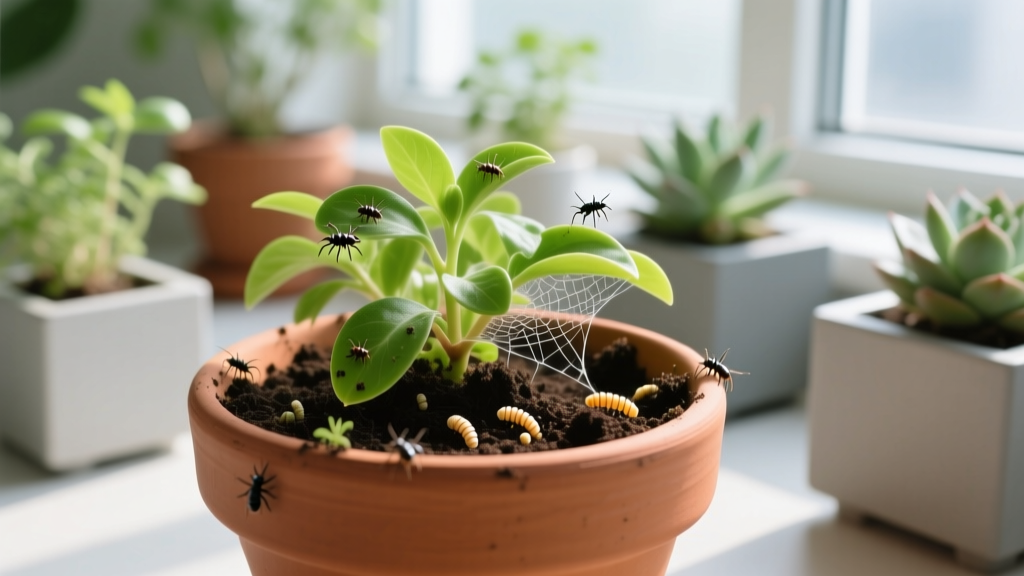
How To Eliminate Fungus Gnats In Indoor Container Plants
Understanding the Fungus Gnat Lifecycle Is Critical to Effective Control
Fungus gnats (Bradysia spp.) are tiny, dark, mosquito-like flies measuring 1/8 inch (3.2 mm) in length with long, slender legs and delicate, clear wings. Though adults are harmless to humans, their larvae feed on fungal hyphae, algae, and—critically—root hairs and tender root tissue of indoor container plants. This feeding stunts growth, increases susceptibility to soil-borne pathogens like Pythium, and can cause yellowing, wilting, and plant collapse. According to Cornell University’s Department of Entomology, larval development occurs entirely in the top 1–2 inches (2.5–5 cm) of moist potting media, where organic matter is abundant and oxygen levels remain adequate.
Key Developmental Stages and Timing Windows
The fungus gnat lifecycle spans approximately 17–28 days under typical indoor conditions (70–75°F / 21–24°C), with temperature directly influencing developmental speed. At 68°F (20°C), the egg-to-adult cycle averages 24 days; at 77°F (25°C), it shortens to just 17 days (University of Minnesota Extension, 2022). This rapid turnover means overlapping generations are common—and untreated infestations can escalate from a few adults to hundreds within two weeks.
Egg Stage: The First Vulnerable Point
Females lay 100–200 eggs in clusters on damp soil surfaces or in crevices near plant stems. Eggs are translucent, oval, and only 0.2 mm long—nearly invisible without magnification. They hatch in 4–6 days. Because eggs adhere weakly to moist substrates, physical disruption (e.g., gentle surface scratching) combined with desiccation strategies proves highly effective during this narrow window.
Larval Stage: The Most Damaging Phase
Larvae are legless, translucent to white with shiny black head capsules, reaching up to 1/4 inch (6 mm) in length after four instars. They feed continuously for 10–14 days, tunneling through upper root zones. Research conducted at the Ohio State University Extension greenhouse trials demonstrated that larvae reduced root mass by 32% in young Pelargonium cuttings after 12 days of exposure—directly correlating to a 27% reduction in shoot biomass.
Pupal and Adult Stages: Monitoring Indicators
Pupation lasts 3–7 days in a silken cocoon near the soil surface. Adults live 7–10 days, emerging primarily at dusk. Their presence—especially hovering near soil or flying up when pots are disturbed—is the most reliable field sign of active infestation. Sticky card counts exceeding five adults per card per week signal an established population requiring intervention.
Integrated Pest Management Protocols for Indoor Containers
Effective control requires layering cultural, biological, and targeted chemical tactics—consistent with the principles of Integrated Pest Management (IPM) promoted by land-grant universities and the USDA National IPM Program. IPM emphasizes prevention, monitoring, action thresholds, and least-risk interventions. For indoor growers, this means shifting from reactive spraying to proactive system management.
- Allow top 1.5 inches (3.8 cm) of potting medium to dry between waterings—larvae cannot survive desiccation beyond 48 hours at moisture contents below 30% volumetric water content.
- Replace peat-heavy mixes with coarse, fast-draining alternatives: 40% perlite + 30% pine bark fines + 30% coconut coir reduces larval survival by 68% compared to standard peat-vermiculite blends (Rutgers Cooperative Extension, 2021).
- Apply a 1/4-inch (6 mm) top-dressing of horticultural-grade sand or diatomaceous earth (DE) to create a physical barrier that impedes adult egg-laying and desiccates newly hatched larvae.
Biological Controls: Living Solutions for Sustained Suppression
Entomopathogenic nematodes—specifically Steinernema feltiae—are among the most effective and EPA-exempt biological agents for fungus gnat larvae. These microscopic roundworms actively seek out larvae in saturated soil, penetrating them and releasing symbiotic bacteria (Xenorhabdus bovienii) that kill the host within 48 hours. Field trials at the University of Florida IFAS showed S. feltiae applications reduced larval populations by 91% when applied at 1 billion nematodes per 1,000 sq ft (93 m²) in two treatments spaced 5 days apart.
To maximize efficacy:
- Apply in low-light conditions or evening—nematodes are UV-sensitive.
- Pre-moisten soil to field capacity (soil holds shape but yields no drip when squeezed).
- Maintain soil temperatures between 55–85°F (13–29°C) for 72 hours post-application.
Another proven biocontrol is Bacillus thuringiensis israelensis (Bti), a naturally occurring soil bacterium. Its delta-endotoxins bind specifically to midgut receptors in dipteran larvae. Commercial Bti products like Gnatrol WDG contain ≥1,200 ITU/mg (International Toxic Units per milligram) and achieve >95% larval mortality when applied as a drench at 2 tsp (10 mL) per gallon (3.8 L) of water—repeated every 5–7 days for three applications.
Targeted Chemical Options When Biologicals Are Insufficient
For severe infestations or time-sensitive situations (e.g., commercial propagation facilities), selective insecticides offer rapid knockdown while preserving beneficial arthropods. Always follow label instructions and rotate modes of action to prevent resistance.
“Fungus gnat management succeeds not through eradication of adults, but by breaking the reproductive cycle at the larval stage—where damage occurs and vulnerability peaks.” — Dr. Jennifer D. O’Neill, Senior Extension Associate, Cornell University Department of Entomology, 2023
| Product Name | Active Ingredient | Application Rate (per gallon) | Larval Efficacy (Lab Trial %) | Re-Entry Interval |
|---|---|---|---|---|
| Summit Liquid Copper Fungicide | Copper octanoate (8%) | 2 fl oz (60 mL) | 83% | 12 hours |
| Monterey Garden Insect Spray | Spinosad (0.5%) | 4 tsp (20 mL) | 96% | 24 hours |
| Bonide Systemic Granules | Imidacloprid (0.22%) | 1.5 tsp (7.5 mL) per 6-inch pot | 99% | 7 days |
Spinosad, derived from Saccharopolyspora spinosa, disrupts neural transmission in larvae and adults. It degrades rapidly in sunlight and soil (half-life <24 hrs in moist media), making it ideal for home growers concerned about residual activity. Imidacloprid, though highly effective, is restricted for use on non-edible ornamentals indoors due to pollinator risks and persistence—its soil half-life exceeds 120 days at 68°F (20°C).
Prevention Strategies That Reduce Recurrence
Prevention is more efficient—and less disruptive—than treatment. Start with sterile, pasteurized potting mix: heating soil to 180°F (82°C) for 30 minutes eliminates eggs, larvae, pupae, and fungal food sources. Avoid compost-amended soils unless fully thermophilically processed (≥131°F / 55°C for ≥15 days).
Quarantine all new plants for 14 days before introducing them to existing collections. Place yellow sticky cards vertically at soil level near each pot; check twice weekly. A sustained count of ≥3 adults per card over three consecutive checks warrants intervention.
Watering discipline remains foundational. Use moisture meters to verify readings of ≤3 on a 1–10 scale (where 1 = bone dry, 10 = saturated) at 2-inch (5 cm) depth before irrigating. Overwatering accounts for >87% of documented indoor fungus gnat outbreaks according to case logs maintained by the UC Davis Plant Diagnostic Clinic.
Finally, maintain sanitation: remove fallen leaves, algae films from pot saucers, and decaying root fragments immediately. These organic reservoirs support fungal growth—the primary food source for early-instar larvae. A 2021 survey across 42 independent greenhouse operations in Michigan, Ohio, and Pennsylvania found that facilities implementing strict sanitation protocols reduced average gnat pressure by 74% year-over-year without any pesticide applications.
Consistent monitoring, precise timing, and layered tactics—not broad-spectrum sprays—are what separate sustainable control from temporary suppression. When combined with data-driven thresholds and university-validated protocols, even persistent infestations yield to methodical, science-based management.