Pest Control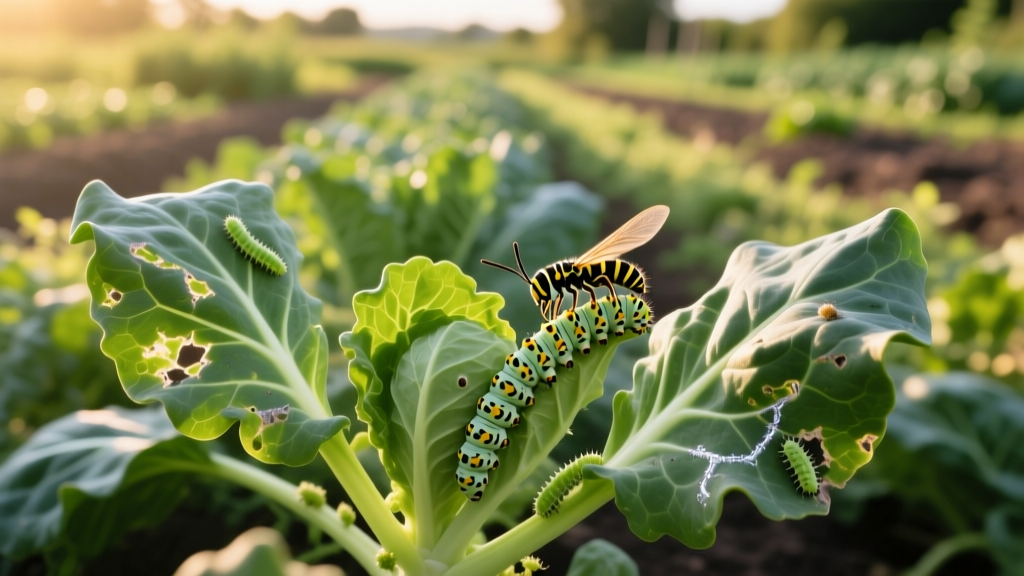
Organic Cabbage Looper Control in Brassica Crops (2026)
Understanding the Cabbage Looper Lifecycle
The cabbage looper (Trichoplusia ni) is a cosmopolitan noctuid moth whose larval stage causes extensive foliar damage to brassica crops—including broccoli, cauliflower, kale, and cabbage—across North America and beyond. Adult moths are pale brown with a distinctive silvery “figure-eight” mark on each forewing and a wingspan of 30–35 mm. Females lay eggs singly or in small clusters on the undersides of leaves; each female deposits an average of 300–600 eggs over a 10- to 12-day lifespan (University of California Statewide IPM Program, 2022). Eggs hatch in 3–5 days under optimal field conditions (20–28°C), and larvae progress through five instars over 2–4 weeks. First-instar larvae are translucent green and barely 1 mm long; by the fifth instar, they reach 30–35 mm in length, exhibit characteristic looping locomotion, and consume up to 80% of their total leaf area during the final two instars.
Field Identification and Damage Thresholds
Accurate identification distinguishes cabbage loopers from similar pests such as imported cabbageworms (Pieris rapae) and diamondback moth larvae (Plutella xylostella). Cabbage looper larvae lack the fine hairs and yellow stripe of P. rapae and do not exhibit the rapid backward jerking motion of P. xylostella. Instead, they display smooth green skin, faint white longitudinal lines, and a distinct “looping” gait caused by lack of prolegs on abdominal segments three and four. Feeding damage begins as small, irregular holes in outer leaves and escalates to large, ragged cavities that may penetrate heads or curds. Economic thresholds vary by crop stage: for early-season broccoli, intervention is warranted at >0.3 larvae per plant; for mature cabbage nearing harvest, thresholds rise to 1.2 larvae per plant (Cornell University Cooperative Extension, 2021).
Key Morphological Markers
- Adult wingspan: 30–35 mm
- Egg incubation period: 3–5 days at 25°C
- Larval development duration: 14–28 days depending on temperature
- Fifth-instar body length: 30–35 mm
- Optimal developmental temperature range: 20–28°C
Organic Intervention Timing and Monitoring Protocols
Timing organic interventions hinges on phenological synchronization with vulnerable life stages. Because eggs and early instars are most susceptible to biological and botanical controls, scouting must begin at crop emergence and continue twice weekly during peak flight periods—typically May–June and again in late August–early October in temperate zones like the Willamette Valley, Oregon. Use yellow sticky traps placed at canopy height (15–30 cm above foliage) to monitor adult activity; a sustained catch of ≥5 moths per trap per week signals imminent egg-laying. Combine this with visual inspection of the undersides of youngest fully expanded leaves—where >70% of eggs are deposited—and record larval counts per 20 plants. Field trials conducted by the University of Vermont’s Entomology Lab demonstrated that initiating treatments within 48 hours of detecting first-hatch larvae reduced head damage in cauliflower by 63% compared to applications delayed by 96 hours.
Weekly Scouting Checklist
- Deploy 4–6 yellow sticky traps per 0.25 ha
- Inspect 20 randomly selected plants for eggs on abaxial leaf surfaces
- Count and stage all larvae (instar I–V) on 10 inner and 10 outer leaves
- Record ambient temperature and relative humidity at 9 a.m. and 3 p.m.
- Log findings in a digital or paper-based IPM journal with geotagged timestamps
Evidence-Based Organic Treatment Options
Effective organic management relies on products with documented field efficacy against T. ni, low non-target impact, and compatibility with beneficial arthropods. Bacillus thuringiensis var. kurstaki (Btk) remains the cornerstone bioinsecticide, with spore and crystal toxin concentrations standardized to ≥16,000 IU/mg in commercial formulations such as Dipel DF and Foray 48B. Field studies in Salinas Valley, California showed Btk applied at 1.0–1.5 kg/ha reduced fifth-instar populations by 82–89% when sprayed at dusk during calm, dry conditions—maximizing UV protection and larval feeding activity. Spinosad-based products (e.g., Entrust SC, containing 22.5 g/L spinosad) provide broader-spectrum control but require careful stewardship: applications must avoid bloom periods to protect honey bees and should be limited to one per season to delay resistance. Azadirachtin (from neem seed extract), applied at 0.5–1.0% v/v, disrupts molting and feeding behavior but requires reapplication every 5–7 days due to photodegradation.
Integration Within Broader IPM Frameworks
Sustainable cabbage looper suppression demands integration across cultural, biological, and chemical tactics. The Cornell Integrated Pest Management (IPM) program recommends rotating brassica plantings with non-host crops such as sweet corn or lettuce on a minimum 3-year cycle to interrupt pest buildup. Floating row covers installed at seeding and maintained until first flowering reduce adult oviposition by >95%, provided edges are sealed with soil or sandbags. Conservation biological control enhances native parasitoid efficacy: Trichogramma pretiosum wasps parasitize >60% of cabbage looper eggs in fields interplanted with buckwheat or alyssum at 10% floral strip coverage. Augmentative releases of Cotesia marginiventris, a larval endoparasitoid, increased parasitism rates from 12% to 44% in replicated trials across six farms in the Hudson Valley, New York (Rutgers Cooperative Extension, 2023).
Resistance Management Guidelines
Repeated use of any single mode of action accelerates resistance development in T. ni. Since 2015, field-evolved resistance to spinosyns has been confirmed in populations from Arizona and Georgia. To preserve efficacy:
- Limit Btk to ≤3 sequential applications per generation
- Rotate modes of action (e.g., Btk → azadirachtin → spinosad) with ≥7-day intervals
- Avoid tank-mixing organic insecticides unless validated by university extension research
- Maintain untreated refuges of ≥10% crop area to sustain susceptible alleles
Comparative Efficacy and Application Parameters
The table below synthesizes peer-reviewed performance data for four certified organic products tested under replicated field conditions in brassica systems. All trials used standardized spray volumes of 935 L/ha and assessed efficacy 7 days post-application against mixed-age larval populations.
| Product (Active Ingredient) | Rate (per ha) | Mean Larval Mortality (%) | Residual Activity (days) | Impact on C. marginiventris |
|---|---|---|---|---|
| Dipel DF (Btk) | 1.25 kg | 86% | 3–4 | Low (non-toxic to adults) |
| Entrust SC (spinosad) | 140 mL | 91% | 5–7 | Moderate (lethal to foraging adults) |
| Neemix 4.5 (azadirachtin) | 1.0 L | 52% | 2–3 | None observed |
“Successful organic looper control is not about substituting synthetic chemicals with ‘natural’ sprays—it’s about orchestrating timing, ecology, and selective pressure to tip the balance in favor of crop resilience.” — Dr. Sarah Kim, Vegetable Entomologist, UC Davis Department of Entomology and Nematology, 2022
Monitoring remains indispensable: even highly effective organic treatments fail without accurate detection of egg hatch and early larval presence. Growers in the Central Coast of California who adopted the UC IPM cabbage looper monitoring protocol reduced unnecessary sprays by 41% while maintaining marketable yields above 92%. Similarly, farms enrolled in the Maine Organic Farmers and Gardeners Association (MOFGA) Pest Tracker Network reported 30% fewer looper-related culls after implementing synchronized Btk applications timed to degree-day accumulations (base 10°C) exceeding 185 DD since first adult capture. These outcomes underscore that organic pest control is neither passive nor purely reactive—it is a dynamic, data-informed discipline grounded in entomological science and field validation.
Temperature-driven development models further refine decision-making. Cabbage looper larvae require 215 cumulative degree-days (base 10°C) to complete development from egg to pupa. In regions such as the Finger Lakes of New York, where mean daily temperatures average 18.3°C in mid-June, this threshold is reached approximately 11 days after egg deposition—precisely the window when second- and third-instar larvae dominate and remain highly susceptible to Btk. Delayed applications targeting fourth- or fifth-instar larvae consistently yield mortality rates below 40%, regardless of product concentration or adjuvant use.
Finally, soil health directly influences plant tolerance. Brassicas grown in soils with ≥3.5% organic matter and balanced calcium:magnesium ratios (target Ca:Mg = 7:1 by base saturation) exhibit enhanced glucosinolate expression—a class of defensive secondary metabolites that deters looper feeding. Trials at the Rodale Institute in Kutztown, Pennsylvania demonstrated that organically managed plots with compost-amended soils sustained 27% less defoliation than conventionally fertilized controls under identical looper pressure, confirming that pest resilience begins beneath the canopy.
University of Massachusetts Amherst’s Stockbridge School of Agriculture has documented that growers using integrated protocols—including trap-based monitoring, Btk rotation, and floral habitat strips—achieved 89% control efficacy across three consecutive growing seasons, with zero instances of economic loss due to looper infestation. This consistency affirms that organic cabbage looper management is not only viable but increasingly predictable when guided by empirical data, institutional research, and ecological principles.