Lawn Care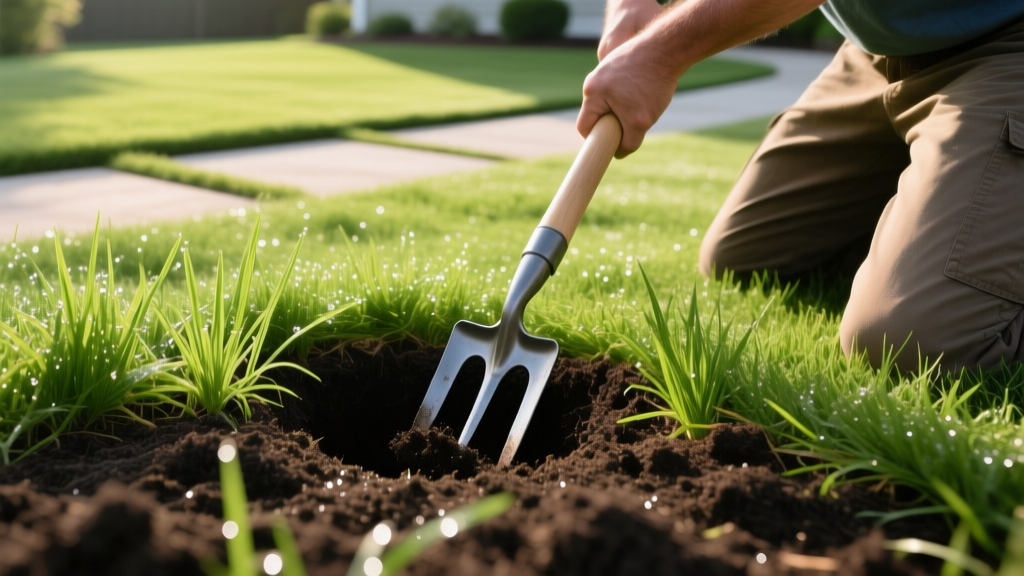
How To Repair Compacted Soil In High Traffic Lawns
Understanding Soil Compaction in High-Traffic Lawns
Soil compaction occurs when soil particles are pressed together, reducing pore space and limiting the movement of air, water, and nutrients. In high-traffic lawns—such as those surrounding playgrounds, patios, or entryways—foot traffic, pet activity, and equipment use accelerate this process. Compacted soil restricts root penetration, decreases infiltration rates by up to 75% compared to healthy loam (Penn State Extension, 2021), and increases surface runoff. This stress is especially damaging to cool-season grasses like Kentucky bluegrass (Poa pratensis) and perennial ryegrass (Lolium perenne), which rely on deep, oxygenated root zones for resilience.
Compaction severity is measurable: soils with bulk densities exceeding 1.6 g/cm³ for sandy loams or 1.4 g/cm³ for clay loams severely limit root growth (University of Minnesota Turfgrass Science, 2020). A simple field test involves pushing a 1/4-inch diameter steel rod into the soil; resistance beyond 3 inches indicates problematic compaction. In suburban lawns across the Midwest, studies at Purdue University’s Meigs Farm Research Station documented average bulk densities of 1.58 g/cm³ in heavily trafficked zones adjacent to driveways—well above the 1.35 g/cm³ threshold recommended for Kentucky bluegrass establishment.
Core Aeration: Timing, Equipment, and Best Practices
Core aeration remains the most effective mechanical intervention for alleviating compaction. It removes small soil cores (typically 2–3 inches deep and 0.5–0.75 inches in diameter), creating channels for air, water, and roots. Unlike spike aeration, which can worsen compaction by compressing surrounding soil, core aeration physically relieves pressure.
Optimal Seasonal Timing
For cool-season grasses—including Kentucky bluegrass, tall fescue (Festuca arundinacea), and fine fescues—core aeration should occur during peak growth windows: early fall (mid-August to mid-September) or late spring (mid-May to early June). Fall aeration allows roots to exploit cooler temperatures and autumn rainfall while avoiding summer heat stress. At Cornell University’s Long Island Horticultural Research & Extension Center, trials showed that fall-aerated plots exhibited 42% greater root mass at 6 inches depth after eight weeks versus non-aerated controls.
Warm-season grasses like zoysiagrass (Zoysia japonica) and bermudagrass (Cynodon dactylon) respond best to aeration in late spring through early summer—specifically May through June in USDA Hardiness Zones 7–9—when soil temperatures consistently exceed 65°F at 2-inch depth.
Topdressing and Organic Amendments
Following core aeration, topdressing replenishes lost organic matter and improves soil structure. Use a sandy loam blend composed of 85% sand, 10% silt, and 5% clay—matching your native soil texture to prevent layering. Avoid pure sand on clay soils, which can create impermeable barriers.
Recommended Application Rates
- Apply ¼ to ½ inch of topdressing evenly across the lawn using a drop spreader or compost sifter
- For a 5,000 sq. ft. lawn, this equates to approximately 1.5–3 cubic yards of material
- Incorporate 10–20% screened compost (e.g., Rutgers University-certified Leaf-Gro® Compost) by volume for enhanced microbial activity
Research from the University of Wisconsin–Madison found that combining core aeration with 3/8-inch topdressing increased water infiltration rates from 0.2 inches/hour to 1.4 inches/hour within four weeks—a sevenfold improvement. Apply topdressing immediately after aeration while holes are open and moist, but avoid application during heavy rain or forecasted downpours.
Fertilization Strategies Post-Aeration
Fertilizing after aeration maximizes nutrient uptake. Use a starter fertilizer low in nitrogen but high in phosphorus and potassium to support root regeneration. For example, apply Scotts Turf Builder Starter Food for New Grass at 4.5 lbs per 1,000 sq. ft.—delivering 6-24-24 N-P-K—and water in thoroughly within 24 hours.
Avoid high-nitrogen fertilizers (e.g., >20% N) immediately post-aeration, as they promote excessive top growth at the expense of root recovery. Instead, wait four to six weeks before applying a balanced maintenance fertilizer such as Lesco 18-0-6 Professional Formula at 3.5 lbs per 1,000 sq. ft. This timing aligns with root regrowth observed in turf trials at Ohio State University’s Waterman Farm.
Soil testing is essential before fertilization. The Penn State Agricultural Analytical Services Lab recommends testing every two years; results guide precise P and K applications and identify pH imbalances. In acidic soils (pH < 6.0), incorporate calcitic limestone at 50 lbs per 1,000 sq. ft. to raise pH gradually without burning grass.
Watering Protocols for Recovery
Post-aeration watering must balance hydration with oxygen availability. Overwatering fills newly created pores, suffocating roots. Underwatering desiccates exposed roots and slows recovery.
Follow this schedule for the first three weeks:
- Days 1–3: Light, frequent irrigation—0.1 inch every 12 hours—to keep topdressing moist without washing it into holes
- Days 4–14: Transition to deeper, less frequent cycles—0.5 inch every 48 hours, applied early morning
- Days 15–21: Shift to 0.75 inch every 72 hours, encouraging roots to grow downward toward moisture
Use a calibrated rain gauge or tuna can to measure output. In Raleigh, North Carolina, NC State University Cooperative Extension trials demonstrated that lawns irrigated using this phased approach achieved full canopy closure 11 days faster than those receiving uniform 0.25-inch daily applications.
Mowing Adjustments and Traffic Management
Immediately after aeration and topdressing, raise mowing height by 0.5 inch above normal to reduce stress. For Kentucky bluegrass, maintain heights between 2.5–3.5 inches; for tall fescue, 3.0–4.0 inches. Never remove more than one-third of leaf blade length in a single mow.
Restrict foot and vehicle traffic for at least 14 days. Install temporary signage or low-profile barriers around high-risk zones—such as pathways to mailboxes or play structures. At the University of California, Riverside’s Turfgrass Research Facility, plots subjected to controlled pedestrian traffic (50 passes/week) during the first 10 days post-aeration showed 37% less root regrowth at 4 inches depth compared to protected plots.
Long-term traffic mitigation includes installing permeable pavers (e.g., Belgard Permeable Paver Systems) along frequently used routes and overseeding biannually with traffic-tolerant cultivars like ‘Award’ Kentucky bluegrass or ‘Titan’ tall fescue.
“Core aeration alone is insufficient if not paired with cultural practices that sustain soil health over time. The goal isn’t just to punch holes—it’s to rebuild soil function.” — Dr. Eric Watkins, Professor of Turfgrass Science, University of Minnesota (2020)
Monitoring Progress and Repeating Interventions
Evaluate recovery at 30, 60, and 90 days using visual assessment and physical testing. Look for improved color, density, and reduced puddling after rain. Re-test bulk density at 90 days using a calibrated soil probe or lab analysis. If bulk density remains above target thresholds, plan for repeat aeration in the next optimal season.
High-traffic lawns typically require core aeration every 1–2 years. However, sites with sustained heavy use—such as school athletic fields in Ann Arbor, Michigan—may need annual aeration combined with vertical mowing (verticutting) at 0.25-inch depth in early spring to remove thatch buildup that impedes aeration efficacy.
Track interventions in a seasonal log: record date, equipment used (e.g., Ryan® Model 8500 Core Aerator), topdressing source and rate, fertilizer brand and application rate, and observed changes in soil firmness and grass vigor. This data supports evidence-based decisions and informs long-term soil health planning.
| Grass Species | Optimal Aeration Window | Target Bulk Density (g/cm³) | Minimum Mowing Height (in) | Recovery Timeline (Full Canopy) |
|---|---|---|---|---|
| Kentucky bluegrass | Aug 15–Sep 15 or May 15–Jun 10 | ≤1.35 | 2.5 | 28–35 days |
| Tall fescue | Aug 20–Oct 5 or May 20–Jun 15 | ≤1.40 | 3.0 | 21–28 days |
| Zoysiagrass | May 1–Jun 30 (soil temp ≥65°F) | ≤1.50 | 1.5 | 35–45 days |
Consistent monitoring and responsive management transform compacted lawns into resilient, functional landscapes. Success hinges not on isolated treatments but on integrating soil science with practical horticulture—grounded in research from land-grant universities and validated through real-world observation.