Lawn Care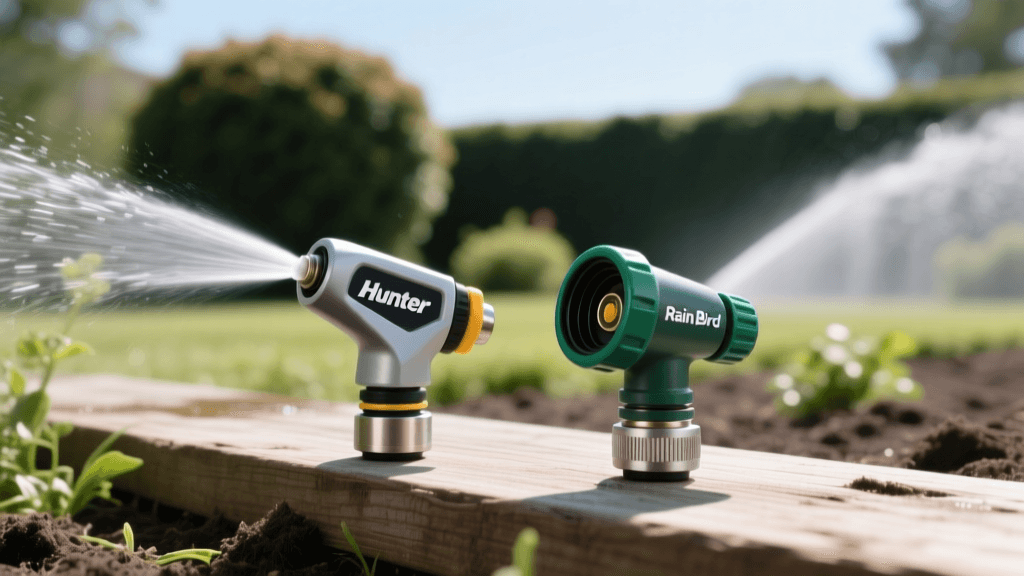
Hunter Pro Spray vs Rain Bird 1800 Nozzles: 2026 Review
Hunter Pro Spray vs Rain Bird 1800: The 2026 Irrigation Showdown
As we navigate the 2026 landscaping season, municipal water restrictions, shifting climate patterns, and rising utility costs have made efficient lawn irrigation more critical than ever. When homeowners and landscaping professionals set out to upgrade or install a new sprinkler system, two names consistently dominate the conversation: Hunter Industries and Rain Bird. Specifically, the debate often centers on the Hunter Pro-Spray versus the Rain Bird 1800 series.
While these two product lines are direct competitors, there is a common misconception in the lawn care community regarding terminology. Homeowners frequently search for a "nozzle comparison" between these two models, but technically, the Pro-Spray and the 1800 are spray bodies—the plastic housings, pop-up stems, and internal springs that deliver water to the surface. The nozzles are the removable tips that screw into these bodies, dictating the spray pattern, distance, and precipitation rate. However, because each brand has cultivated a distinct ecosystem of proprietary and compatible nozzles, comparing these systems requires looking at both the durability of the bodies and the water-efficiency of their respective nozzle lineups.
In this comprehensive 2026 guide, we will break down the Hunter Pro-Spray and Rain Bird 1800 ecosystems, compare their top-performing nozzles, and help you decide which system is best for your lawn's specific needs.
Clarifying the Ecosystem: Bodies vs. Nozzles
Before diving into precipitation rates and distribution uniformity, it is vital to understand how these systems are built. The spray body acts as the delivery vehicle. It houses the spring that pushes the stem up, the wiper seal that prevents leaks and keeps dirt out, and the filter screen that protects the nozzle from debris.
According to the USGS Water Science School, agricultural and residential irrigation accounts for a massive percentage of freshwater withdrawals in the United States. Because residential outdoor water use is under heavy scrutiny in 2026, the efficiency of the nozzle screwed into the top of the body is where the real water savings occur. Both Hunter and Rain Bird offer standard spray nozzles, high-efficiency fixed spray nozzles, and multi-stream rotary nozzles that fit their respective bodies.
The Hunter Pro-Spray Ecosystem
The Hunter Pro-Spray body has long been praised for its heavy-duty co-polymer construction and robust internal components. In 2026, Hunter continues to refine its wiper seal technology, which is crucial for preventing debris from entering the body and causing the dreaded "stuck stem" issue.
Key Features of the Hunter Pro-Spray Body:
- Heavy-Duty Spring: Ensures reliable retraction even in sandy or clay-heavy soils.
- Ratchet Riser: Allows you to easily align the nozzle without digging up the entire body.
- Flush Plug Included: Newer 2026 kits often include a flush plug to blow out debris before installing the nozzle and filter.
The Hunter Nozzle Lineup:
Hunter’s standard Pro Spray Nozzles are reliable, but their crown jewel is the MP Rotator. The MP Rotator is a multi-trajectory, multi-stream rotary nozzle that drastically reduces the precipitation rate, allowing water to soak into the soil rather than running off into the street. It is widely considered the gold standard for retrofitting older, inefficient spray zones.
The Rain Bird 1800 Series Ecosystem
The Rain Bird 1800 series is the undisputed workhorse of the irrigation industry. You will find these bodies in millions of residential and commercial properties worldwide. Rain Bird offers several variations of the 1800, including the standard model, the SAM (Seal-A-Matic) model with a built-in check valve, and the PRS (Pressure Regulating Stem) model.
Key Features of the Rain Bird 1800 Body:
- Seal-A-Matic (SAM): A built-in check valve that holds up to 14 feet of elevation change, preventing low-head drainage—a common issue where water leaks out of the lowest sprinkler head after the zone shuts off.
- Pressure Regulating Stem (PRS): Regulates pressure to an optimal 30 PSI right at the nozzle, which is critical for preventing misting and fogging in high-pressure municipal systems.
- Co-Molded Seal: Provides excellent debris resistance and smooth retraction.
The Rain Bird Nozzle Lineup:
Rain Bird counters Hunter’s offerings with their HE-VAN (High Efficiency Variable Arc) nozzles and their own line of U-Series Rotary Nozzles. The HE-VAN provides excellent distribution uniformity for standard spray zones, while the Rotary Nozzles compete directly with the MP Rotator for low-precipitation, multi-stream applications.
Head-to-Head Nozzle Comparison Table (2026 Data)
To truly understand how these systems perform in your yard, we must compare the nozzles that installers actually use in 2026. Below is a comparison of the top rotary and high-efficiency nozzles from both brands.
| Feature | Hunter MP Rotator (MP1000/2000/3000) | Rain Bird U-Series Rotary Nozzle | Rain Bird HE-VAN (Standard Spray) |
|---|---|---|---|
| Precipitation Rate | ~0.4 inches per hour | ~0.6 inches per hour | ~1.5 to 2.0 inches per hour |
| Distance Range | 13 ft to 35 ft (depending on model) | 13 ft to 24 ft | 8 ft to 17 ft |
| Wind Resistance | Excellent (Heavy streams) | Very Good (Multi-stream) | Poor (Prone to misting) |
| Distribution Uniformity (DU) | High (Excellent overlap) | High | Moderate to High |
| Ideal Application | Large zones, slopes, clay soils | Medium zones, retrofit upgrades | Small, narrow strips, quick watering |
| Avg. Cost per Nozzle (2026) | $11.00 - $16.00 | $9.00 - $13.00 | $3.50 - $5.00 |
Water Efficiency and Distribution Uniformity (DU)
Distribution Uniformity (DU) measures how evenly water is applied across a given area. A high DU means the grass gets the same amount of water everywhere, preventing brown spots and waterlogged zones. According to EPA WaterSense, up to 50% of water used for irrigation is wasted due to evaporation, wind, and inefficient sprinkler heads.
When comparing the Hunter MP Rotator to the Rain Bird Rotary Nozzle, both offer vastly superior DU compared to traditional spray nozzles like the HE-VAN. The MP Rotator's multi-trajectory streams (shooting water at multiple angles simultaneously) create a highly uniform blanket of water, making it exceptionally resistant to wind distortion. The Rain Bird Rotary nozzle is also highly effective and often praised for being slightly easier to adjust on the fly, but the MP Rotator maintains a slight edge in maximum distance and wind resistance for expansive lawns.
However, if you are watering small, narrow parkways or shrub beds, rotary nozzles are often the wrong tool. In these scenarios, the Rain Bird HE-VAN paired with a Rain Bird 1800 PRS body is a phenomenal choice. The built-in pressure regulation stops the HE-VAN from misting, ensuring the water droplets remain heavy enough to reach the soil.
The Importance of Pressure Regulation in 2026
One of the most significant trends in 2026 lawn care is the push for pressure-regulated sprinkler bodies. Many municipal water systems operate at 70 to 90 PSI, but standard spray nozzles are designed for 30 PSI. When high pressure hits a standard nozzle, the water atomizes into a fine mist that blows away in the breeze, wasting thousands of gallons per season.
Both brands offer solutions, but they approach it differently:
- Rain Bird 1800 PRS: Features an integrated pressure regulator built directly into the pop-up stem. It guarantees 30 PSI at the nozzle, regardless of the incoming zone pressure. This is a massive advantage for DIYers and professionals who want guaranteed efficiency without installing inline pressure-reducing valves.
- Hunter Pro-Spray PRS: Hunter also offers pressure-regulated bodies (typically regulating to 40 PSI for rotors and 30 PSI for sprays). While highly effective, Rain Bird's 1800 PRS is often slightly more accessible and widely stocked in big-box home improvement stores in 2026.
Durability and Maintenance
Both the Hunter Pro-Spray and Rain Bird 1800 are constructed from high-grade, UV-resistant plastics designed to withstand the elements, lawnmower strikes, and foot traffic. However, maintenance routines differ slightly.
The Rain Bird 1800 features a flush cap that is easily removed with a flathead screwdriver, making seasonal blowouts and debris clearing straightforward. The Hunter Pro-Spray utilizes a ratchet riser mechanism that is fantastic for alignment but can occasionally strip if forced by hand against hardened dirt.
For areas with heavy clay soil or frequent construction debris, the Hunter Pro-Spray's heavier wiper seal tends to keep grit out of the internal spring housing slightly better over a 5-to-10-year lifespan. Conversely, the Rain Bird 1800 SAM model is the undisputed king of sloped terrains, as its integrated check valve saves thousands of gallons of water that would otherwise drain out of the lateral lines after the system shuts off.
Cost and ROI Analysis for 2026
When budgeting your irrigation upgrade, it is essential to look beyond the initial cost of the plastic body and factor in the nozzle and long-term water savings.
- Standard Bodies: Both the Hunter Pro-Spray and Rain Bird 1800 standard bodies retail between $4.50 and $6.50 each in 2026.
- Premium Bodies (PRS/SAM): Upgrading to pressure-regulating or check-valve models will cost between $9.00 and $13.00 per head.
- Nozzles: Standard spray nozzles are cheap ($3.00 - $5.00), but rotary nozzles (MP Rotator or Rain Bird Rotary) cost $10.00 to $16.00 each.
While outfitting a 10-head zone with Hunter Pro-Spray bodies and MP Rotators might cost $150 to $180 in parts, the reduction in your monthly water bill will typically yield a return on investment within 1.5 to 2 irrigation seasons. Furthermore, pairing these high-efficiency nozzles with a smart Wi-Fi controller—highly recommended by the EPA's guide on irrigation controllers—can reduce outdoor water use by an additional 15% to 20%.
Final Verdict: Which Should You Choose?
The choice between the Hunter Pro-Spray and Rain Bird 1800 series ultimately comes down to your specific landscape topology and water pressure.
Choose the Hunter Pro-Spray with MP Rotators if:
- You have large, expansive lawn zones requiring distances over 20 feet.
- Your property experiences high winds that disrupt standard spray patterns.
- You are dealing with heavy clay soils that require a very slow precipitation rate (0.4 in/hr) to prevent runoff.
Choose the Rain Bird 1800 (PRS/SAM) with HE-VAN or Rotary Nozzles if:
- Your yard has significant elevation changes and you need the SAM check valve to prevent low-head drainage.
- You have high municipal water pressure and want the convenience of the 1800 PRS body to eliminate misting without digging up pipes to install inline regulators.
- You have a complex yard with many small, narrow zones where standard HE-VAN nozzles are more practical than rotary streams.
Both systems represent the pinnacle of residential irrigation technology in 2026. By matching the correct body features (like check valves and pressure regulation) with the appropriate high-efficiency nozzle, you will secure a lush, green lawn while remaining a responsible steward of your local water supply.