Lawn Care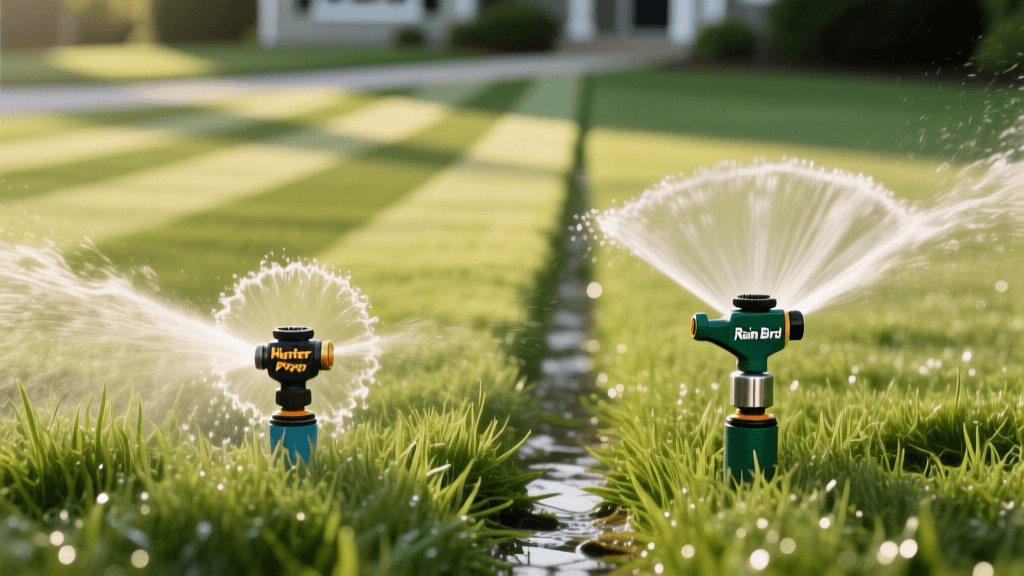
Hunter Pro Spray vs Rain Bird 1800: 2026 Striping Guide
The Art and Science of Lawn Striping in 2026
Creating pristine, stadium-quality lawn stripes in your home landscape is one of the most rewarding achievements in modern turf management. However, the secret to a flawless checkerboard or diamond pattern is not just a heavy roller or a specialized striping kit; it begins beneath the soil with uniform irrigation. If your grass lacks consistent cellular turgor pressure due to uneven watering, the blades will bend erratically, resulting in muddy, low-contrast patterns. In 2026, the debate over which irrigation hardware best supports high-aesthetic turf management often centers on two industry titans: the Hunter Pro-Spray and the Rain Bird 1800 series. While both are exceptional spray heads, their subtle engineering differences drastically impact lawn striping and visual uniformity.
Why Sprinkler Pop-Up Height Dictates Stripe Quality
To achieve a high-contrast stripe, cool-season grasses like Kentucky Bluegrass and Tall Fescue must be maintained at a taller cutting height, typically between 3.0 and 4.0 inches. The longer the grass blade, the more surface area is available to reflect sunlight, creating the striking light and dark bands that define aesthetic lawn patterns. This is where sprinkler pop-up height becomes a critical aesthetic variable.
The standard Hunter Pro-Spray 04 and Rain Bird 1804 both feature a 4-inch pop-up stem. When surrounded by 4-inch grass, these heads barely clear the canopy. This creates a phenomenon known as 'head shadow,' where the immediate microclimate around the sprinkler cap traps excess moisture, promotes fungal disease, and physically stunts the grass directly adjacent to the head. When you mow over these areas, the resulting brown rings break the visual continuity of your stripes.
For dedicated striping, upgrading to taller pop-up stems is mandatory. The Rain Bird 1800 series offers the 1806 (6-inch) and the 1812 (12-inch) models. The 12-inch pop-up is particularly favored by turf artists in 2026 for deep-border striping, as it allows the spray to clear tall, uncut ornamental grasses and ensures the head remains completely concealed within the turf canopy when retracted. Hunter offers the Pro-Spray 06 (6-inch), but their 12-inch options are generally reserved in commercial rotors rather than the standard Pro-Spray line. For pure aesthetic concealment and mower clearance during intricate diagonal mowing passes, Rain Bird holds a slight edge in height versatility.
Nozzle Uniformity and Turgor Pressure
According to the University of Minnesota Extension, uniform water distribution is the cornerstone of healthy, resilient turf. Uneven precipitation leads to dry spots where grass loses its turgor pressure—the internal water pressure that keeps plant cells rigid. When a mower roller bends brittle, dehydrated grass, the blades snap rather than fold, leaving a jagged, brownish stripe instead of a smooth, reflective one.
Both Hunter and Rain Bird have made massive strides in nozzle uniformity by 2026. The Hunter Pro-Spray bodies are frequently paired with the legendary MP Rotator nozzles, which deliver water at a slow, precise rate that eliminates runoff and ensures deep soil penetration. Rain Bird’s 1800 series is often fitted with the HE-VAN (High Efficiency Variable Arc Nozzle) or the R-VAN rotary nozzles. Both setups can achieve a Distribution Uniformity (DU) of over 70%, which is the gold standard for maintaining the deep, emerald-green canvas required for striping.
However, the Hunter Pro-Spray features a co-molded wiper seal that is incredibly forgiving of debris, ensuring the stem retracts fully every time. A partially retracted stem will leak, creating a localized soggy patch that turns the grass a lighter, yellowish-green, instantly ruining the dark band of your stripe. Rain Bird’s 1800 series utilizes a heavy-duty rubber wiper seal and offers the SAM (Seal-A-Matic) check valve, which prevents low-head drainage on sloped properties. If your striped lawn is on an incline, the Rain Bird SAM is essential to prevent the lower zones from drowning and losing their vibrant color.
2026 Head-to-Head Comparison for Aesthetic Turf
| Feature | Hunter Pro-Spray (2026 Models) | Rain Bird 1800 Series (2026 Models) |
|---|---|---|
| Available Pop-Up Heights | 2", 3", 4", 6" | 2", 3", 4", 6", 12" |
| Seal Technology | Co-molded wiper seal (debris resistant) | Heavy-duty rubber wiper seal |
| Check Valve Option | Optional (up to 10 ft elevation) | SAM integrated (up to 10 ft elevation) |
| Cap Design & Mower Clearance | Wider profile, high impact resistance | Flush profile, low snag risk |
| Best for Striping Applications | Pro-Spray 06 with MP Rotator | 1806 / 1812 with R-VAN |
Cap Design: The Hidden Enemy of Lawn Patterns
When executing complex aesthetic patterns like concentric circles or tight checkerboards, your mower—and specifically your striping roller—will pass directly over sprinkler heads from multiple angles. The physical design of the sprinkler cap plays a surprising role in lawn aesthetics. The Hunter Pro-Spray features a slightly wider, more robust cap designed to withstand heavy commercial foot traffic. While durable, this wider lip can occasionally catch the edge of a low-hanging striping roller, tearing a small divot out of the turf.
Conversely, the Rain Bird 1800 series features a more tapered, flush-mount cap design that allows mower wheels and striping kits to glide over the head with minimal friction. In 2026, landscape architects focused on high-end residential aesthetics frequently recommend the Rain Bird 1800 for flat, intricate pattern work simply because the reduced snag risk preserves the unbroken visual flow of the grass canopy.
Winterization and Spring Aesthetic Recovery
A striped lawn is only as beautiful as its underlying health, and surviving the winter is crucial for spring striping. Both Hunter and Rain Bird bodies are constructed from heavy-duty, UV-resistant plastics that handle freeze-thaw cycles well. However, the internal spring mechanisms differ. The Hunter Pro-Spray utilizes a stainless-steel spring that resists corrosion from fertilizers and soil amendments over time. A corroded spring can lead to a sluggish retraction, leaving the head exposed during the first few mows of spring, which can result in the mower blade striking the plastic and scattering debris across your freshly striped lawn.
Rain Bird’s 1800 series also uses high-grade stainless steel but pairs it with a unique sand-flush mechanism that clears fine grit from the seal area upon retraction. For homeowners in sandy soils or those who frequently top-dress their lawns to achieve a perfectly level surface (a prerequisite for reel-mower striping), the Rain Bird sand-flush feature ensures the head drops completely flush with the soil line, maintaining the illusion of an endless, unbroken carpet of green.
Final Recommendations for 2026 Lawn Patterns
Choosing between the Hunter Pro-Spray and the Rain Bird 1800 series ultimately depends on your specific topography and mowing habits. If your lawn is entirely flat and you prioritize a flush cap design to protect intricate striping patterns from roller snags, the Rain Bird 1806 or 1812 paired with R-VAN nozzles is the premier choice for 2026. The 12-inch pop-up option is a game-changer for hiding irrigation hardware in tall, lush fescue lawns.
However, if your landscape features slopes, heavy clay soil, or you prefer the unmatched precipitation uniformity of the MP Rotator system, the Hunter Pro-Spray 06 is an outstanding, reliable workhorse. Its co-molded seal ensures that the head retracts perfectly every time, preventing the localized overwatering that causes the unsightly yellow rings that ruin high-contrast lawn stripes. By prioritizing pop-up height and nozzle uniformity, you can transform your home landscape into a masterpiece of turf art this season.