Lawn Care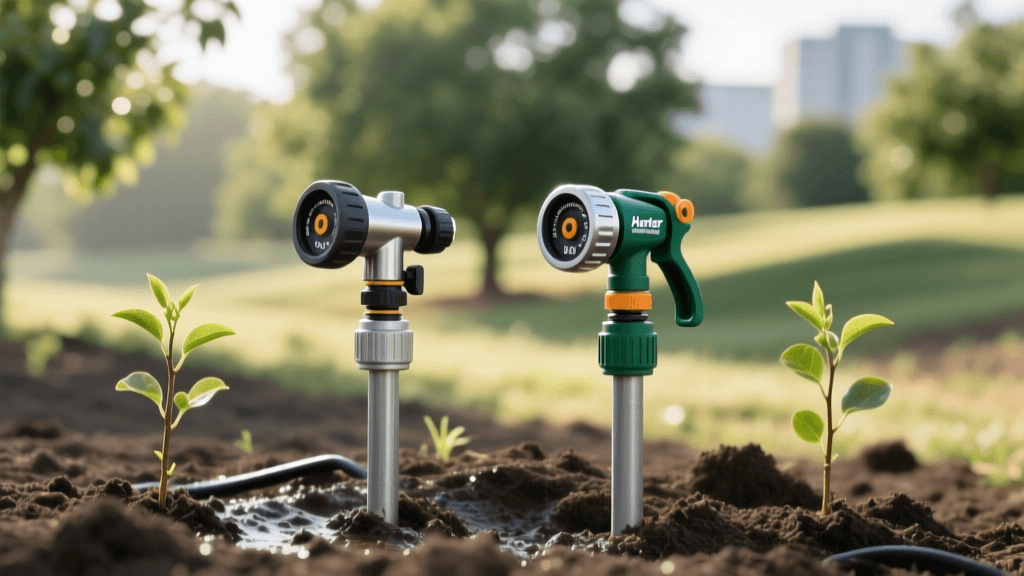
Hunter Pro-Spray vs Rain Bird 1800 for Trees in 2026
The Critical Role of Irrigation in Tree Planting (2026 Update)
When selecting and planting trees in 2026, the margin for error during the establishment phase is smaller than ever. With shifting climate patterns and stricter municipal water conservation regulations, homeowners and landscapers must rely on precision irrigation to ensure young trees develop deep, resilient root systems. While drip irrigation and deep-root bubblers are often the end-goal for mature trees, the first two years of a tree's life require consistent, even moisture across the entire root ball and surrounding mulch ring. This is where high-quality pop-up spray heads become indispensable.
Two titans dominate the landscape irrigation market: the Hunter Pro-Spray series and the Rain Bird 1800 series. While often debated in the context of turfgrass, their performance in tree planting beds, shrub borders, and mulch rings reveals distinct advantages for arboriculture. In this comprehensive guide, we will compare the Hunter Pro-Spray and Rain Bird 1800 spray bodies, their nozzle ecosystems, and how to configure them specifically for tree selection and planting success in 2026.
Hunter Pro-Spray vs. Rain Bird 1800: Head-to-Head Comparison
Before diving into tree-specific applications, it is essential to understand the mechanical differences between these two industry-standard spray bodies. Both brands offer 4-inch and 6-inch pop-up models, but their internal engineering dictates how well they handle the debris, soil, and mulch commonly found in tree planting beds.
| Feature | Hunter Pro-Spray | Rain Bird 1800 Series |
|---|---|---|
| Seal Mechanism | Cap Seal (Prevents debris entry) | Coiled Spring Seal (Wipes on retraction) |
| Pressure Regulation | PRS40 (Built-in 40 PSI) | PRS (Built-in 30 or 45 PSI options) |
| Check Valve | Up to 10 ft elevation hold | SAM (Seal-A-Matic) up to 14 ft hold |
| Warranty | 5 Years | 5 Years |
| Best Tree Application | High-pressure zones, MP Rotator pairing | Low-pressure drip transitions, bubbler conversions |
Seal Mechanisms: Surviving the Mulch Ring
Tree planting beds are notoriously messy environments. Wood chips, bark mulch, and loose topsoil frequently shift during heavy rains or windstorms, often finding their way into irrigation heads. If debris enters the spray body, it can clog the nozzle or prevent the riser from retracting, leading to damaged heads and uneven watering of the tree's root zone.
The Hunter Pro-Spray utilizes a unique cap seal design. When the head retracts, the cap seals tightly against the body, preventing debris from entering the internal mechanism. This makes it exceptionally reliable in heavy mulch rings surrounding newly planted Oaks or Maples.
Conversely, the Rain Bird 1800 relies on a heavy-duty coiled spring and a wiper seal. As the riser retracts, the seal wipes the outside of the stem clean. While highly effective for turfgrass, the wiper seal can sometimes trap fine organic matter from tree beds, requiring more frequent maintenance in heavily mulched landscape zones.
Pressure Regulation: The Key to Deep Root Penetration
In 2026, water pressure management is critical. Municipal water systems often deliver pressure exceeding 80 PSI. When this high pressure hits a standard spray head, it creates a fine mist. Misting is disastrous for tree watering for two reasons: it is easily blown away by wind (missing the root ball entirely), and it settles on the tree's lower trunk and foliage, promoting fungal diseases like powdery mildew or root rot.
Both manufacturers offer pressure-regulating (PR) models. The Hunter Pro-Spray PRS40 regulates at 40 PSI, which is the optimal pressure for modern rotary nozzles. The Rain Bird 1800 PRS offers a 30 PSI option, which is ideal for low-flow bubbler nozzles used to flood the base of a tree's root ball without causing soil erosion. According to the Arbor Day Foundation, slow, deep watering is the most effective way to establish new trees, making pressure-regulated spray bodies paired with low-flow nozzles the gold standard for 2026.
Nozzle Ecosystems for Tree Watering
A spray body is only as good as the nozzle it houses. For tree establishment, you must move away from standard fixed-spray nozzles (which apply water too quickly for soil to absorb) and utilize specialized tree-watering nozzles.
Hunter Pro-Spray and the MP Rotator
The Hunter Pro-Spray is the native home for the legendary MP Rotator. For tree planting beds, the MP800 or MP1000 series delivers multiple streams of water at a very slow precipitation rate. This allows water to slowly percolate through thick layers of mulch and dense clay soils, reaching the tree's fine feeder roots without causing runoff. The 40 PSI regulation of the Hunter PRS40 ensures the MP Rotator streams maintain their trajectory and do not collapse into a mist.
Rain Bird 1800 and Rotary/Bubbler Options
The Rain Bird 1800 excels when paired with the R-VAN (Rotary VAN) nozzles or specialized shrub bubblers. If you are planting a tree that requires immediate, localized flooding of the root ball (such as a Balled-and-Burlapped Evergreen), the Rain Bird 1800 can be easily fitted with a PC (Pressure Compensating) Bubbler nozzle. This converts the pop-up head into a localized flooding device, delivering gallons per minute directly into the tree's basin without overspraying onto nearby hardscapes.
Best Practices for Watering Newly Planted Trees
Selecting the right irrigation head is only half the battle. Proper scheduling and placement are vital for tree survival. The University of Minnesota Extension emphasizes that newly planted trees require consistent moisture in the top 12 inches of soil, but the frequency depends heavily on soil composition.
- Clay Soils: Use Hunter Pro-Spray with MP Rotators. Run the zone for longer durations but less frequently (e.g., twice a week) to allow water to penetrate dense clay without pooling.
- Sandy Soils: Use Rain Bird 1800 with standard shrub nozzles or bubblers. Run the zone for shorter durations but more frequently (e.g., every other day) to prevent water from draining past the shallow root ball.
- Mulch Management: Always maintain a 3-inch layer of organic mulch over the tree's root zone, but keep the mulch pulled 3 inches away from the actual trunk to prevent bark decay.
Top 5 Tree Watering Mistakes to Avoid in 2026
- Using Fixed Spray Nozzles: Standard 15-foot spray nozzles apply water at 1.5 inches per hour. Most soils can only absorb 0.5 inches per hour, leading to massive runoff and a dry root ball.
- Spraying the Trunk: Position spray heads at the drip line (the outer edge of the tree canopy) where the active feeder roots are located, rather than blasting the trunk.
- Ignoring Check Valves: If your tree is planted on a slope or a raised berm, low-head drainage will empty the pipes into the bed after the cycle ends, causing waterlogged soil and root rot. Use the Hunter Pro-Spray with a check valve or the Rain Bird 1800 SAM model to hold water in the lateral lines.
- Overwatering in Autumn: As deciduous trees enter dormancy in late fall, reduce irrigation frequency. However, continue to water evergreens until the ground freezes to prevent winter desiccation.
- Forgetting Smart Controllers: In 2026, pairing your spray heads with a Wi-Fi-enabled smart controller (like Hunter Hydrawise or Rain Bird ESP-ME3) ensures your trees receive weather-based watering adjustments, preventing overwatering during rainy weeks.
Transitioning from Establishment to Maturity
It is important to remember that spray heads are primarily for the establishment phase (years 1 through 3). Once a tree's root system expands beyond the original planting hole and into the surrounding native soil, its water needs change. Mature trees benefit from deep, infrequent soakings that encourage roots to dive downward.
Both the Hunter Pro-Spray and Rain Bird 1800 are designed with standard female threads, making it incredibly easy to swap out rotary nozzles for deep-root watering needles or sub-surface drip injection tees as the tree matures. This modularity makes them excellent long-term investments for landscape beds.
Final Verdict for Landscapers and Homeowners
When it comes to tree selection and planting guides, the choice between the Hunter Pro-Spray and Rain Bird 1800 ultimately depends on your specific soil type, water pressure, and tree species.
Choose the Hunter Pro-Spray PRS40 if you are planting in heavy clay soils, dealing with high municipal water pressure, or relying on MP Rotators to slowly soak large, expansive mulch beds. Its cap seal is superior for keeping fine organic debris out of the mechanism.
Choose the Rain Bird 1800 PRS (30 PSI) if you are planting Balled-and-Burlapped specimens that require immediate basin flooding via bubbler nozzles, or if you are dealing with low-head drainage issues on sloped terrain where the SAM check valve's superior elevation hold is required.
By matching the right spray body and nozzle combination to your specific tree planting scenario, you ensure that your newly selected trees survive their critical first years, providing shade, beauty, and ecological benefits for decades to come.