
Lawn Care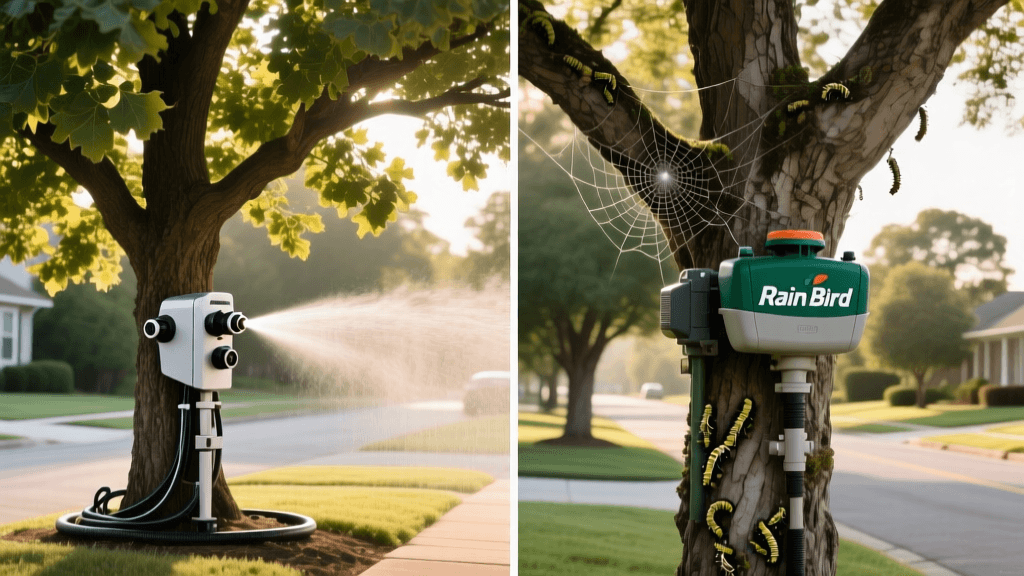
Hunter Pro Spray vs Rain Bird 1800 Webworm Control 2026
The 2026 Fall Webworm Threat and the Role of Irrigation
As we navigate the 2026 landscaping season, arborists and lawn care professionals are witnessing a significant shift in pest pressure. Due to shifting climate patterns and extended summer heatwaves, the fall webworm (Hyphantria cunea) is now completing three distinct generations in many USDA hardiness zones that previously only saw two. While these tent-building caterpillars are primarily a cosmetic nuisance to mature, healthy deciduous trees, they can cause fatal defoliation in drought-stressed saplings and ornamental species like pecans, walnuts, and sweetgums.
When discussing tree web worm control, most homeowners immediately think of chemical sprays or manual web removal. However, integrated pest management (IPM) relies heavily on maintaining optimal tree vigor and utilizing mechanical disruption. This is where your in-ground irrigation hardware becomes an unexpected but vital tool. Specifically, the choice between the industry-leading Hunter Pro Spray and Rain Bird 1800 series sprinkler bodies dictates how effectively you can hydrate the root zone to prevent drought stress, and how you can adapt nozzles to physically blast early-stage webs off lower canopy branches.
According to the University of Kentucky Entomology department, healthy trees can easily withstand a single defoliation event, but consecutive years of stress or severe drought during a webworm outbreak can lead to secondary pest invasions and tree mortality. Therefore, selecting the right irrigation components is a foundational step in your 2026 webworm defense strategy.
Why Sprinkler Bodies Matter for Pest Management
You might wonder how a pop-up sprinkler body relates to caterpillars in the trees above. The connection lies in two distinct IPM tactics: root-zone hydration and lower-canopy mechanical disruption.
First, a tree's ability to push out a second flush of leaves after a webworm defoliation event depends entirely on its water reserves and root health. Poorly performing spray heads that leak, clog, or fail to provide uniform distribution create dry spots that stress the tree. Second, in commercial nurseries and high-end residential landscapes, irrigation zones are sometimes adapted with specialized jet nozzles to physically knock down early instar webworm nests on the lower branches of young trees before the caterpillars can expand their silk tents.
Hunter Pro Spray: Reliability for Deep Root Hydration
The Hunter Pro Spray body has long been a staple for premium irrigation systems. In 2026, the Pro-Spray remains highly regarded for its robust wiper seal and heavy-duty spring, which prevent debris from clogging the riser—a common issue in landscaped tree beds where mulch and soil shift frequently.
For webworm management, the Pro-Spray's primary advantage is its compatibility with the MP Rotator nozzle line. While standard spray nozzles apply water too quickly for clay soils to absorb, the MP Rotator delivers water at a low precipitation rate. This allows for deep, slow soaking of the tree's critical root zone without causing runoff. A deeply watered tree in late July will have the carbohydrate reserves necessary to survive and recover from a sudden August webworm outbreak.
Furthermore, the Hunter Pro-Spray features an innovative co-molded wiper seal that ensures the riser retracts fully, keeping soil and mulch out of the internal mechanisms. This reliability means your automated IPM watering schedules will execute flawlessly, even in heavily mulched tree rings where webworm pupae often overwinter in the soil litter.
Rain Bird 1800: Precision and Upward Canopy Blasting
The Rain Bird 1800 series is the direct competitor to the Hunter Pro Spray and offers unique features that make it highly effective for the mechanical disruption aspect of webworm control. The 1800 series is famous for its heavy-duty stainless steel spring and optional SAM (Seal-A-Matic) check valve, which prevents low-head drainage and keeps the system pressurized.
When landscapers need to use an irrigation zone to physically blast early webworm nests out of the lower canopy of saplings or ornamental crabapples, they often turn to the Rain Bird 1800 equipped with a VAN (Variable Arc Nozzle). By adjusting the VAN to a very narrow, zero-degree stream and angling the nozzle slightly upward, the 1800 body can deliver a high-velocity jet of water. This mechanical force is often enough to tear the delicate silk tents of first-generation webworms, exposing the young larvae to predatory birds and parasitic wasps without the need for chemical interventions.
Additionally, the Rain Bird 1800's pressure-regulating stem (PRS) option ensures that even if your system's PSI fluctuates, the nozzle operates at an optimal 30 PSI. This prevents fogging and misting, which can inadvertently create the humid microclimates around the tree trunk that promote fungal diseases like anthracnose, which often attack trees already weakened by webworms.
Feature Comparison Chart: 2026 IPM Applications
| Feature | Hunter Pro Spray | Rain Bird 1800 Series |
|---|---|---|
| Primary IPM Use | Deep root hydration via MP Rotators to prevent drought stress. | High-velocity jet blasting via VAN nozzles for mechanical web disruption. |
| Seal Design | Co-molded wiper seal (excellent for mulched tree beds). | Heavy-duty wiper seal with optional SAM check valve. |
| Pressure Regulation | Available with Pro-Spray PRS (40 PSI). | Available with 1800-PRS (30 PSI or 45 PSI options). |
| Canopy Adaptability | Better for understory watering and Bt soil drenching prep. | Better for upward-angled mechanical web tearing on saplings. |
| 2026 Avg. Body Cost | $14.00 - $18.00 | $12.00 - $16.00 |
Integrated Pest Management: Combining Water and Biologicals
To maximize your tree web worm control in 2026, relying on irrigation hardware alone is not enough. You must combine the uniform water distribution provided by the Hunter Pro Spray or Rain Bird 1800 with targeted biological controls. The gold standard for caterpillar management is Bacillus thuringiensis var. kurstaki (Bt), a naturally occurring soil bacterium that is toxic only to caterpillars when ingested.
Step 1: Drought Prevention and Vigor Maintenance
From early spring through mid-summer, use your Hunter Pro-Spray bodies equipped with MP Rotators to deliver 1 to 1.5 inches of water per week to the tree's drip line. This ensures the tree is not experiencing the physiological stress that makes its foliage more attractive to egg-laying female moths. As noted in the Hunter Pro-Spray specifications, the uniform distribution of matched-precipitation rotators eliminates dry spots in the root zone.
Step 2: Mechanical Web Disruption
When the first generation of webs appears in late May or June (depending on your zone), inspect the lower branches of vulnerable trees. If you have Rain Bird 1800 bodies installed in the adjacent bed, swap the standard spray nozzle for a narrow-stream VAN nozzle. Run the zone manually for 3 to 5 minutes. The high-velocity water stream will physically shred the small, early-stage webs. This exposes the larvae to the elements and natural predators, drastically reducing the population before they can defoliate the branch.
Step 3: Biological Application Timing
If the webworm population is too high for mechanical disruption, you will need to apply a Bt spray. Crucial IPM Rule: Never apply Bt while your irrigation system is running or immediately before a scheduled watering cycle. Bt must be ingested by the caterpillar as it eats the treated leaf surface. If your Hunter or Rain Bird sprinklers wash the Bt off the foliage, the treatment is useless. Always schedule your irrigation zones to water the root zone early in the morning, and apply your Bt foliar spray in the late afternoon once the sprinkler heads have retracted and the lower canopy is dry.
Final Verdict for Landscapers and Arborists
When comparing the Rain Bird 1800 series and the Hunter Pro Spray for tree web worm control in 2026, the 'best' choice depends on your specific IPM strategy. If your primary goal is to maintain massive, mature shade trees through severe summer droughts so they can easily shrug off late-season defoliation, the Hunter Pro Spray paired with MP Rotators is the superior choice for deep, slow root-zone hydration.
However, if you are managing a nursery, a young orchard, or a landscape with vulnerable saplings where mechanical disruption of lower-canopy webs is a viable tactic, the Rain Bird 1800 with adjustable VAN nozzles offers the high-velocity precision required to tear apart early nests. By understanding the intersection of irrigation engineering and entomology, you can protect your trees from the expanding 2026 webworm threat without over-relying on harsh synthetic pesticides.