Tree Care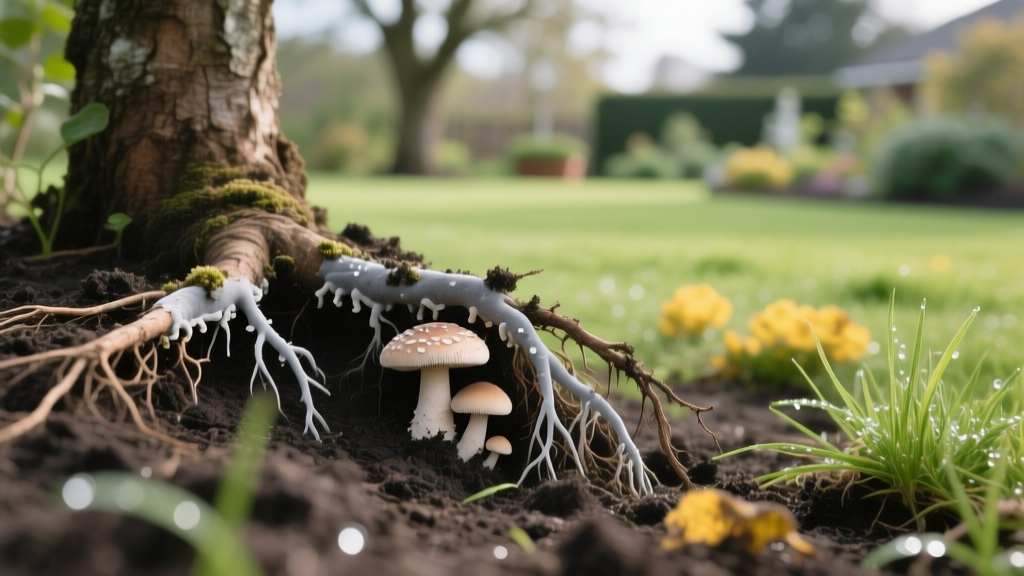
How to Identify and Treat Fungal Root Rot in Trees
Sarah ChenPublished
The Shared Root Zone: Where Lawn Care Meets Tree Health
When homeowners embark on lawn disease identification and treatment, their focus is almost exclusively on the turf. We scout for brown patch, dollar spot, or fairy ring, applying granular fungicides and adjusting irrigation to save the grass. However, this hyper-focus often leads to a critical blind spot: the shared root zone. Trees and turfgrass coexist in a complex, often competitive underground environment. The cultural practices used to maintain a pristine lawn—such as frequent shallow watering, heavy nitrogen fertilization, and soil compaction from mower traffic—can inadvertently create the perfect breeding ground for devastating tree root diseases.
While a turf fungicide like Scotts DiseaseEx (azoxystrobin) might clear up a fungal outbreak on your lawn, it does not penetrate deeply enough into the soil profile to protect the structural and feeder roots of mature trees. In fact, overwatering your lawn to combat summer drought stress is one of the leading triggers for water molds and fungal pathogens that attack tree root systems. To truly protect your landscape, you must understand how to identify and treat the two most destructive root diseases that bridge the gap between lawn care and tree health: Armillaria Root Rot and Phytophthora Root Rot.
Identifying the Culprits: Armillaria vs. Phytophthora
Before you can treat a declining tree, you must accurately identify the pathogen. Armillaria and Phytophthora require vastly different management strategies. Below is a comparison chart to help you differentiate between these two common landscape killers.
| Feature | Armillaria Root Rot (Oak Root Fungus) | Phytophthora Root Rot (Water Mold) |
|---|---|---|
| Pathogen Type | Basidiomycete Fungus | Oomycete (Water Mold) |
| Soil Moisture Preference | Tolerates moderate moisture; thrives in stressed trees | Requires saturated, poorly drained, waterlogged soils |
| Visible Signs on Tree | White mycelial fans under bark; honey-colored mushrooms at base in fall | Dark, cinnamon-colored cankers at root collar; bleeding sap |
| Impact on Surrounding Lawn | May cause localized turf decline due to fungal mats | Turf often suffers from simultaneous Pythium blight due to overwatering |
| Common Host Trees | Oaks, Pines, Maples, Fruit Trees | Yews, Arborvitae, Rhododendrons, Dogwoods |
Deep Dive: Armillaria Root Rot
Armillaria mellea, commonly known as oak root fungus, is a pervasive soil-borne pathogen. According to the Clemson University Home & Garden Information Center, this fungus typically attacks trees that are already stressed by drought, defoliation, or construction damage. The most definitive way to identify Armillaria is to carefully scrape away the bark at the base of the tree. If you see white, fan-shaped mycelial mats (mycelial fans) growing between the bark and the wood, and the wood smells distinctly like mushrooms, Armillaria is present. In the autumn, you may also see clusters of honey-colored mushrooms emerging from the soil near the tree's base or spreading into the adjacent lawn.
Deep Dive: Phytophthora Root Rot
Phytophthora is not a true fungus, but a water mold that thrives in saturated soils. The Penn State Extension notes that this pathogen is frequently introduced to landscapes through infected nursery stock or contaminated runoff. Homeowners who run their lawn irrigation systems for 20-30 minutes daily, keeping the soil perpetually soggy, are practically inviting Phytophthora. Symptoms above ground mimic drought stress—wilting, yellowing leaves, and branch dieback—which tricks homeowners into watering even more. Below ground, you will find dark, sunken cankers at the root collar that often exude a reddish-brown, foul-smelling sap.
Step-by-Step Field Diagnosis in the Root Collar
To properly diagnose root rot, you must inspect the root collar—the area where the trunk transitions into the roots. Follow these steps:
- Clear the Turf and Mulch: Carefully remove any grass, weeds, or mulch piled against the trunk. Avoid using string trimmers, which can wound the bark and invite infection.
- Excavate the Soil: Use a hand trowel or an air-spade to gently remove the top 2 to 4 inches of soil around the base of the tree until the lateral roots are exposed.
- Inspect the Bark: Look for the white mycelial fans of Armillaria or the dark, oozing cankers of Phytophthora.
- Test the Cambium: Use a sterile pocket knife to make a small scratch on an exposed root. Healthy tissue is crisp and greenish-white; infected tissue is brown, mushy, and easily sloughs off.
Treatment Protocols: Fungicides and Soil Drenches
Treating root rot requires a targeted approach that bypasses the turfgrass and delivers active ingredients directly to the tree's vascular system or deep root zone.
Phosphonates for Phytophthora
Because Phytophthora is a water mold, standard lawn fungicides are ineffective. You must use phosphonate-based fungicides, such as Agri-Fos or Alamo. These can be applied as a soil drench or via trunk injection. For a soil drench on a tree with a 12-inch trunk diameter, mix 1 to 2 fluid ounces of Agri-Fos per gallon of water, and apply 15 gallons of the solution evenly beneath the tree's drip line. Timing is critical: apply in early spring as leaves emerge, or in early fall when roots are actively growing. Avoid applying soil drenches during peak summer heat or when the soil is already saturated.
Managing Armillaria
Unfortunately, there is no chemical cure for Armillaria once it has colonized the structural roots. The Morton Arboretum emphasizes that management relies entirely on cultural controls and prolonging the tree's life through stress reduction. Fungicides will not save a tree heavily infected with Armillaria; instead, focus on improving soil drainage and reducing competition from the surrounding lawn.
Cultural Controls: Modifying Lawn and Tree Care
The most effective treatment for root rot is prevention through proper landscape management. Implement the following actionable steps to protect your trees while maintaining your lawn:
- Implement the 3-3-3 Mulch Rule: Keep mulch 3 inches deep, in a 3-foot radius (minimum) around the trunk, and leave a 3-inch gap between the mulch and the trunk bark. This prevents the root collar from staying damp, which suffocates roots and invites Phytophthora.
- Separate Irrigation Zones: Turfgrass requires frequent, shallow watering, while trees need infrequent, deep soaking. If your lawn sprinkler heads are spraying directly onto tree trunks, cap them or adjust the radius. Install deep-root watering probes for trees that deliver water 12 inches below the surface.
- Alleviate Soil Compaction: Lawn mower traffic and foot traffic compact the soil, destroying the macropores needed for oxygen exchange. Perform vertical mulching by drilling 2-inch wide holes, 12 to 18 inches deep, in a grid pattern under the tree's drip line, and backfill them with coarse sand or compost.
- Avoid High-Nitrogen Turf Fertilizers: Excessive nitrogen promotes rapid, weak, succulent tree growth that is highly susceptible to fungal invasion. Use slow-release, low-nitrogen fertilizers near the drip line of mature trees.
When to Call an Arborist and Cost Expectations
If your tree exhibits severe canopy dieback (more than 30% of the crown is dead), visible honey mushrooms, or structural leaning, it is time to call an ISA Certified Arborist. A professional can perform advanced diagnostics, such as sonic tomography, to assess the internal decay caused by Armillaria.
Expect to pay between $150 and $300 for a comprehensive tree health assessment and root collar excavation. If the tree is a viable candidate for chemical intervention, professional trunk injections of phosphonates typically cost between $15 and $25 per inch of Diameter at Breast Height (DBH). For a 20-inch oak tree, a single trunk injection treatment will cost roughly $300 to $500 and provides systemic protection for up to two years. If the tree is deemed a hazard due to advanced root decay, removal costs can range from $800 to $2,500 depending on the tree's size and proximity to your home. By understanding the intersection of lawn care and tree health, you can implement proactive strategies that keep both your turf and your canopy thriving for decades.
