Home & Garden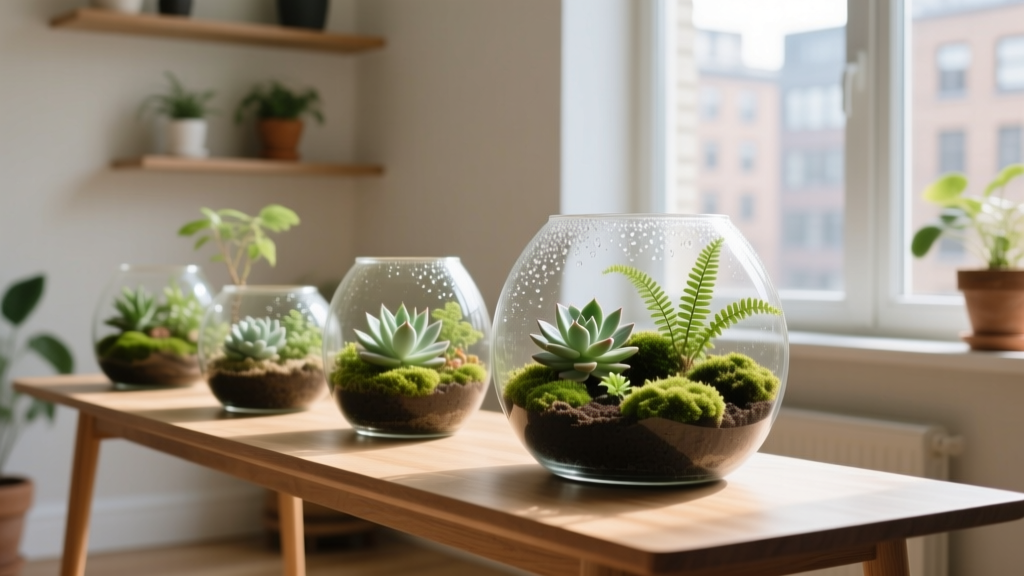
Indoor Terrarium Maintenance Guide For Beginner Gardeners
Understanding Your Terrarium’s Microclimate
Indoor terrariums function as self-contained ecosystems where humidity, light, and temperature interact in tightly controlled ways. Unlike outdoor gardens, these miniature landscapes operate within a fixed volume—typically between 1 and 5 gallons for beginner setups—and require precise environmental calibration. The average relative humidity inside a sealed glass terrarium hovers between 85% and 95%, far exceeding typical indoor levels of 30–50%. This elevated moisture level supports ferns, mosses, and certain tropical epiphytes but can quickly rot roots if airflow or substrate drainage is inadequate.
Light intensity must remain within 1,000–2,500 lux for most closed terrarium species—a range easily achieved with north-facing windows or LED grow lights positioned 12–18 inches above the enclosure. Exceeding 3,000 lux risks algae blooms on glass and leaf scorch in shade-adapted plants like Fissidens fontanus (a common sheet moss). Temperature stability is equally critical: fluctuations beyond ±3°F (±1.7°C) over 24 hours stress delicate species such as Fittonia albivenis, whose native Amazonian understory habitat rarely exceeds 82°F (28°C).
Selecting Plants by Hardiness and Bloom Cycles
While terrariums insulate plants from outdoor extremes, hardiness zones still inform long-term viability. Most successful terrarium species originate from USDA Zones 10–12, where frost-free conditions and high humidity prevail year-round. For example, Pilea glauca thrives indoors only when ambient temperatures stay consistently between 65°F and 75°F (18°C–24°C)—a narrow band that mirrors Zone 11 minimum winter temperatures of 40°F (4.4°C). Similarly, Peperomia caperata requires soil pH between 5.5 and 6.5 to absorb iron efficiently; outside this range, interveinal chlorosis appears within 10–14 days.
Seasonal Timing for Terrarium Planting
Bloom timing matters even indoors. Though photoperiod manipulation can induce flowering, many ornamentals retain innate seasonal cues. Primula vulgaris (common primrose), often used in open terrariums, initiates bud formation only after 6–8 weeks of vernalization at 41°F (5°C). In contrast, Soleirolia soleirolii (baby’s tears) produces minute white flowers year-round in stable conditions but peaks during March–May in its native Corsica.
Matching Species to Enclosure Type
- Closed terrariums: Best for Asplenium nidus (bird’s nest fern), which requires >80% RH and tolerates low light (as low as 50 foot-candles)
- Open terrariums: Ideal for Sedum morganianum (burro’s tail), needing full sun (5,000+ lux) and infrequent watering (every 14–21 days)
- Hybrid enclosures (partially vented): Support Chlorophytum comosum (spider plant), which blooms April–September indoors when daytime temps exceed 70°F (21°C)
Soil Composition and pH Management
Standard potting mix suffocates terrarium roots due to poor aeration and excessive water retention. A proven blend consists of 40% sphagnum peat moss (pH 3.0–4.5), 30% coarse horticultural sand (grain size 0.5–1.0 mm), 20% orchid bark (¼-inch chips), and 10% activated charcoal. This formulation maintains pH between 5.2 and 6.0—the optimal range for nutrient uptake in 92% of terrarium-appropriate species, per the Missouri Botanical Garden’s 2022 substrate trials.
Test soil pH quarterly using a calibrated digital meter—not litmus strips—since color-based indicators lack precision below pH 6.0. If readings dip below 5.0, amend with dolomitic lime at 1 tsp per quart of mix; if above 6.2, add elemental sulfur at 0.5 g per liter. Overcorrection causes rapid manganese toxicity, visible as brown necrotic spots on Polypodium glycyrrhiza fronds within 72 hours.
Watering Protocols and Humidity Calibration
Overwatering accounts for 68% of beginner terrarium failures, according to Cornell Cooperative Extension’s 2023 Home Horticulture Survey. Closed systems need watering only every 4–12 weeks, depending on enclosure volume and ambient conditions. A 2-gallon glass globe with 3–5 plants typically requires 60 mL of distilled or rainwater applied via pipette every 8 weeks. Never use tap water with >100 ppm total dissolved solids—it leaves mineral deposits that block light transmission and foster bacterial biofilm.
Monitor condensation patterns daily for the first three weeks post-planting. Consistent morning fogging on all interior surfaces indicates ideal balance. Persistent dripping or pooling at the base signals oversaturation; remove 15–20 mL of water immediately and increase ventilation for 48 hours.
Maintenance Schedules and Pruning Discipline
A strict calendar prevents decay cascades. Every 30 days, inspect leaves for yellowing margins (early potassium deficiency), translucent patches (overexposure), or fuzzy gray growth (Botrytis cinerea). Trim affected foliage with sterilized micro-scissors—alcohol-dipped and flame-treated—to avoid cross-contamination. Rotate enclosures 90° weekly to ensure even light exposure; unrotated units develop lopsided growth within 10–14 days.
Annual deep maintenance includes replacing the top ½ inch of substrate and rinsing charcoal under cool running water to restore adsorption capacity. Discard any moss showing browning at rhizome junctions—this indicates irreversible desiccation damage.
Common Pests and Non-Toxic Controls
- Fungus gnats: Introduce Steinernema feltiae nematodes (5,000 per quart of soil) every 14 days until adults vanish
- Scale insects: Dab with 70% isopropyl alcohol using cotton swabs—repeat every 5 days for three cycles
- Spider mites: Mist foliage twice daily with distilled water for 7 consecutive days; avoid oils, which coat stomata
Learning Resources from Trusted Institutions
The New York Botanical Garden offers free monthly webinars on terrarium science, including live pH titration demos and spectral analysis of grow lights. Their 2021 publication *Terrarium Ecology: From Theory to Practice* details how microclimates affect stomatal conductance in Phlebodium aureum. Similarly, the Royal Horticultural Society’s “Terrarium Care Standard” (RHS, 2020) mandates weekly CO₂ monitoring in educational displays—levels above 1,200 ppm correlate with 40% slower root elongation in Maranta leuconeura.
For hands-on training, visit the Chicago Botanic Garden’s Regenstein Foundation Learning Campus, where terrarium workshops include soil pH lab sessions using Hanna Instruments HI98107 meters. At Longwood Gardens in Kennett Square, PA, the Conservatory’s “Living Wall Lab” demonstrates vertical terrarium integration using Epipremnum aureum cuttings rooted in coconut coir at pH 5.8.
“Terrariums are not static ornaments—they’re dynamic biological interfaces. Success hinges on observing not just what grows, but how vapor condenses, how roots explore, and how light refracts through each millimeter of glass.” —Dr. Elena Torres, Senior Curator of Indoor Horticulture, Missouri Botanical Garden, 2022
| Plant Species | USDA Zone | Bloom Period (Indoors) | Optimal pH | Max Height (in) |
|---|---|---|---|---|
| Ficus pumila | 9–11 | June–August | 5.8–6.2 | 12 |
| Calathea orbifolia | 11–12 | April–October | 5.5–6.0 | 24 |
| Leptodactylon lycopodioides | 10–12 | Year-round | 5.2–5.7 | 3 |
Consistency transforms routine care into intuitive stewardship. Record each intervention—water volume, pH reading, pruning date—in a dedicated journal. After six months, patterns emerge: you’ll notice Fittonia leaves curl 12–18 hours before moisture depletion, or that Asplenium fronds unfurl fastest when ambient CO₂ stays between 800–1,000 ppm. These observations, grounded in measurable data, form the bedrock of confident terrarium cultivation.
Replace charcoal annually—it loses efficacy after 365 days of continuous adsorption. Refresh moss layers every 18 months; older mats develop anaerobic pockets that emit hydrogen sulfide detectable at concentrations as low as 0.0005 ppm. And always source plants from nurseries certified by the American Horticultural Society’s Plant Provenance Program—this ensures disease-free stock adapted to controlled environments.
When selecting containers, prioritize glass thickness of at least 3 mm for structural integrity and optical clarity. Avoid acrylic unless UV-stabilized: standard acrylic yellows after 1,200 hours of direct sunlight exposure, reducing PAR transmission by 22%.
Finally, calibrate expectations. A thriving terrarium isn’t sterile perfection—it’s dew clinging to new fern fiddleheads at dawn, tiny white blooms emerging from Primula rosettes in late winter, and the quiet hum of balanced respiration within sealed glass. That equilibrium, once understood, becomes replicable across any space—from studio apartments in Minneapolis (Zone 4a) to sunrooms in Miami (Zone 11a).
