Pest Control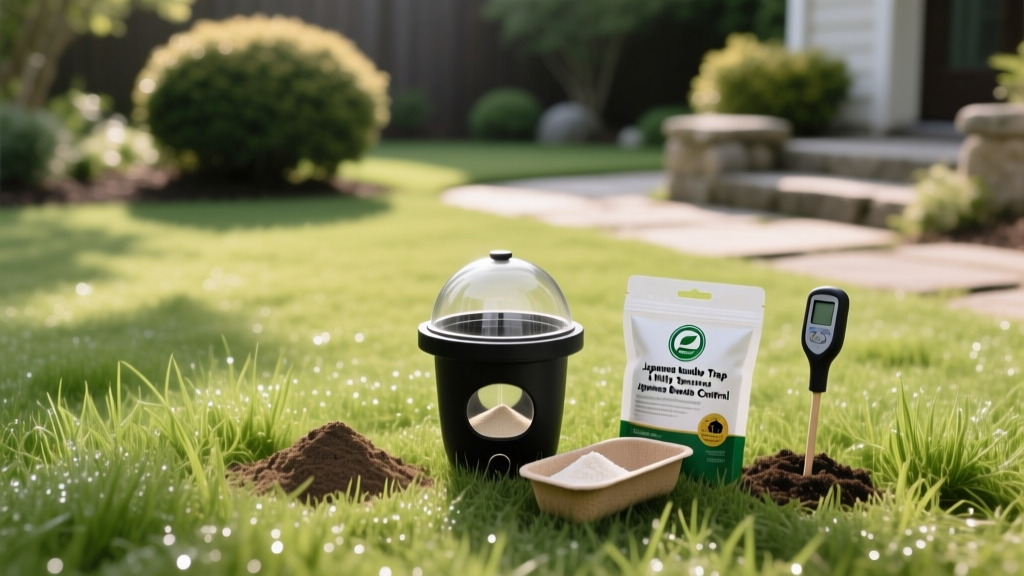
Milky Spore for Japanese Beetles: 2026 Application Guide
The 2026 Japanese Beetle Threat and the Fertilizer Connection
As we navigate the 2026 lawn care season, the Japanese beetle (Popillia japonica) remains one of the most destructive turf and ornamental pests across North America. While most homeowners focus exclusively on chemical sprays or manual removal, a highly effective, integrated approach requires looking beneath the soil surface and rethinking your lawn diet. The intersection of Japanese beetle trap placement, milky spore biological control, and strategic fertilizer scheduling is the cornerstone of modern Integrated Pest Management (IPM). In 2026, understanding how your fertilizer choices influence grub survival and adult beetle attraction is critical for maintaining a pristine landscape without relying on harsh synthetic pesticides.
The Japanese beetle operates on a one-year life cycle. Adults emerge in early summer to feed on foliage and mate, while females lay eggs in the soil. These eggs hatch into white grubs that feed on grassroots from late summer through fall, overwinter deep in the soil, and resume feeding in early spring before pupating. Many gardeners do not realize that the type and timing of lawn fertilizer directly impact both the survival rate of these grubs and the attractiveness of the surrounding foliage to adult beetles. By aligning your fertilizer schedule with biological controls like milky spore and strategic pheromone trapping, you can disrupt the beetle lifecycle at multiple vulnerable stages.
How Fertilizer Types Influence Japanese Beetle Populations
The most common mistake homeowners make is applying high-nitrogen, fast-release synthetic fertilizers (such as urea-based 46-0-0 blends) in late spring or early summer. This practice forces rapid, succulent top-growth just as adult Japanese beetles are emerging in June and July. Adult beetles are highly attuned to the volatile organic compounds (VOCs) emitted by rapidly growing, lush, and slightly stressed plant tissues. A lawn or garden pushed with synthetic nitrogen essentially becomes a beacon, drawing beetles from neighboring properties.
Furthermore, high-salt-index synthetic fertilizers can degrade the soil microbiome over time. A healthy, biologically active soil food web is essential for suppressing soil-borne pests naturally. In 2026, the leading turfgrass management strategy involves transitioning to slow-release, organic, or bio-stimulant-enhanced fertilizers. Products featuring feather meal, biochar, and mycorrhizal inoculants (typically with an N-P-K ratio around 5-2-0 or 8-2-4) provide a steady nutrient drip. This promotes deep, robust root systems rather than excessive top-growth. Deep roots can tolerate minor grub feeding far better than the shallow, weak root systems produced by synthetic fertilizers. More importantly, organic fertilizers foster the specific soil bacteria required to support long-term biological controls like milky spore.
Milky Spore Biological Control: The Long-Term Grub Killer
Milky spore disease is caused by the bacterium Paenibacillus popilliae, a naturally occurring soil organism that specifically targets and kills Japanese beetle grubs. When grubs ingest the spores while feeding on grassroots, the bacteria multiply inside their hemolymph, eventually killing the grub and releasing billions of new spores back into the soil. According to the University of Kentucky Entomology Department, milky spore can persist in the soil for 10 to 15 years, providing a self-sustaining, long-term defense once established.
However, milky spore is not a quick fix, nor is it compatible with all lawn care practices. The spores require soil temperatures above 65 degrees Fahrenheit and adequate soil moisture to be effective, as this is when grubs are actively feeding near the surface. Applying milky spore in the middle of a summer drought or during winter dormancy is a waste of resources. Additionally, because milky spore relies on a living soil ecosystem, the use of harsh synthetic fertilizers, broad-spectrum soil drenches, and chemical grub preventatives (like imidacloprid) can inadvertently suppress the bacterial spread. This is why pairing milky spore with an organic fertilizer schedule is the gold standard for 2026 IPM protocols.
Application Protocol for Milky Spore
Milky spore is typically sold in powder or granular forms. The granular formulations introduced in recent years are easier to apply using a standard broadcast spreader, while the traditional powder is applied using a grid pattern with a specialized dispenser or by hand. For optimal results, apply milky spore in late summer to early fall (late August through September) when grubs are young, small, and feeding aggressively. Water the lawn immediately after application to wash the spores into the root zone, and avoid aerating or dethatching the lawn for at least two weeks post-application to prevent disturbing the newly established bacterial colonies.
Strategic Japanese Beetle Trap Placement
Japanese beetle traps utilize a powerful dual-lure system: a floral scent (often a mix of eugenol and phenethyl propionate) to attract females seeking food, and a synthetic sex pheromone to attract males. While these traps are highly effective at capturing thousands of beetles, they are notoriously misunderstood. The most critical rule of trap placement is to never place them near your prized ornamentals, vegetable gardens, or favorite turf areas. The lures are so potent that they will attract beetles from a wide radius, and many of the incoming beetles will stop to feed on your plants before they ever reach the trap.
To use traps effectively as a perimeter defense, place them at least 30 to 50 feet away from the plants you are trying to protect, ideally downwind from your property. The goal is to intercept beetles migrating from neighboring areas or emerging from peripheral wild zones before they reach your core landscape. According to the USDA APHIS Japanese Beetle guidelines, mass trapping can reduce local populations if implemented on a community-wide scale, but individual property traps must be strategically isolated. Empty the trap collection bags every two to three days during peak emergence; the accumulation of dead beetles and the resulting ammonia scent can actually repel new arrivals, rendering the trap useless.
The 2026 Integrated Fertilizer and Pest Control Schedule
Integrating your fertilizer applications with milky spore and trap deployment requires a disciplined, month-by-month approach. Below is the recommended 2026 schedule for cool-season and transitional zone turfgrasses.
| Time of Year | Fertilizer Action | Milky Spore Action | Trap Deployment |
|---|---|---|---|
| Early Spring (April) | Apply slow-release organic fertilizer (e.g., 5-2-0 with biochar) to encourage deep root growth without excessive top-growth. | Monitor soil temps. Do not apply yet; grubs are pupating or deep in soil. | Keep traps in storage. Ensure lures are fresh and not expired. |
| Early Summer (June) | Avoid all nitrogen applications. Focus on foliar kelp or humic acid for drought and heat stress tolerance. | No application. Grubs are in the pupal stage, transitioning to adults. | Deploy traps 30-50 feet away from prized plants, downwind. Empty bags twice weekly. |
| Late Summer (August) | Prepare for fall feeding. Assess turf health. Apply compost tea to boost soil microbiome. | Apply Milky Spore granules via spreader. Water in immediately with 1/4 inch of irrigation. | Traps will catch late-emerging stragglers. Remove traps by late August to prevent catching beneficial insects. |
| Early Fall (September) | Apply primary fall organic fertilizer (higher potassium for winter hardiness and root storage). | Monitor soil moisture. Spores are actively infecting young, newly hatched grubs. | Traps should be stored, cleaned, and winterized. |
| Late Fall (November) | Final winterizer application if necessary, focusing on organic phosphorus and potassium. | Spores overwinter in the soil, waiting for the next generation of grubs. | N/A |
Sourcing and Cost Considerations for 2026
Budgeting for an integrated pest management program requires understanding current market prices. In 2026, high-quality milky spore granular treatments cost approximately 75 to 95 dollars per 10-pound bag, which is sufficient to treat roughly 2,500 square feet of turf. While the upfront cost is higher than a single application of synthetic chemical grub killers, the 10-year residual effect makes it vastly more economical over time. Premium organic fertilizers infused with soil microbes and biochar average 40 to 55 dollars per 40-pound bag, covering up to 5,000 square feet. Replacement dual-lure kits for beetle traps (which must be replaced annually as the pheromones degrade) run about 15 to 20 dollars per season.
By shifting your budget away from reactive, fast-acting synthetic chemicals and toward proactive soil-building organics and biological controls, you insulate your lawn from the cyclical outbreaks of Japanese beetles. The synergy between a robust, organically fed root system, a thriving soil microbiome that supports milky spore, and smartly placed perimeter traps creates an environment where Japanese beetles simply cannot gain a foothold. Implement this schedule consistently, and your landscape will naturally resist infestations year after year.