Lawn Care
2026 Mowing Heights: Kentucky Bluegrass vs Tall Fescue
Introduction to Cool-Season Grass Mowing in 2026
As we navigate the 2026 growing season, achieving a pristine, resilient lawn requires much more than simply pushing a mower in circles. For homeowners managing cool-season turf, understanding the distinct biological needs of your specific grass type is the foundation of elite lawn care. Two of the most popular cool-season grasses in North America are Kentucky bluegrass (KBG) and tall fescue (TF). While they often share the same geographic regions, their growth habits, stress tolerances, and optimal mowing heights differ significantly. Mowing at the incorrect height can lead to shallow root systems, increased weed pressure, and severe vulnerability to the increasingly erratic summer heatwaves we are experiencing in 2026. This comprehensive guide breaks down the exact mowing height settings, techniques, and patterns required to maximize the health and aesthetics of both Kentucky bluegrass and tall fescue.
The Core Differences: Kentucky Bluegrass vs. Tall Fescue
Before setting your mower deck, it is crucial to understand how these two grasses grow. Kentucky bluegrass is a rhizomatous grass, meaning it spreads via underground stems called rhizomes. This allows it to form a dense, carpet-like sod that recovers beautifully from damage and traffic. Because of its finer leaf blade and aggressive lateral growth, KBG can tolerate slightly lower mowing heights, which encourages it to tiller and thicken.
Conversely, tall fescue is a bunchgrass. It does not spread via rhizomes or stolons; instead, it grows in individual clumps or 'bunches' and expands primarily through vertical shoot growth and tillering at the base. Tall fescue features a much wider, coarser leaf blade and a deeper, more extensive root system. According to the NC State TurfFiles database, tall fescue's deep roots are its greatest asset for drought tolerance, but mowing it too short severely restricts its ability to maintain that vital root mass. As a general rule of turf agronomy, the taller you mow a bunchgrass, the deeper its roots will grow.
The Golden Rule: The One-Third Principle
Regardless of whether you are managing a Kentucky bluegrass sports field or a residential tall fescue lawn, the universally accepted 'One-Third Rule' remains the golden standard for 2026. You should never remove more than one-third of the total leaf blade in a single mowing session. If your target height for tall fescue is 3.5 inches, you must mow when the grass reaches approximately 5.25 inches. Removing more than one-third of the blade shocks the plant, halts root growth for up to two weeks, and exposes the lower, more sensitive parts of the stem to direct UV radiation, leading to a scorched, yellowish appearance.
Optimal Mowing Height Settings by Season
Adjusting your mowing height to match the seasonal growth cycles and environmental stressors is critical. The following table outlines the recommended mowing heights and frequencies for both grass types throughout the 2026 calendar year.
| Season | Kentucky Bluegrass Height | Tall Fescue Height | Expected Mowing Frequency |
|---|---|---|---|
| Early Spring | 2.0 - 2.5 inches | 3.0 - 3.5 inches | Every 4-5 days |
| Peak Spring | 2.5 inches | 3.5 inches | Every 3-4 days |
| Summer (Heat Stress) | 2.5 - 3.0 inches | 3.5 - 4.5 inches | Every 5-7 days |
| Early Fall | 2.5 inches | 3.5 inches | Every 4-5 days |
| Late Fall | 2.0 - 2.5 inches | 3.0 - 3.5 inches | Every 6-8 days |
Spring Management
In the spring, both grasses experience a massive flush of growth fueled by moderate temperatures and abundant rainfall. For Kentucky bluegrass, maintaining a height of 2.0 to 2.5 inches encourages lateral rhizome spread, helping to fill in any bare patches left by winter. For tall fescue, keeping it at 3.0 to 3.5 inches shades the soil early on, which is vital for preventing the germination of spring annual weeds like crabgrass.
Summer Survival Tactics
Summer is where mowing mistakes become fatal. As soil temperatures rise, cool-season grasses naturally want to go dormant. To combat the intense 2026 summer heat, you must raise your mower deck. The experts at NC State TurfFiles note that raising the mowing height of Kentucky bluegrass to 3.0 inches during July and August drastically reduces soil moisture evaporation and protects the crown of the plant. For tall fescue, pushing the height to 4.0 or even 4.5 inches during peak summer is highly recommended. The extra leaf surface area allows for maximum photosynthesis while shading the root zone, keeping the soil up to 10 degrees cooler than the ambient air temperature.
Mowing Patterns: Aesthetics Meet Agronomy
Mowing patterns are not just for the striped aesthetics of professional baseball fields; they serve a vital agronomic purpose. Continuously mowing in the same direction causes the grass blades to lean or 'grain' in one direction, leading to uneven cutting and increased soil compaction along the mower's wheel tracks.
Alternating Patterns for Soil Health
In 2026, the best practice is to alternate your mowing pattern every single session. Switch between horizontal, vertical, and diagonal patterns. This ensures that the grass blades are cut evenly from all angles and prevents the mower wheels from creating permanent ruts in the soil, which is especially important in the heavy clay soils where tall fescue is often planted.
Striping: KBG vs. Tall Fescue
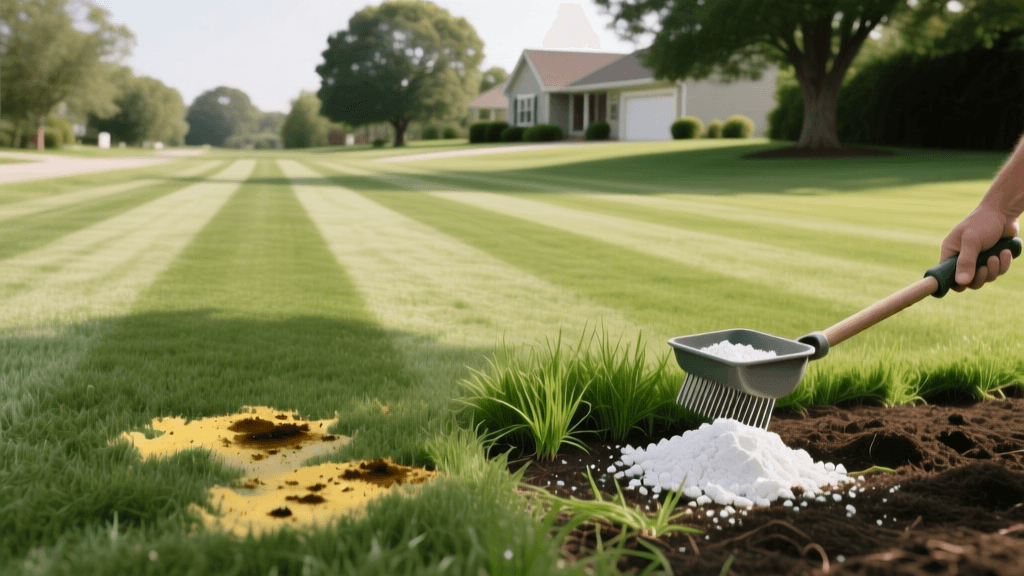
If your goal is to create dramatic, professional-looking stripes, Kentucky bluegrass is the clear winner. Its fine texture and high shoot density allow it to bend and reflect light beautifully when pushed down by a roller. To achieve this, use a mower equipped with a rear striping kit or pull a weighted lawn roller behind your tractor. Tall fescue, with its stiff, wide blades and bunch-type growth habit, is notoriously difficult to stripe. While a heavy roller can force the blades down temporarily, the stripes on a tall fescue lawn will typically fade within hours as the stiff blades spring back upright. For tall fescue, focus on the clean, uniform cut of alternating diagonal patterns rather than attempting high-contrast striping.
Equipment Calibration and Blade Selection
The height settings on your mower deck are only as accurate as your last calibration. In 2026, with the rise of advanced robotic mowers and precision zero-turns, ensuring your equipment is actually cutting at the stated height is vital. Park your mower on a flat, concrete surface, measure from the ground to the lowest point of the blade edge, and adjust all four corners equally to prevent a tilted deck that will scalp your lawn on one side.
Mulching vs. High-Lift Blades
For Kentucky bluegrass, mulching blades are highly recommended. Because KBG is mowed lower and more frequently, a mulching blade chops the fine clippings into tiny pieces that easily filter down to the soil surface, returning vital nitrogen and moisture to the root zone without smothering the dense turf. For tall fescue, especially when mowed at 4 inches during the summer, the volume of clippings is massive. If you attempt to mulch tall fescue when it is slightly damp or overgrown, you will leave thick, matted clumps that block sunlight and invite fungal diseases like brown patch. For tall fescue, a high-lift blade is often superior, as the powerful vacuum stands the tall, heavy blades upright for a clean cut and efficiently discharges the clippings out the side deck.
Robotic Mowers in 2026: A New Paradigm
The adoption of robotic mowers has surged by 2026, fundamentally changing how we approach mowing heights. Robotic mowers operate on a 'continuous micro-mulching' principle, cutting only a millimeter or two of grass every single day. For Kentucky bluegrass, setting a robotic mower to 2.5 inches provides a constant, manicured look and stimulates relentless lateral growth. However, tall fescue can struggle with the low, constant cutting of some entry-level robotic mowers. If you use an automated mower on a tall fescue lawn, ensure you select a 2026 model with a high-clearance deck and set the boundary height to at least 3.5 inches to prevent the bunchgrasses from being slowly scalped down to their crowns over time.
Common Mistakes to Avoid
- Scalping in Spring: Many homeowners mistakenly lower their deck to 1.5 inches in early spring to 'clean up' the lawn. This removes the photosynthetic factory of the plant right when it needs energy to push new roots. Never scalp cool-season grasses.
- Mowing Wet Grass: Tall fescue blades are heavy when wet and will bend under the mower wheels, resulting in a jagged, uneven cut that leaves the lawn vulnerable to pathogens.
- Ignoring Blade Sharpness: A dull mower blade tears the grass rather than slicing it. This leaves a frayed, white tip on the grass blade that rapidly loses moisture and turns brown, giving the entire lawn a diseased appearance. Sharpen your blades every 20-25 hours of use.
Conclusion
Mastering the mowing heights and techniques for Kentucky bluegrass and tall fescue is the most impactful cultural practice you can implement in 2026. By respecting the biological differences between these two grasses, adhering to the one-third rule, raising your deck during summer stress, and alternating your mowing patterns, you will cultivate a turf that is not only visually stunning but deeply rooted and resilient against environmental extremes. Treat your mower deck height not as a static setting, but as a dynamic tool that responds to the seasons, ensuring your lawn remains the envy of the neighborhood year after year.