Gardening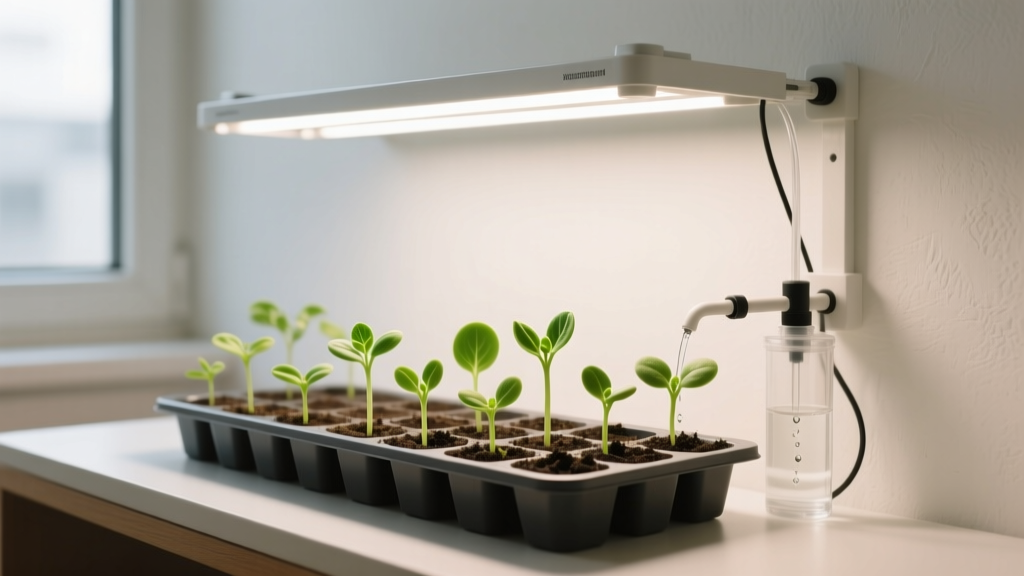
2026 Indoor Seed Starting: LED & Micro-Irrigation Schedules
James MillerPublished
Bridging the Gap: LED Light Schedules and Indoor Irrigation
As we move through the 2026 growing season, indoor seed starting has evolved from a hobbyist's windowsill experiment into a highly controlled, data-driven horticultural practice. While most gardeners obsess over the photon output and spectral tuning of their modern LED grow lights, the true secret to vigorous, disease-free seedlings lies in an often-overlooked discipline: micro-irrigation scheduling. When you are running high-intensity full-spectrum LED panels for 14 to 16 hours a day, your seedlings' transpiration rates skyrocket. Hand-watering with a watering can is no longer just inefficient; it is a liability that disrupts the microclimate, compacts delicate seed-starting mixes, and invites fungal pathogens.
From the perspective of sprinkler and irrigation systems engineering, an indoor seed tray is essentially a miniature agricultural zone. It requires precise water delivery, calculated flow rates, and automated timing that works in perfect harmony with your lighting schedule. In this comprehensive guide, we will explore how to design, install, and program an indoor micro-irrigation system that syncs flawlessly with your 2026 LED grow light schedule, ensuring your seeds germinate rapidly and your seedlings develop robust root systems before they ever see the outdoor sun.
The Physics of Transpiration Under Modern LEDs
To understand why your irrigation schedule must be tethered to your LED light schedule, we must look at plant physiology. When your LED grow lights power on, stomata on the leaves open to absorb carbon dioxide for photosynthesis. This process inevitably leads to transpiration—the loss of water vapor from the plant. In 2026, top-tier LED fixtures like the Spider Farmer SE5000 or Mars Hydro FC-4800 run cooler than older HPS (High-Pressure Sodium) bulbs, but they still drive significant ambient evaporation from the surface of your seed-starting soil.
If you water your seedlings during the "dark cycle" (when the LEDs are off), the stomata close, transpiration halts, and the soil remains saturated for hours. This prolonged surface moisture is the primary catalyst for Pythium and Rhizoctonia, the water molds responsible for damping-off disease. According to the UMass Amherst Extension, managing moisture levels and ensuring the soil surface dries slightly between watering events is the most critical cultural control for preventing damping-off in greenhouse and indoor environments. Therefore, your micro-irrigation system must only deliver water when the lights are on, and ideally, it should cease watering at least three hours before the lights power down to allow the soil surface to dry before nightfall.
Designing Your Indoor Micro-Irrigation Network
Adapting outdoor sprinkler and drip irrigation concepts for indoor seed trays requires a shift in scale. We are dealing with flow rates measured in fractions of a gallon per hour (GPH) rather than gallons per minute (GPM). Here are the core components you will need to build a 2026-compliant indoor micro-irrigation network:
- Reservoir and Submersible Pump: A 5-gallon opaque bucket serves as your water reservoir. A low-head submersible pump (around 100-200 GPH capacity) is sufficient to push water through 1/4-inch micro-tubing without blowing out the emitters.
- Pressure Regulator: Even small pumps can generate too much pressure for micro-drip emitters. A inline pressure reducer rated for 15-25 PSI ensures your button drippers do not pop off the tubing.
- 1/4-Inch Distribution Tubing: Flexible vinyl or polyurethane tubing that snakes across your shelving units, feeding individual seed trays.
- Micro-Emitters: For standard 1020 seed trays, use 0.5 GPH button drippers or adjustable micro-sprinklers. If you are using humidity domes, micro-misting nozzles can be mounted to the underside of the dome to maintain ambient humidity without waterlogging the soil.
- Capillary Wicking Mats (Sub-Irrigation Alternative): If overhead dripping is undesirable, sub-irrigation via capillary mats connected to a slow-drip reservoir line is highly effective. The mat draws water up into the bottom of the seed cells, encouraging roots to grow downward.
The Ultimate 2026 LED & Irrigation Sync Schedule
Syncing your water delivery to your light cycle requires a programmable dual-outlet smart timer or a smart home hub integration. Below is the ideal daily schedule for a standard 16-hour LED light cycle, optimized for vegetable and flower seedlings in a 70°F indoor environment.
| Time of Day | LED Light Status | Micro-Irrigation Action | Horticultural Rationale |
|---|---|---|---|
| 6:00 AM | Lights Turn ON | System Idle | Allows soil surface to warm up under LEDs before introducing cool water. |
| 7:00 AM | Lights ON (Hour 1) | Primary Drip Cycle (4 mins) | Delivers bulk moisture to the root zone as stomata open and transpiration begins. |
| 12:00 PM | Lights ON (Hour 6) | System Idle / Sensor Check | Smart moisture sensors verify soil tension; bypasses watering if soil is still adequately moist. |
| 4:00 PM | Lights ON (Hour 10) | Secondary Drip Cycle (2 mins) | Replenishes water lost to peak afternoon transpiration and LED ambient heat. |
| 7:00 PM | Lights ON (Hour 13) | Final Cut-Off / Flush | No water applied. Allows 3 hours for the top 1/4 inch of soil to dry out. |
| 10:00 PM | Lights Turn OFF | System Idle (Dark Cycle) | Prevents surface saturation and fungal growth during the dark respiration phase. |
Integrating Smart Sensors for Precision Watering
In 2026, relying purely on a blind timer is considered outdated. The most successful indoor growers integrate wireless soil moisture sensors into their micro-irrigation loops. Devices like the Ecowitt WH51 or specialized indoor greenhouse probes can be placed directly into a representative seed tray. These sensors connect via Wi-Fi or Zigbee to smart home platforms like Home Assistant or Apple HomeKit.
By setting an automation routine, you can dictate that the micro-irrigation pump will only activate during the scheduled "Primary Drip Cycle" window if the soil moisture tension drops below 35%. This prevents the most common mistake in indoor seed starting: overwatering. As noted by the Penn State Extension, maintaining consistent but not soggy moisture is paramount for seed germination and early root development. Overwatering displaces oxygen in the soil pore spaces, effectively suffocating the delicate new roots and leading to stunted, yellowing seedlings.
Overhead Micro-Sprinklers vs. Drip Emitters: Which is Best?
When designing your indoor irrigation layout, you must choose between overhead micro-sprinklers and targeted drip emitters. Both have distinct advantages depending on your seed starting methodology.
Overhead Micro-Misters and Sprinklers
Micro-misters suspended above the seed trays mimic natural rainfall and are excellent for the initial germination phase, especially for tiny seeds like lettuce, petunias, or snapdragons that require surface moisture and light to germinate. However, once the seedlings develop their first true leaves, overhead watering can splash soil-borne pathogens onto the foliage, increasing the risk of bacterial leaf spot or botrytis. If you use micro-sprinklers, ensure they are calibrated to deliver a fine mist rather than heavy droplets, and always pair them with an oscillating fan to ensure rapid foliage drying.
Targeted Button Drip Emitters
For larger seeds (tomatoes, peppers, squash) and the post-germination growing phase, 0.5 GPH button drippers placed directly at the base of each seedling are vastly superior. They deliver water exactly where the roots can access it, keeping the foliage and the soil surface completely dry. This targeted approach is the gold standard for commercial greenhouse operations and is easily replicated on a home shelving unit using standard 1/4-inch barbed connectors and spaghetti tubing.
Troubleshooting Your Indoor Irrigation System
Even the best-designed micro-irrigation systems require maintenance. Because indoor reservoirs are often filled with tap water or nutrient solutions, mineral buildup and biofilm can quickly clog micro-emitters. Here is a quick troubleshooting guide for the 2026 indoor grower:
- Uneven Watering Across Trays: This is almost always a pressure issue. Ensure your reservoir is elevated slightly or that your pump provides consistent pressure. Alternatively, install pressure-compensating (PC) emitters, which deliver the exact same GPH regardless of minor fluctuations in line pressure or tubing length.
- Clogged Drip Emitters: If you notice dry seed trays, check the emitters for calcium or iron buildup. Once a month, flush the reservoir and run a solution of 1 part white vinegar to 10 parts water through the system for 15 minutes, followed by a clean water flush. This dissolves mineral deposits without harming the vinyl tubing.
- Algae Growth in Tubing: Algae requires light to grow. If your clear vinyl tubing is exposed to the intense output of your LED grow lights, algae will bloom inside and restrict water flow. Always use opaque black polyurethane tubing for your main distribution lines, or cover clear tubing with reflective foil tape.
Conclusion: The Future of the Indoor Seedling
As we navigate the 2026 gardening season, the convergence of advanced LED lighting and precision micro-irrigation offers home gardeners unprecedented control over their seed starting success. By treating your indoor seed trays as a managed irrigation zone—calculating flow rates, respecting the transpiration cycle dictated by your LED schedule, and utilizing smart moisture sensors—you eliminate the guesswork that leads to damping-off and stunted growth. Investing a weekend into building an automated micro-drip network will pay dividends in the form of robust, deeply rooted seedlings that are primed to thrive the moment they are transplanted into your outdoor garden beds.
