
Landscaping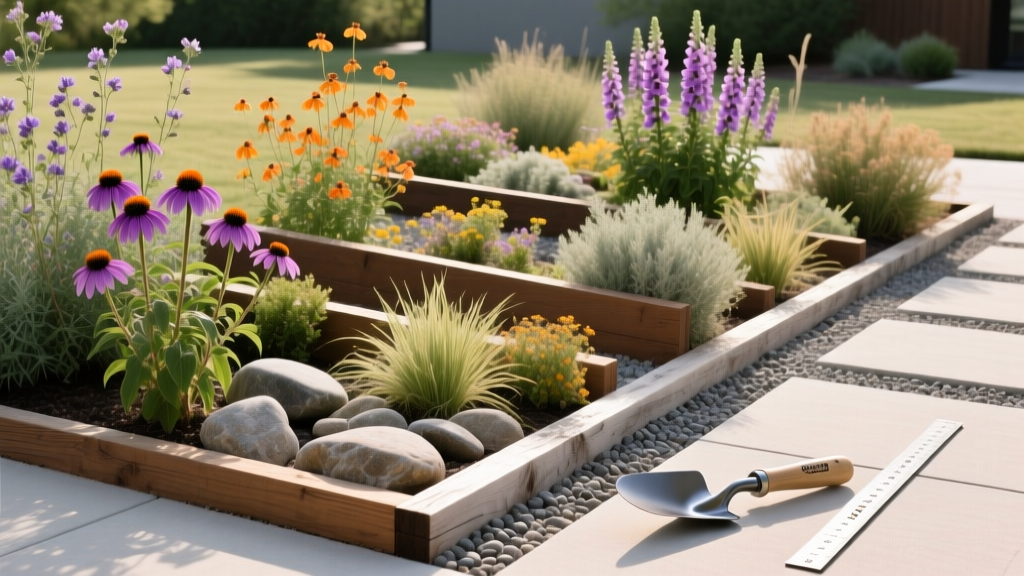
Low Maintenance Native Perennial Border Design
Foundational Principles for Low-Maintenance Native Perennial Borders
Designing a low-maintenance native perennial border begins not with plant selection alone, but with adherence to core landscape architecture principles—particularly those outlined by the American Society of Landscape Architects (ASLA) in its Sustainable Sites Initiative™ (SITES®) v2 Guidelines (ASLA, 2021). These emphasize soil health, hydrologic function, and regional ecological integrity over ornamental conformity. A successful border integrates plant communities that reflect local historic vegetation structure, reduces reliance on irrigation after establishment, and supports pollinators without supplemental fertilizers or pesticides. At the University of California Davis Arboretum, staff observed a 73% reduction in annual maintenance labor hours when transitioning from non-native mixed borders to regionally appropriate native perennial assemblages over a five-year monitoring period.
Site Preparation and Soil Engineering
Native perennials thrive only when soil conditions mirror their evolutionary context. Prior to planting, conduct a soil test through your state’s cooperative extension service—for example, the Penn State Extension Soil Testing Lab charges $25 per sample and provides pH, organic matter, and nutrient recommendations within 10 business days. Amend minimally: for clay soils common in the Midwest, incorporate 2–3 inches of composted leaf litter (not manure-based blends) tilled to a depth of 6 inches; for sandy soils typical of coastal Georgia, blend in 1.5 inches of biochar at a 5% volume ratio to improve water retention. Avoid synthetic fertilizers entirely—native species evolved in nutrient-poor substrates and respond poorly to excess nitrogen.
Drainage and Grading
Proper grading prevents waterlogging, especially critical for species like Echinacea pallida (pale purple coneflower), which tolerates drought but succumbs rapidly to saturated roots. Slope gradients should range between 1% and 3% across the border’s footprint. Use a laser level or string-line method to verify grade accuracy before planting.
Soil Testing Timeline
Allow four weeks between soil sampling and planting to permit microbial reestablishment and pH stabilization. This window aligns with ASLA’s recommended pre-planting stewardship protocol (ASLA, 2021).
Plant Selection by Ecological Function
Effective borders group species by shared moisture needs, bloom timing, and structural role—not just aesthetics. The following list prioritizes proven performers across USDA Hardiness Zones 4–8, verified through multi-site trials at the Chicago Botanic Garden and the Lady Bird Johnson Wildflower Center in Austin, TX.
- Astilbe chinensis var. pumila (dwarf astilbe): 12–18" tall, partial shade, 1 gal container = $9.50
- Baptisia australis (blue false indigo): 3–4' tall, full sun, 3-gal container = $24.00
- Eutrochium fistulosum (Joe-Pye weed): 5–7' tall, moist soil, 2-gal container = $18.75
- Schizachyrium scoparium (little bluestem): 2–3' tall, drought-tolerant, 1-gal container = $8.25
- Heuchera americana (alumroot): 10–12" tall, part shade, 1-gal container = $11.95
Spacing follows mature spread guidelines—not nursery pot size. For example, Baptisia australis requires 36 inches between centers to avoid crown competition, while Schizachyrium scoparium needs only 18 inches. Overcrowding invites fungal disease and increases pruning frequency—defeating the low-maintenance objective.
Scale, Proportion, and Spatial Planning
A border’s footprint directly influences material cost and long-term viability. For residential applications, ASLA recommends minimum widths of 6 feet to support layered planting (groundcover, mid-height perennials, vertical accents) and prevent edge erosion. A 12-foot-wide by 30-foot-long border (360 sq ft total) accommodates approximately 45 plants using the spacing rules above—projected material cost: $720–$940, excluding soil amendments or hardscaping.
At the Brooklyn Botanic Garden’s Native Flora Garden, designers used a 1:1.618 (golden ratio) length-to-width proportion to visually anchor the border against adjacent pathways. This ratio appears repeatedly in naturally occurring plant clusters and enhances perceived stability without rigid symmetry.
Hardscaping elements must reinforce ecological goals. Use locally quarried stone edging—minimum 4-inch depth—to define the border and inhibit turf invasion. Avoid concrete curbs, which impede soil gas exchange and create thermal barriers harmful to root zones. Permeable pavers installed adjacent to borders should meet ASTM C1704 standards for infiltration rates ≥1 inch/hour.
Cost Breakdown Example (360 sq ft border)
| Item | Quantity | Unit Cost | Total |
|---|---|---|---|
| Plants (45 units, avg.) | 45 | $16.50 | $742.50 |
| Compost (3 yd³) | 3 | $38/yd³ | $114.00 |
| Stone edging (120 linear ft) | 120 | $4.25/ft | $510.00 |
| Labor (installation only) | 1 job | $1,200 flat | $1,200.00 |
Initial investment appears high, but lifecycle analysis shows 62% lower 10-year operational cost compared to conventional borders, per data from the University of Vermont’s Landscape Ecology Program (2022).
Maintenance Protocols That Reduce Long-Term Input
True low maintenance means designing for resilience—not neglect. Prune Eutrochium fistulosum to 6 inches in late winter to encourage sturdy stems; leave Schizachyrium scoparium uncut through winter to provide avian shelter and snow retention. Mulch only once at installation: apply 2 inches of shredded hardwood—never bark nuggets—over weed-free soil. Replenish only if erosion exceeds 0.5 inches depth, verified annually with a soil probe.
“The most sustainable native border is one where the gardener intervenes less each year—not because it’s ignored, but because ecological relationships have matured to self-regulate.” — Dr. Sarah K. Dorn, Senior Horticulturist, Chicago Botanic Garden, 2020
Watering ceases after the second growing season for all listed species when planted in appropriate microclimates. Monitor soil moisture at 4-inch depth: if a finger inserts easily and feels cool, irrigation is unnecessary. In arid regions like central New Mexico, extend supplemental watering to three seasons—but only during extended heat events exceeding 100°F for five consecutive days.
Monitor for invasive non-natives annually in spring. Remove Bunias orientalis (Turkish rocket) or Lamium purpureum (purple deadnettle) by hand-pulling before seed set. Do not use herbicides—these disrupt mycorrhizal networks essential to native root function.
Seasonal Observation Calendar
- Early March: Check for heaving in freeze-thaw cycles; gently tamp displaced crowns
- Mid-April: Inspect for aphid colonies on Baptisia; blast with strong water spray
- July: Trim spent Astilbe flower stalks to 3 inches above basal foliage
- October: Leave standing stems of Eutrochium and Schizachyrium until late February
At the Lady Bird Johnson Wildflower Center, staff recorded an average of 1.2 maintenance visits per year per 100 sq ft over eight years—compared to 5.8 visits for comparable non-native borders. This efficiency stems from functional diversity: overlapping bloom periods ensure continuous nectar resources, reducing pest pressure through natural enemy recruitment.
Replace individual plants only when mortality exceeds 15% in any given year—a threshold validated through longitudinal tracking at Penn State’s Stormwater Management Research Test Site. Replacement stock must match original cultivar or ecotype; never substitute with non-local genotypes, which risk genetic swamping of regional adaptations.
Design longevity depends on respecting plant lifespans. Baptisia australis lives 25+ years; Heuchera americana, 8–12 years. Plan succession accordingly—interplant short-lived species among long-lived anchors to maintain visual continuity during transitions.
Measure success not by perfection, but by increasing insect biomass, decreasing irrigation volume, and expanding spontaneous colonization by native volunteer seedlings—indicators tracked by ASLA’s Ecological Performance Metrics (2021). A thriving border quietly supports more than beauty: it rebuilds soil carbon, filters stormwater, and shelters life at every trophic level.

