Gardening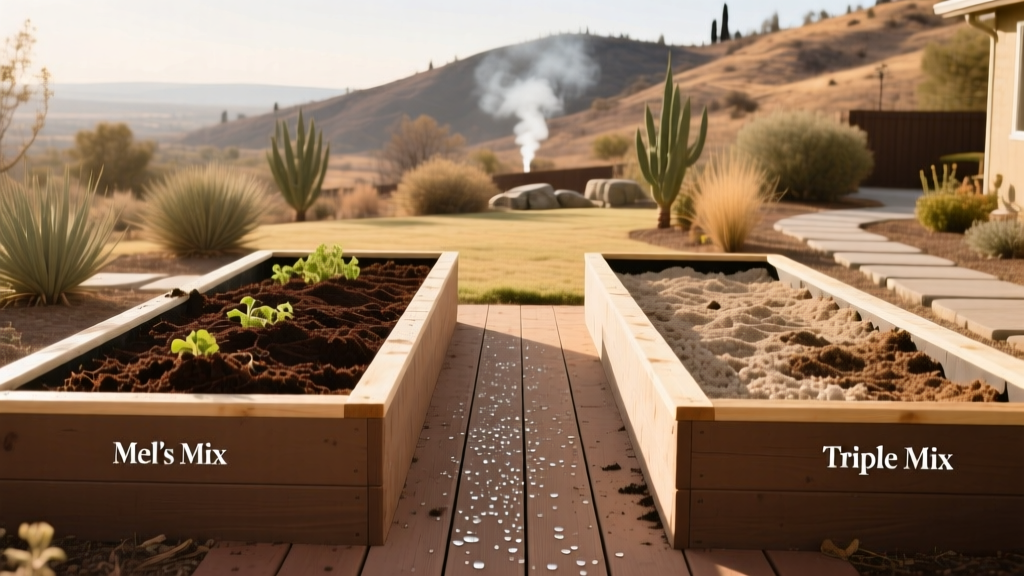
2026 Fire-Safe Raised Beds: Mel's Mix vs Triple Mix Soil
Lisa ThompsonPublished
The 2026 Wildfire Season: Rethinking Raised Bed Soil
As we navigate the 2026 gardening season, the reality of extended droughts and increasingly severe wildfire seasons has forced home gardeners to rethink their landscaping strategies. For those living in the Wildland-Urban Interface (WUI) or any fire-prone region, creating a defensible space around the home is no longer optional; it is a critical safety measure. Raised garden beds are a staple of modern home food production and floral gardening, but the soil inside them can inadvertently become a fuel source if not carefully formulated.
When designing fire-resistant landscaping, the focus often lands on plant selection and hardscaping. However, the soil medium itself plays a massive role in how your garden reacts to wind-blown embers. Two of the most popular raised bed soil recipes are Mel's Mix (the foundation of Square Foot Gardening) and the traditional Triple Mix. But which one is safer for your home during a fire event? In this comprehensive 2026 guide, we break down the combustion dynamics, moisture retention, and ember resistance of both soil recipes to help you build a beautiful, productive, and fire-resilient garden.
Understanding Fire Dynamics in Garden Soil
Before comparing specific recipes, it is vital to understand how soil interacts with fire. According to CAL FIRE's Defensible Space guidelines, the immediate zone (Zone 0) extending five feet from your home must be entirely non-combustible. Raised beds often fall into Zone 1 or Zone 2, where the goal is to reduce fuel loads and maintain high moisture levels.
Soil combustion is primarily driven by its organic matter content. Mineral components like sand, silt, clay, and expanded minerals do not burn. Organic components like peat moss, compost, and manure can smolder if they become bone-dry. Wind-blown embers from a distant wildfire can land in a raised bed; if the surface organic matter is dry and hydrophobic, the ember can ignite a slow smoldering fire that is difficult to detect and extinguish. Therefore, a fire-resistant soil mix must prioritize mineral density, deep moisture retention, and non-combustible surface barriers.
Analyzing Mel's Mix for Fire Resistance
Mel's Mix, popularized by Mel Bartholomew, is the gold standard for lightweight, high-yield raised bed gardening. The classic recipe consists of equal parts (by volume):
- 1/3 Compost: Provides nutrients and microbial life.
- 1/3 Peat Moss (or Coco Coir): Provides water retention and soil structure.
- 1/3 Coarse Vermiculite: Provides aeration, drainage, and moisture retention.
The Fire-Safe Pros of Mel's Mix
The standout ingredient in Mel's Mix from a fire-prevention perspective is vermiculite. Vermiculite is a naturally occurring mineral that expands when heated. It is entirely non-combustible and is actually used in commercial fireproofing materials and insulation. In a raised bed, vermiculite acts as a mineral heat sink and helps trap moisture within the soil profile. Furthermore, the high water-holding capacity of the mix means that, when properly irrigated, the bed can act as a moist firebreak.
The Fire Hazards of Mel's Mix
The primary vulnerability of Mel's Mix lies in the peat moss. When peat moss dries out completely, it becomes highly hydrophobic (water-repellent) and extremely flammable. Dry peat can ignite from a single ember and smolder underground for days, potentially spreading fire to nearby combustible structures or dry vegetation. While many gardeners in 2026 are swapping peat for coco coir due to environmental concerns, coco coir is still an organic fiber that can dry out and smolder if not kept consistently moist. Additionally, Mel's Mix is very lightweight and fluffy, meaning wind-blown embers can easily penetrate the surface layer and find pockets of dry organic matter.
Analyzing Triple Mix for Fire Resistance
Triple Mix is a more traditional, heavier soil blend commonly sold in bulk at landscape supply yards. While recipes vary slightly by region, the standard formulation is:
- 1/3 Topsoil: The mineral base (sand, silt, clay).
- 1/3 Peat Moss or Compost: For organic matter and moisture retention.
- 1/3 Well-Rotted Manure: For dense nitrogen and microbial activity.
The Fire-Safe Pros of Triple Mix
Topsoil is the ultimate fire-resistant ingredient. Because it is heavily mineral-based, it does not burn. The clay and silt particles in topsoil hold onto water tightly, creating a dense, moist matrix that is highly resistant to smoldering combustion. When an ember lands on a Triple Mix bed, the heavy, mineral-rich surface is far less likely to ignite than a fluffy peat-based mix. The density of the soil also prevents embers from penetrating deeply into the bed, keeping the threat on the surface where it can be easily managed or extinguished.
The Fire Hazards of Triple Mix
The main drawback of Triple Mix in a fire scenario is its tendency to compact and crack when subjected to the severe drought conditions common in 2026. Deep cracks in dry soil can expose deeper organic layers (like the manure and compost) to the air. If an ember falls into a deep shrinkage crack, it could ignite the subsurface organic matter. Furthermore, Triple Mix is incredibly heavy, making it less ideal for elevated raised beds or rooftop gardens, though its weight provides excellent stability against high winds that often accompany firestorms.
Head-to-Head Comparison: Mel's Mix vs. Triple Mix
To help you decide which mix is best for your defensible space, we have compiled a comparison chart based on 2026 landscaping standards and fire-safety metrics.
| Feature | Mel's Mix (Classic) | Triple Mix (Traditional) |
|---|---|---|
| Mineral Content | Low (33% Vermiculite) | High (33% Topsoil + minerals in compost) |
| Organic Fuel Load | High (66% Compost/Peat) | Moderate to High (66% Peat/Manure) |
| Ember Penetration Risk | High (Fluffy, porous structure) | Low (Dense, compact structure) |
| Moisture Retention | Excellent (but hydrophobic when dry) | Good (holds deep moisture via clay) |
| Smoldering Risk | High (if peat moss dries out) | Moderate (surface cracks can expose organics) |
| 2026 Bulk Cost Estimate | High ($$$) | Moderate ($$) |
| Best Defensible Zone | Zone 2 (Further from home) | Zone 1 (Closer to home, if mulched properly) |
The 2026 Fire-Safe Soil Modification Strategy
Neither Mel's Mix nor Triple Mix is perfectly fireproof straight out of the gate. To align with the National Fire Protection Association's Firewise principles, you must modify your raised bed soil and maintenance routines to maximize ember resistance.
1. Swap Peat for High-Quality Coco Coir
If you are building Mel's Mix, eliminate peat moss entirely. Peat's hydrophobic nature when dry makes it a severe fire hazard. Coco coir, while still organic, re-wets much faster and holds water more evenly, reducing the chance of hidden dry pockets that can harbor smoldering embers.
2. Incorporate Pumice or Perlite
To increase the mineral, non-combustible volume of your soil without adding the crushing weight of topsoil, substitute half of your vermiculite or compost volume with horticultural pumice. Pumice is a volcanic glass that is completely fireproof, improves drainage, and adds structural integrity to the soil, preventing the deep cracking seen in Triple Mix during droughts.
3. The Inorganic Mulch Cap (Crucial for 2026)
The most effective way to protect *any* raised bed soil from embers is to cap the surface. The University of California Agriculture and Natural Resources division strongly recommends avoiding combustible mulches like bark or wood chips in fire-prone zones. Instead, apply a 2-inch layer of inorganic mulch over your soil. Options include:
- Decomposed Granite (DG): Packs tightly and blocks embers from reaching the soil.
- River Rock or Pea Gravel: Excellent for heat dissipation and moisture trapping.
- Crushed Pumice: Lightweight, fireproof, and allows water to penetrate easily.
By placing a layer of landscape fabric or heavy cardboard beneath the gravel, you separate the mineral mulch from the organic soil below, creating a physical barrier against smoldering.
4. Sub-Surface Drip Irrigation
Overhead watering wets the surface but often fails to penetrate deep into the root zone, leaving subsurface organics dry and prone to smoldering. In 2026, install inline drip irrigation grids directly *under* your inorganic mulch layer. This keeps the entire soil profile consistently moist, drastically raising the ignition threshold of the compost and manure components, while conserving water in drought-restricted areas.
Conclusion: Which Mix Wins for Fire-Resistant Landscaping?
When strictly evaluating fire resistance and ember defense for the 2026 season, a modified Triple Mix edges out Mel's Mix due to its heavy mineral topsoil base. The density and clay content of topsoil naturally resist wind-blown embers and prevent deep smoldering. However, Mel's Mix remains superior for lightweight container gardening and elevated beds where structural weight limits are a concern.
Ultimately, the safest raised bed is not defined by the soil mix alone, but by how it is managed. Whether you choose the fluffy aeration of Mel's Mix or the dense mineral foundation of Triple Mix, capping your beds with inorganic gravel mulch and utilizing subsurface drip irrigation will transform your vegetable and flower gardens into a lush, productive, and highly effective component of your home's defensible space.
