Pest Control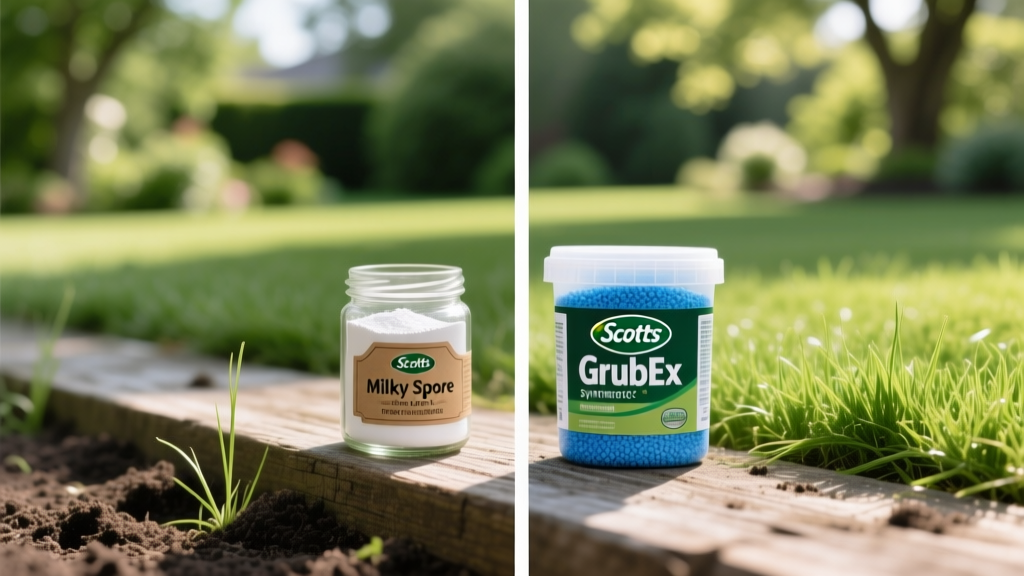
Milky Spore vs Scotts GrubEx: Which Grub Killer Wins?
Emily WatsonPublished
The Battle Against Lawn Grubs
White grubs are the larvae of various scarab beetles, and they pose one of the most significant threats to residential lawns. Feeding aggressively on grassroots just below the soil surface, these pests can turn a lush, green yard into a spongy, brown wasteland in a matter of weeks. When homeowners discover grub damage, the immediate instinct is to reach for a treatment. However, the pest control market is divided into two distinct camps: biological controls and synthetic preventatives. Two of the most popular products representing these camps are Milky Spore Powder and Scotts GrubEx. Choosing between an organic, long-term biological agent and a modern, synthetic chemical preventative requires a deep understanding of how each product works, its target pests, and its overall cost-effectiveness. In this comprehensive comparison, we break down Milky Spore versus Scotts GrubEx to help you decide which grub killer deserves a spot in your garden shed.
Contender 1: Milky Spore (The Biological Approach)
How Milky Spore Works
Milky Spore is a naturally occurring bacterium scientifically known as Paenibacillus popilliae (formerly Bacillus popilliae). It is a highly specialized biological control agent that targets only one specific pest: the Japanese beetle grub. When grubs ingest the spores while feeding on grassroots, the bacteria multiply rapidly inside the grub's hemolymph (blood), eventually killing the host. Upon death, the grub decomposes and releases billions of new spores back into the soil, creating a self-sustaining cycle of pest control. According to Penn State Extension, this biological amplification means that a single application can provide control for 10 to 15 years, provided the soil environment remains conducive to the bacteria's survival.
Application, Timing, and Cost
Milky Spore is typically sold in powder or granular form. The traditional powder requires a specific application pattern: one teaspoon of powder is applied every four feet in a grid pattern across the lawn. A 20-ounce box of Milky Spore powder treats approximately 7,000 square feet and costs around $60 to $70. While the upfront cost is significantly higher than synthetic alternatives, the multi-year longevity drastically reduces the long-term cost per square foot. For the spores to establish, the soil must be warm (ideally above 65°F), and the grubs must be actively feeding. Therefore, late summer to early fall is the optimal application window. After application, the area must be watered in thoroughly to push the spores down into the root zone where the grubs are feeding.
Contender 2: Scotts GrubEx (The Synthetic Preventative)
How Chlorantraniliprole Works
Scotts GrubEx utilizes the active ingredient Chlorantraniliprole, a synthetic chemical belonging to the anthranilic diamide class. Unlike older neonicotinoids that act on the insect's nervous system, Chlorantraniliprole targets the ryanodine receptors in the insect's muscle cells. This causes uncontrolled calcium release, leading to rapid muscle paralysis, feeding cessation, and eventual death. The Environmental Protection Agency (EPA) notes that Chlorantraniliprole is highly effective against a broad spectrum of turf-destroying caterpillars and beetle larvae. Crucially, GrubEx is a preventative, not a curative treatment. It must be ingested by young, early-instar grubs to be effective, meaning it stops the damage before it begins rather than killing mature grubs that are already destroying your lawn.
Application, Timing, and Cost
Scotts GrubEx is sold in granular form and is applied using a standard rotary or drop spreader. The application rate is straightforward: 2.87 pounds of product per 1,000 square feet. A standard 10,000-square-foot bag costs approximately $25 to $30, making it highly affordable on an annual basis. Timing is everything with GrubEx. Because it targets young grubs, it must be applied in the spring or early summer (typically between April and June, depending on your hardiness zone). The granules must be watered in with at least a quarter-inch of irrigation or rainfall within 24 hours of application to activate the chemical and move it into the soil profile. As the University of Minnesota Extension emphasizes, failing to water in preventative grub controls is the number one reason for product failure.
Head-to-Head Comparison Chart
To visualize the differences between these two popular grub control methods, review the structured comparison below:
| Feature | Milky Spore Powder | Scotts GrubEx (Chlorantraniliprole) |
|---|---|---|
| Active Ingredient | Paenibacillus popilliae (Bacteria) | Chlorantraniliprole (Synthetic) |
| Target Pests | Japanese Beetle Grubs ONLY | Japanese Beetles, June Bugs, European Chafers, Asiatic Garden Beetles |
| Speed of Control | Slow (1-3 years to reach peak efficacy) | Fast (Kills young grubs within days of ingestion) |
| Longevity | 10 to 15 years | 1 season (4-6 months of residual control) |
| Cost per 10,000 sq ft | ~$90 (Upfront) / ~$0 (Subsequent years) | ~$25 to $30 (Annually) |
| Application Window | Late Summer / Early Fall | Spring / Early Summer |
| Safety Profile | 100% safe for pets, humans, and pollinators | Low toxicity to mammals and bees; safe once watered in and dry |
Common Application Mistakes to Avoid
Whether you choose the organic route or the synthetic route, improper application will result in wasted money and continued lawn damage. Here are the most frequent errors homeowners make with both products:
- Using Milky Spore for the Wrong Pest: Milky Spore is entirely ineffective against June bug larvae, European chafers, and Asiatic garden beetles. If your lawn is suffering from a mixed grub population, Milky Spore will leave your turf vulnerable to the non-Japanese species.
- Applying GrubEx Too Late: Homeowners often notice brown patches in late August and rush to apply GrubEx. Because GrubEx is a preventative designed for early-instar grubs, applying it in late summer to fully grown, voracious grubs will yield virtually zero results. For late-summer curative treatment, a fast-acting contact insecticide like Trichlorfon (Dylox) is required instead.
- Skipping the Water-In Step: Both products require moisture to reach the soil surface where grubs feed. Leaving GrubEx granules on the surface of the lawn will result in UV degradation and chemical breakdown. Similarly, Milky Spore powder must be washed into the soil matrix; otherwise, it will simply blow away in the wind.
Environmental and Safety Considerations
For gardeners practicing Integrated Pest Management (IPM), environmental impact is a primary concern. Milky Spore is the undisputed champion of ecological safety. Because it is a host-specific bacterium, it poses absolutely zero threat to earthworms, beneficial nematodes, pollinators, pets, or humans. It is fully approved for use in certified organic agriculture and near sensitive waterways.
Scotts GrubEx, while synthetic, represents a massive leap forward in environmental safety compared to older grub control chemicals. Historically, homeowners relied on Imidacloprid and other neonicotinoids, which have been heavily linked to bee colony collapse and aquatic invertebrate toxicity. Chlorantraniliprole, the active ingredient in GrubEx, has a remarkably low toxicity profile for bees and mammals. Once the granules are watered into the soil and the grass blades are dry, the lawn is safe for children and pets to play on. However, it is still a synthetic pesticide, and care should be taken to prevent granular runoff into storm drains or koi ponds.
Which Product Should You Choose?
Choose Milky Spore If:
- You have confirmed that your grub problem is exclusively caused by Japanese Beetles.
- You are committed to a 100% organic lawn care regimen.
- You plan to stay in your current home for the next decade and want to invest in a long-term, self-sustaining biological solution.
- You have a severe aversion to applying synthetic chemicals around your family and pets.
Choose Scotts GrubEx If:
- You are dealing with a mixed population of grubs (e.g., June bugs and European chafers in addition to Japanese beetles).
- You need immediate, reliable protection for the current growing season.
- You prefer the predictable, lower upfront cost of an annual treatment.
- You are managing a large property where the initial $100+ investment for Milky Spore powder is cost-prohibitive.
Final Thoughts on Integrated Pest Management
Ultimately, the choice between Milky Spore and Scotts GrubEx comes down to your specific pest pressure, budget, and lawn care philosophy. For many homeowners, a hybrid approach works best: utilizing Scotts GrubEx for immediate, broad-spectrum protection while simultaneously inoculating the soil with Milky Spore to build long-term, organic resistance against Japanese beetles. Regardless of the product you select, proper lawn maintenance—including deep, infrequent watering and proper mowing heights—will encourage deep root growth, making your turf naturally more resilient to the inevitable stress of seasonal pest pressures.