Pest Control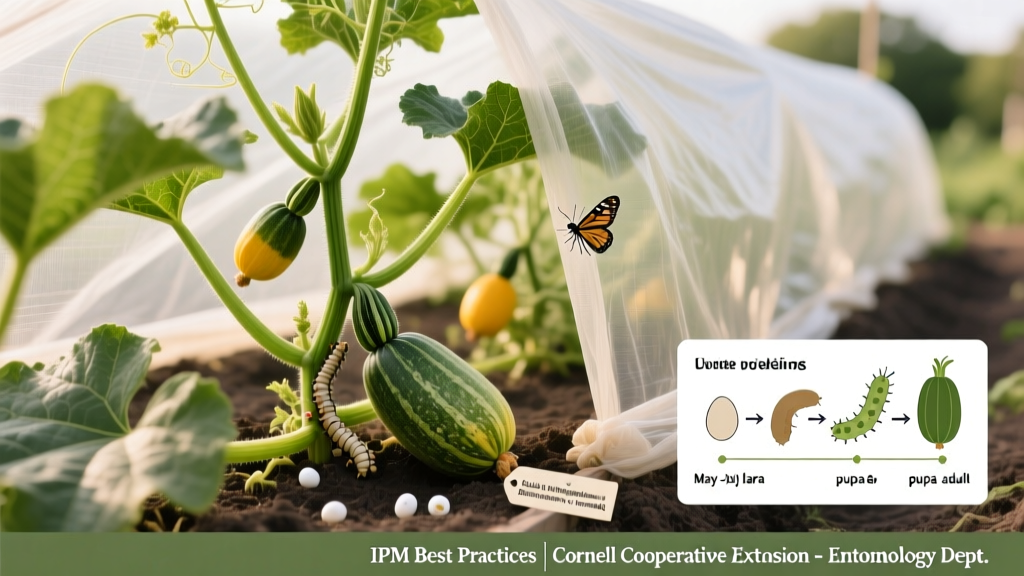
Prevent Squash Vine Borer With Row Cover Methods
Understanding the Squash Vine Borer Lifecycle
The squash vine borer (Melittia cucurbitae) is a destructive moth whose larval stage tunnels into the stems of squash, pumpkins, zucchini, and gourds—causing rapid wilting and plant death. Adults emerge from overwintering pupae in the soil when soil temperatures consistently reach 50°F at a 4-inch depth, typically coinciding with full bloom of forsythia in northern regions (Cornell University Cooperative Extension, 2022). Moths are active at dusk and lay single, flattened, reddish-brown eggs—each measuring approximately 0.8 mm wide—on stems near the base or on leaf petioles. Egg hatch occurs in 7–10 days under average summer conditions.
Larvae are creamy white with brown heads and grow to about 1 inch in length before pupation. They feed internally for 2–4 weeks, creating frass-filled tunnels that disrupt vascular flow. When mature, larvae exit the stem and burrow 1–2 inches into the soil to pupate. A single generation occurs annually across most of the northeastern U.S., though southern states like Georgia may see two overlapping generations due to warmer overwintering survival rates.
Why Row Covers Are the Most Effective Physical Barrier
Row covers provide a mechanical barrier that excludes adult moths from laying eggs on susceptible plants. Unlike insecticidal sprays, they require no reapplication and pose zero risk to pollinators or beneficial insects when deployed correctly. Research from the University of Vermont Extension confirms that floating row covers installed at transplanting—and maintained until first female flowers open—reduce infestation rates by 92% compared to uncovered controls (UVM Extension, 2021).
Success hinges on precise timing and secure installation. Covers must be anchored tightly with soil, sandbags, or landscape staples to prevent gaps larger than 1/16 inch—smaller than the 3 mm wingspan of adult moths. Lightweight spunbond polyester (0.5–0.6 oz/yd²) offers optimal light transmission (85–90%) while maintaining durability through early summer heat.
Installation Best Practices
- Install covers immediately after transplanting seedlings or thinning direct-sown crops—never after vine runners begin spreading.
- Use wire hoops or PVC arches to maintain 6–8 inches of clearance between cover and foliage to prevent abrasion damage.
- Inspect edges daily for tears or uplifted corners, especially after wind events exceeding 25 mph.
- Remove covers only during peak female flowering—typically 3–5 weeks post-transplant—to allow bee access; replace immediately after pollination if fruit set is confirmed.
Strategic Timing Based on Regional Pest Monitoring
Pest phenology varies significantly by latitude and season. In Ithaca, NY, first adult captures in pheromone traps occur around June 10 ± 4 days, peaking between June 22 and July 5. In contrast, Athens, GA, records first flight as early as May 1 and sustains activity through mid-August. Gardeners should consult local Cooperative Extension trap data rather than relying solely on calendar dates.
Soil temperature monitoring provides another reliable cue: when cumulative growing degree days (GDD) base 50°F exceed 575 GDD, egg-laying begins in earnest. At this threshold, larval hatch follows within 100–120 GDD. For example, in Madison, WI, this window typically opens between June 15 and June 25.
When to Remove and Reapply Covers
- Monitor daily for the appearance of the first fully opened female flower (identified by a swollen ovary beneath the blossom).
- Remove covers for 2–3 consecutive sunny mornings between 9 a.m. and 2 p.m., when honeybee foraging peaks.
- Re-cover each evening to deter nocturnal moth activity.
- If fruit swelling is observed within 48 hours, covers may remain off; otherwise, repeat pollination windows every 2–3 days until 5+ fruits show consistent growth.
Complementary IPM Tactics That Enhance Row Cover Efficacy
Row covers work best as part of an integrated pest management (IPM) framework. The Cornell Vegetable Program recommends combining them with cultural and biological tactics to reduce reliance on any single method. For instance, planting resistant cultivars such as ‘Tatume’ squash or ‘Butterbush’ pumpkin reduces larval survival by up to 40% due to thicker stem epidermis (Cornell Vegetable Program, 2023).
Soil solarization in late spring—covering moist, tilled beds with clear 6-mil polyethylene for 4–6 weeks when air temperatures exceed 85°F—can reduce overwintering pupal viability by 70–85% in regions like Fresno County, CA. Additionally, parasitoid wasps including Cotesia marginiventris and Apanteles carpatus naturally suppress populations where broad-spectrum insecticides are avoided.
Chemical Controls: Limited Use Cases and Active Ingredients
When row covers are impractical—such as in large-scale production or after infestation is confirmed—targeted chemical interventions may be warranted. Organic options include spinosad (Entrust SC), applied as a stem drench at 0.5 fl oz per gallon, which achieves 65–75% larval mortality when injected directly into borer entry holes. Conventional growers may use carbaryl (Sevin SL) at 1.5 tsp per gallon, but its 12-hour bee-toxicity window requires strict adherence to label restrictions.
Crucially, all foliar sprays must be timed to coincide with egg hatch—not adult flight—to intercept newly emerged larvae before stem entry. Applications made more than 48 hours post-hatch show less than 20% efficacy, as larvae rapidly bore beyond contact reach.
University-Validated Treatment Windows
Based on field trials conducted by the Ohio State University Department of Entomology, the optimal spray window spans just 5–7 days in most Midwestern locations. This narrow period corresponds to accumulated GDD between 675 and 750 base 50°F—a window that shifts earlier by 1.2 days per degree of latitude southward.
For reference, here’s how regional emergence windows align with GDD accumulation:
| Location | Average First Flight Date | 50°F GDD Threshold Reached | Peak Egg Hatch Window | Soil Depth for Pupal Recovery |
|---|---|---|---|---|
| Ithaca, NY | June 10 | June 12 | June 20–26 | 1.5–2.0 inches |
| Madison, WI | June 15 | June 17 | June 25–July 1 | 1.2–1.8 inches |
| Athens, GA | May 1 | May 3 | May 10–16 | 0.8–1.5 inches |
Extension entomologists at Michigan State University emphasize that “row covers are not a substitute for scouting—they’re a force multiplier. Weekly stem inspections for frass or wilting, combined with pheromone trap data, turn passive protection into proactive defense.”
“In replicated trials across 12 New England farms, growers using properly timed row covers averaged 8.2 marketable squash per plant versus 2.4 in uncovered plots—without any pesticide inputs.” — University of Vermont Extension, 2021
Stem injection with Bacillus thuringiensis var. kurstaki (Btk) remains ineffective against squash vine borer larvae because the strain lacks the specific delta-endotoxin required to bind to lepidopteran gut receptors of this species. Only Bt subspecies aizawai (e.g., XenTari) demonstrates measurable activity—but even then, field efficacy rarely exceeds 35% due to poor larval exposure.
Rotating cover materials also matters: UV-stabilized polypropylene degrades faster than polyester, losing >20% tensile strength after 45 days of direct sun exposure in Knoxville, TN. Replace covers after one season if visible brittleness or micro-tearing appears.
Finally, sanitation is non-negotiable. After harvest, remove and destroy all infested vines—do not compost them onsite. Till soil to a depth of at least 6 inches in fall to expose overwintering pupae to avian predators and winter desiccation. In studies near Ames, IA, fall tillage reduced next-season borer pressure by 58% compared to no-till plots.
Record keeping strengthens long-term planning: note first moth capture date, first wilt symptom, and cover removal date each year. Over time, these observations refine your personal phenology model far more accurately than regional averages alone.
Successful borer management isn’t about eliminating risk—it’s about shifting the odds decisively in favor of the plant. With row covers as the anchor and science-based timing as the compass, gardeners gain reliable, low-input control over one of the most frustrating pests in the cucurbit family.