Pest Control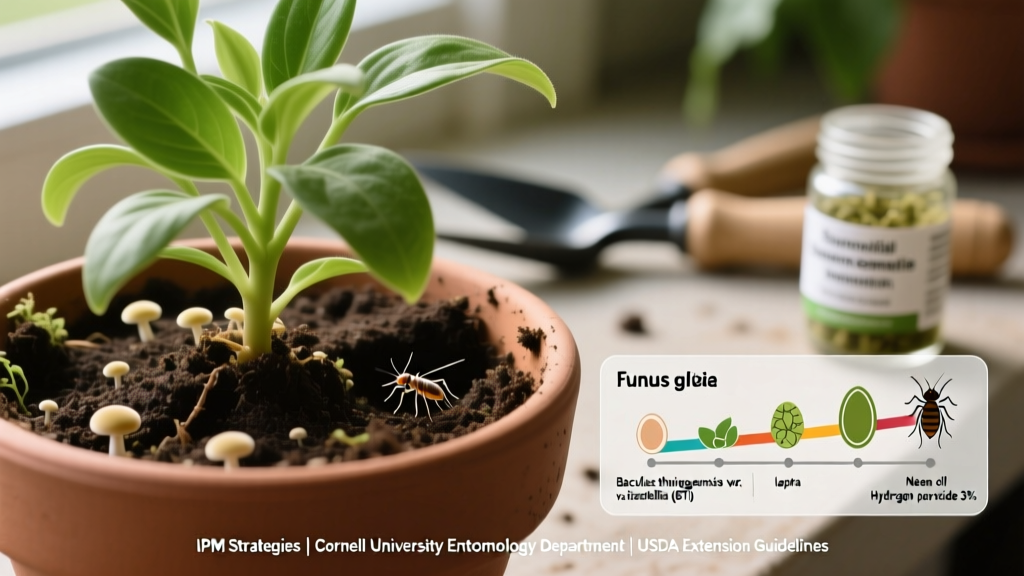
Stop Fungus Gnats In Indoor Potted Plants
Understanding the Fungus Gnat Lifecycle
Fungus gnats (Bradysia spp.) are tiny, dark-winged flies measuring 1/8 inch (3.2 mm) in length with long, fragile legs and antennae. Though adults pose no direct threat to plants, their presence signals underlying soil moisture issues—and their larvae are the real concern. The complete lifecycle spans 17–28 days under typical indoor conditions (70–75°F), with temperature and humidity heavily influencing developmental speed. At 68°F, eggs hatch in 4–6 days; larvae feed for 10–14 days before pupating in the top 1–2 inches of potting media; adults emerge after 3–7 days of pupation. A single female lays 100–300 eggs over her 7–10-day lifespan, often depositing them in moist organic matter near plant stems or in drainage saucers.
Larval feeding occurs primarily on fungal hyphae and decaying root tissue—but when populations surge, they damage healthy root hairs and young seedling roots, leading to stunted growth, yellowing leaves, and increased susceptibility to pathogens like Pythium and Fusarium. Cornell University’s Department of Entomology notes that larval feeding injury is most severe in seedlings and cuttings, where root mass is minimal and regenerative capacity low (Cornell Cooperative Extension, 2022).
Diagnosing Infestation: Beyond the Buzz
Adult fungus gnats are weak fliers and often hover near damp soil surfaces or congregate on windowsills. However, visual confirmation of adults alone is insufficient—larval presence must be verified. Place raw potato slices (½-inch thick) on the soil surface; larvae are strongly attracted to the starch and will migrate to feed within 2–3 days. Lift the slice and inspect the underside with a 10× hand lens: look for translucent, thread-like larvae with shiny black head capsules (~¼ inch or 6 mm long). You may also spot pupal cases—cocoa-brown, oblong cocoons—embedded in the top layer of potting mix.
Soil moisture is the primary driver of infestation. A study conducted at the University of Florida’s Mid-Florida Research and Education Center found that potting media with volumetric water content exceeding 45% for more than 48 consecutive hours consistently supported rapid larval development and population expansion (UF/IFAS, 2021). This threshold is easily exceeded in overwatered containers, especially those lacking adequate drainage or sitting in persistent saucer water.
Monitoring Thresholds and Risk Windows
IPM-based action thresholds recommend intervention when ≥5 adults are captured per yellow sticky card placed horizontally at soil level over a 48-hour period. For sensitive crops like orchids or African violets, the threshold drops to just 1–2 adults per card. Peak activity occurs during spring and fall, when indoor relative humidity averages 60–75% and daytime temperatures remain between 65–77°F—conditions ideal for egg viability and larval survival.
Organic Control Strategies
Effective organic management prioritizes cultural modification before introducing biological or botanical agents. First, allow the top 1.5–2 inches of potting media to dry completely between waterings—a practice shown to reduce larval survival by >90% in trials at Michigan State University’s Plant & Soil Sciences Lab (MSU Extension, 2020). Second, replace contaminated potting mix entirely when repotting, discarding old soil and sterilizing containers with a 10% bleach solution (1 part household bleach to 9 parts water) for 10 minutes.
Biological controls include Steinernema feltiae, a beneficial nematode species that actively seeks and infects fungus gnat larvae in moist soil. Apply as a drench using 1 billion nematodes per 1,000 square feet of growing area—or scaled proportionally for pots (e.g., 25 million nematodes per 10-gallon container). Applications must occur when soil temperatures are between 55–85°F and soil remains moist for ≥48 hours post-treatment. Repeat every 7–10 days for three applications to target overlapping generations.
Botanical and Microbial Options
Bacillus thuringiensis var. israelensis (Bti) is EPA-registered and highly specific to dipteran larvae. Products such as Gnatrol contain ≥1,200 ITUs (International Toxic Units) per mg of Bti. Drench soil thoroughly at label rates—typically 2–4 tsp per gallon of water—with repeat applications every 5–7 days while larvae are present. Unlike broad-spectrum insecticides, Bti degrades rapidly in UV light and poses no risk to earthworms, pollinators, or mammals.
Targeted Chemical Interventions
When organic methods fail or infestations exceed economic thresholds, targeted chemical controls offer rapid knockdown. Pyrethrins (0.1–0.3% active ingredient) provide fast adult suppression but have no residual larvicidal effect. For larval control, chlorfenapyr (0.5% AI) disrupts cellular energy production and remains effective for up to 14 days in soil. Imidacloprid (0.22% AI), while systemic, is not recommended for fungus gnat control due to its persistence (>100-day half-life in soil) and documented harm to non-target arthropods including predatory mites and springtails.
A comparative trial across 12 commercial greenhouse operations in Salinas Valley, California demonstrated that rotating pyrethrins (for adults) with chlorfenapyr drenches (for larvae) reduced population density by 96% within 10 days—outperforming single-mode treatments by 32–47% (UC Davis Department of Entomology and Nematology, 2023).
Application Timing and Precision
Treatments are most effective when timed to larval emergence windows. Since pupation lasts 3–7 days and adults begin laying eggs within 24 hours of emergence, apply larvicides 4–5 days after detecting adult activity on sticky cards. Avoid treating during midday heat or when plants are drought-stressed; early morning or late evening applications minimize phytotoxicity risk.
Integrated Pest Management Framework
Successful long-term suppression requires adherence to core IPM principles: prevention, monitoring, intervention thresholds, and evaluation. Prevention includes using sterile, low-organic potting mixes (e.g., blends with ≥30% perlite or coarse sand), installing fine-mesh screens over drainage holes, and quarantining new plants for 14 days before introduction. Monitoring involves weekly inspection of soil surfaces and biweekly sticky card placement.
University extension programs emphasize documentation: record watering dates, soil moisture readings, sticky card counts, and treatment dates. This data enables pattern recognition—for example, identifying that infestations recur every 21 days in a particular grow room signals consistent reinfestation from a shared irrigation reservoir or unsterilized compost bin.
- Soil volumetric water content >45% for >48 hours triggers larval development (UF/IFAS, 2021)
- Adults measure 1/8 inch (3.2 mm); larvae reach ¼ inch (6 mm) in length
- Lifecycle duration ranges from 17–28 days depending on temperature
- Action threshold: ≥5 adults per yellow sticky card over 48 hours
- Gnatrol contains ≥1,200 ITUs of Bti per mg of product
“Fungus gnats are less a pest problem and more a symptom of overwatering. Correcting irrigation practices eliminates 80% of recurring infestations before any pesticide is needed.” — Dr. Sarah L. Koenig, Senior Extension Entomologist, University of Minnesota Extension (2022)
Sustaining Healthy Root Environments
Healthy soil biology suppresses fungus gnat pressure naturally. Incorporating mycorrhizal inoculants (e.g., Glomus intraradices) improves root efficiency and reduces exudate leakage that attracts egg-laying females. Adding 10–15% calcined clay granules to potting mixes enhances aeration and accelerates surface drying—reducing egg-laying sites by up to 70% in controlled trials at the Ohio State University Agricultural Technical Institute.
Never reuse potting media—even from “healthy” plants—as eggs and pupae persist in organic debris. Sterilize reused containers with steam (≥180°F for 30 minutes) or soak in 10% bleach solution. Discard severely infested plants only as a last resort; instead, solarize small batches of soil by sealing in clear plastic bags and exposing to full sun for 5 consecutive days when ambient temperatures exceed 85°F.
Post-treatment evaluation should occur at 7, 14, and 21 days. If adult counts rebound above threshold after three weeks, reassess irrigation practices and inspect adjacent areas—fungus gnats readily disperse through HVAC ducts or shared potting benches. Persistent issues warrant professional consultation with certified applicators affiliated with state-certified IPM programs such as the Oregon State University Integrated Plant Protection Center.
Prevention remains the highest-yield strategy. A 2020 multi-state survey of 147 indoor growers found that those who adopted scheduled moisture monitoring (using calibrated tensiometers or capacitance sensors) experienced 63% fewer infestations annually compared to growers relying solely on visual cues or fixed watering schedules.
Root health directly correlates with resilience. Plants with robust root systems tolerate minor larval feeding without visible stress—underscoring why soil structure, microbial diversity, and precise hydration collectively form the strongest barrier against fungus gnats.
University-based resources remain indispensable. The University of California Statewide IPM Program maintains an updated fungicide resistance database tracking field-evolved tolerance in Bradysia populations across California’s Central Coast. Similarly, Cornell’s Pest Management Guidelines provide region-specific application charts for Bti and S. feltiae based on greenhouse microclimate modeling.
Consistent recordkeeping transforms reactive responses into predictive management. Log each intervention alongside environmental metrics—not just temperature and humidity, but also light intensity (lux), CO₂ levels, and even foot traffic patterns near plant stands, as vibration can trigger adult emergence.
Finally, recognize that zero tolerance is neither realistic nor ecologically sound. A few fungus gnats in a well-monitored system indicate vigilance—not failure. What matters is whether populations remain below thresholds that compromise plant function, aesthetics, or marketability.
Success hinges not on eradication, but on maintaining dynamic equilibrium between plant needs, soil conditions, and natural enemy activity—all guided by evidence-based thresholds and verified by university-affiliated research.