Lawn Care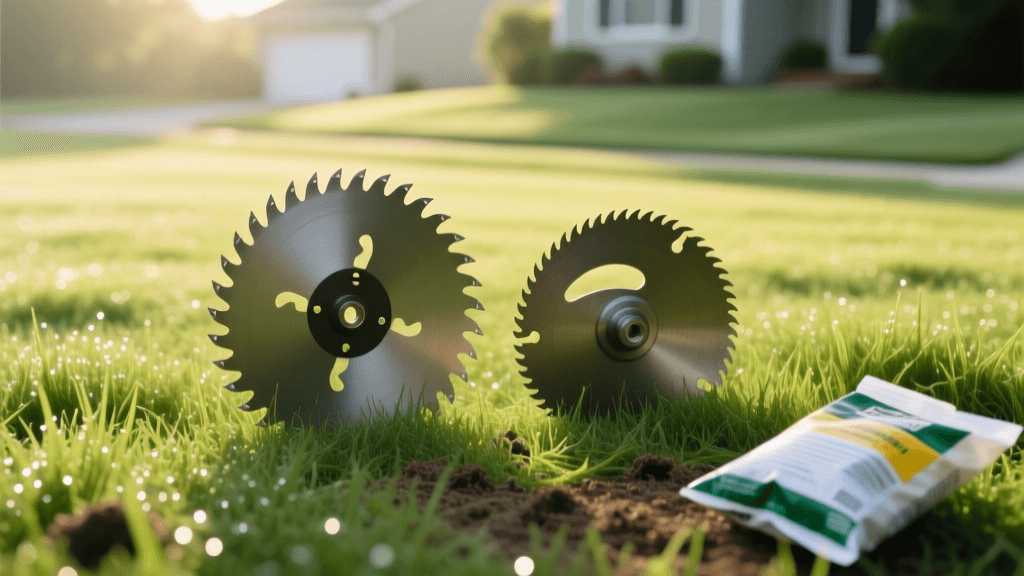
Mulching vs High-Lift Blades: 2026 Fertilizer Schedules
The Hidden Link Between Mower Blades and Fertilizer Schedules
Welcome to the 2026 lawn care season. As environmental regulations regarding synthetic runoff tighten and fertilizer prices continue to fluctuate, maximizing nutrient efficiency has never been more critical for homeowners. While most lawn care enthusiasts obsess over soil tests, irrigation schedules, and the latest slow-release nitrogen products, one of the most impactful variables in your lawn's nutritional health is hiding right under your mower deck: the blade.
The choice between a mulching mower blade and a high-lift blade fundamentally alters how nutrients cycle through your turf ecosystem. In 2026, understanding this mechanical distinction is the key to optimizing your fertilizer types, adjusting your seasonal application schedules, and ultimately saving money while promoting a greener, denser lawn. This comprehensive guide breaks down the agronomic impact of your mower blade choice and provides actionable fertilizer schedules tailored to your mowing strategy.
Mulching Blades: Nature's Slow-Release Fertilizer
Mulching blades, often referred to as 3-in-1 blades, are engineered with a distinct curved design and additional cutting edges along the blade's surface. This geometry creates a localized vortex under the mower deck, suspending grass clippings in the air so they can be sliced multiple times before falling back onto the soil surface.
When executed correctly, this process—known as grasscycling—returns vital organic matter and nutrients directly to the turf. According to the University of Minnesota Extension Lawn Care program, grass clippings are approximately 80% water and contain valuable macronutrients, including roughly 4% nitrogen, 2% potassium, and 1% phosphorus by dry weight. By leaving these finely chopped clippings on the lawn, you are essentially applying a continuous, slow-release organic fertilizer.
Impact on 2026 Fertilizer Needs
Because mulching returns up to 25% of your lawn's annual nitrogen requirements back to the soil, homeowners utilizing mulching blades can significantly reduce their synthetic fertilizer applications. In 2026, this translates to a reduction of one full fertilizer application per year for most cool-season and warm-season turfgrasses, saving the average homeowner between $45 and $80 per season on a 5,000-square-foot lawn.
High-Lift Blades: Bagging, Discharging, and Nutrient Depletion
High-lift blades feature a straighter cutting edge with a pronounced, aggressive upward fin at the rear. This design maximizes airflow and suction, lifting the grass blade upright before cutting it and forcefully ejecting it out of the side chute or into a bagger attachment.
High-lift blades are the undisputed champions of lawn striping, making them a favorite for homeowners who prioritize that pristine, manicured baseball-field aesthetic. They are also essential for mowing wet, overgrown grass or for managing lawns prone to fungal diseases where removing excess thatch and clippings is a necessary preventative measure.
The Nutrient Export Deficit
The trade-off for perfect stripes and a clean lawn surface is nutrient export. Every time you bag and dispose of your grass clippings, you are physically removing the nitrogen, phosphorus, and potassium that your turf extracted from the soil. As noted by Purdue University Turfgrass Science, continuous removal of clippings without compensatory fertilization will lead to rapid soil nutrient depletion, resulting in chlorosis (yellowing), thinning turf, and increased vulnerability to weeds like crabgrass and dandelions.
2026 Fertilizer Schedule Comparison: Mulching vs. High-Lift
To maintain optimal turf health in 2026, your fertilizer schedule must adapt to your mowing methodology. Below is a comparative schedule for a standard cool-season lawn (e.g., Kentucky Bluegrass or Tall Fescue) based on blade type. Application rates are measured in pounds of actual Nitrogen (N) per 1,000 square feet.
| Season | Mulching Blade Schedule (N per 1k sq ft) | High-Lift Blade Schedule (N per 1k sq ft) | Key Differences & Product Recommendations |
|---|---|---|---|
| Early Spring (April) | 0.5 lbs N (Slow-Release) | 1.0 lbs N (Balanced NPK) | Mulching lawns need only a light push. High-lift lawns require a full synthetic or heavy organic dose to replace lost winter reserves. |
| Early Summer (June) | Skip or 0.25 lbs N | 0.75 lbs N (Slow-Release) | Mulching clippings peak in spring/early summer, providing ample natural nitrogen. High-lift lawns need synthetic slow-release to survive heat. |
| Late Summer (August) | 0.5 lbs N (Organic) | 1.0 lbs N (Synthetic) | High-lift lawns require aggressive recovery feeding. Mulching lawns benefit from organic fertilizers like Milorganite to stimulate soil microbes. |
| Late Fall (November) | 1.0 lbs N (Fast-Release) | 1.25 lbs N (Fast-Release) | Winterizer application. High-lift lawns need maximum carbohydrate storage since they lack the organic matter buffer provided by mulched clippings. |
Choosing the Right Fertilizer Type for Your Blade Strategy
The type of fertilizer you purchase in 2026 should synergize with your mower blade's behavior. The interaction between soil biology, synthetic chemicals, and decomposing organic matter is complex, but mastering it yields incredible results.
For Mulching Blade Users: Lean Organic
When you mulch, you are feeding the soil microbiome. Earthworms, fungi, and bacteria break down the clippings, making nutrients bioavailable to the grass roots. To enhance this biological engine, pair your mulching strategy with organic or bio-stimulant fertilizers. Products containing humic acid, kelp, or feather meal (such as Jonathan Green Organic Lawn Food) work in perfect harmony with grasscycling. The microbes process both the clippings and the organic fertilizer simultaneously, creating a rich, loamy topsoil layer that retains moisture and resists compaction.
For High-Lift Blade Users: Strategic Synthetics
Because high-lift blades remove the organic matter that feeds soil microbes, the soil biology can become sluggish. To bridge the nutrient gap quickly and efficiently, high-lift users should rely on high-quality synthetic fertilizers with coated, slow-release nitrogen technologies (like Scotts Turf Builder or Lesco Professional). These products provide a guaranteed, predictable nutrient release that doesn't rely on microbial activity, ensuring your turf gets the exact N-P-K ratio it needs despite the physical removal of clippings.
Environmental Impact and Yard Waste in 2026
Beyond the agronomic benefits, your blade choice has significant environmental implications. The Environmental Protection Agency (EPA) consistently highlights that yard trimmings account for millions of tons of municipal solid waste annually. By switching to a mulching blade, you eliminate the need for paper lawn bags, reduce the fuel consumed by municipal collection trucks, and keep valuable biomass out of landfills where it would otherwise generate methane gas. In 2026, many municipalities are actively incentivizing grasscycling through rebates on mulching mowers or compost bins, making the mulching route both ecologically and economically superior.
Critical Maintenance: The Dull Blade Caveat
Neither fertilizer schedule nor blade type will save your lawn if your equipment is poorly maintained. A dull mulching blade will not create a fine mulch; instead, it will tear and shred the grass tips, leaving them jagged and susceptible to moisture loss and fungal pathogens like Dollar Spot and Brown Patch. A dull high-lift blade will fail to generate the necessary suction, resulting in an uneven cut and missed patches.
2026 Sharpening Schedule:
- Spring: Sharpen or replace blades before the first mow.
- Mid-Summer: Inspect blades after 25 hours of use. If you hit irrigation heads or rocks, replace immediately.
- Fall: Sharpen before the final leaf-mulching passes to ensure leaves are pulverized into dime-sized pieces that won't smother the turf.
Final Verdict: Which Strategy Wins?
There is no universally 'correct' blade; there is only the correct blade for your specific lawn care goals. If your priority in 2026 is reducing chemical inputs, lowering your fertilizer budget, improving soil structure, and minimizing environmental waste, the mulching blade is the undisputed champion. It acts as a continuous, free organic fertilizer that simplifies your seasonal schedule.
However, if you are managing a premium landscape where aesthetic perfection, deep lawn stripes, and aggressive disease prevention are your top priorities, the high-lift blade is mandatory. Just remember that this aesthetic choice comes with a nutritional tax: you must commit to a more robust, slightly more expensive synthetic fertilizer schedule to replace the nutrients you are hauling away in the bagger. By aligning your mower's mechanics with your fertilizer strategy, you can achieve a flawless, vibrant lawn all year long.