Pest Control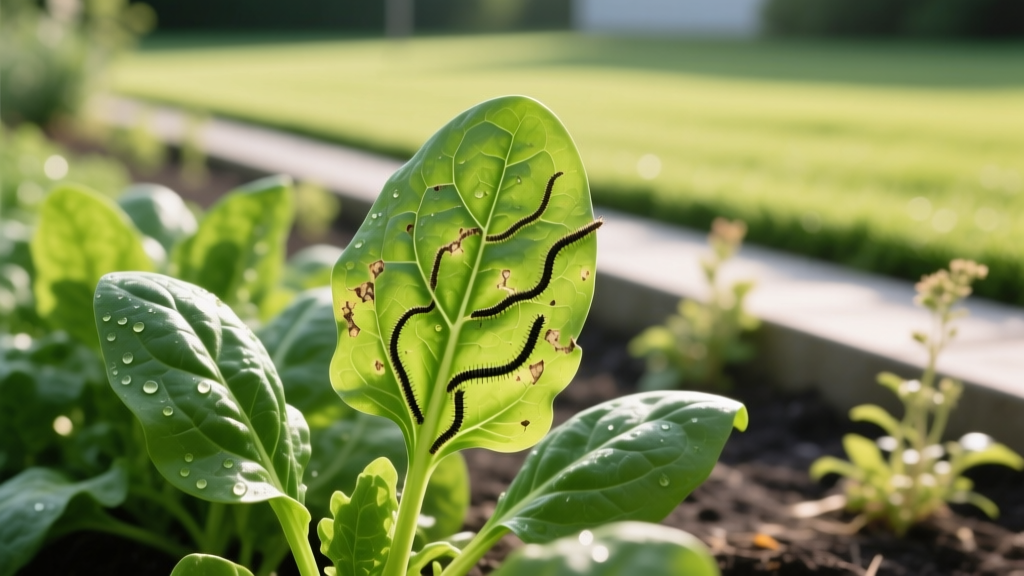
Natural Control Methods For Leaf Miners In Spinach
Understanding the Leaf Miner Lifecycle in Spinach Crops
Leaf miners affecting spinach are primarily the larvae of *Liriomyza langei* and *Liriomyza trifolii*, two polyphagous agromyzid flies native to North America. These pests complete development from egg to adult in as little as 14 days under optimal greenhouse conditions (25°C and 60–70% relative humidity), but field development slows to 21–28 days in cooler spring and fall spinach-growing windows. Adult females live 10–14 days and lay an average of 200 eggs over their lifespan—most deposited singly on the undersides of young, expanding spinach leaves. Eggs hatch in 2–4 days, and newly emerged larvae immediately burrow into the leaf mesophyll, creating serpentine mines that widen progressively as the larva feeds and grows. Larval development lasts 7–10 days before pupation occurs either within the mine or after dropping to the soil surface. Pupae remain viable for up to 3 weeks in dry soil but are highly susceptible to desiccation when soil moisture drops below 15% volumetric water content.
Identifying Early Infestation Signs
Early detection is critical because damage becomes irreversible once larvae enter the leaf tissue. Initial signs include translucent, linear trails on the upper leaf surface—often first visible on the youngest fully expanded leaves. Mines begin as narrow (0.3–0.5 mm wide), pale green lines and widen to 1.5–2.0 mm as the third-instar larva matures. Unlike mechanical injury or nutrient deficiency, these mines contain frass (larval excrement) visible as dark granules along the central axis of the trail. In high-pressure situations, a single leaf may host 5–12 distinct mines, reducing photosynthetic capacity by up to 40% (University of California Integrated Pest Management Program, 2022). Growers should inspect at least 20 randomly selected plants per acre twice weekly during peak risk periods: April–June and September–October in coastal California, and May–July in the Midwest.
Field Scouting Protocol
Use a 10× hand lens to confirm presence of living larvae (pearly white, legless, with anterior mouth hooks) inside mines. Record the percentage of infested leaves and number of mines per leaf. Thresholds vary by market: fresh-market spinach triggers intervention at ≥10% infested leaves; processing spinach allows ≤15% before action is required.
Biological Control Agents with Proven Efficacy
Natural enemies play a pivotal role in suppressing leaf miner populations, especially when conserved through habitat management. The parasitoid wasp *Diglyphus isaea* is the most widely deployed biological control agent against *Liriomyza* spp. Females locate leaf mines using vibrational cues and oviposit directly into host larvae; parasitism rates of 60–80% have been documented in greenhouse spinach trials at Cornell University’s Long Island Horticultural Research & Extension Center. A second effective parasitoid, *Chrysocharis parksi*, exhibits strong cold tolerance and achieves >50% field parasitism in early-spring plantings near Salinas Valley, CA. Both species require consistent releases—typically 0.5–1.0 wasps per square meter weekly for four consecutive weeks—to establish breeding populations.
Conservation Strategies for Beneficial Insects
- Maintain flowering insectary strips with alyssum (*Lobularia maritima*) and buckwheat (*Fagopyrum esculentum*) within 10 meters of spinach beds to provide nectar for adult parasitoids
- Avoid broad-spectrum insecticides such as carbaryl and permethrin, which reduce *D. isaea* survival by 92% within 72 hours of application (Michigan State University Extension, 2021)
- Retain unsprayed refuge zones covering ≥5% of total field area to support overwintering parasitoid populations
Cultural and Physical Control Tactics
Spinach growers in the Imperial Valley, CA, reduced leaf miner incidence by 68% over three seasons using double-layered floating row covers (0.6-oz/yd² spunbonded polypropylene) installed at seeding and maintained until harvest. Covers physically exclude adult flies while permitting light transmission (>85%) and rain penetration. Crucially, covers must be sealed at all edges with soil or sandbags—gaps larger than 2 mm allow entry of gravid females. Crop rotation remains essential: avoid planting spinach or related hosts (beets, chard, lettuce) within 1,000 meters for at least 12 weeks to disrupt the pest’s reproductive cycle. Sanitation is equally vital—remove and solarize (cover with clear plastic for ≥6 weeks at soil temperatures >35°C) infested crop residue within 48 hours of harvest to prevent pupal emergence.
Organic-Rated Active Ingredients and Application Timing
When biological and cultural methods prove insufficient, organically certified products offer targeted intervention. Spinosad (derived from *Saccharopolyspora spinosa*) demonstrates strong larvicidal activity when applied during peak egg hatch. Field trials at the University of Vermont’s Borderview Research Farm showed 72% reduction in mine density when spinosad (Entrust® SC, 0.25 oz/100 gal) was sprayed at 50% egg hatch—confirmed via daily leaf inspection—and repeated after 5 days. Azadirachtin (from neem seed extract) acts as an antifeedant and growth regulator; applications at 0.5% v/v every 4 days suppressed adult emergence by 63% in replicated greenhouse studies. Importantly, both materials degrade rapidly under UV light (half-life <18 hours on leaf surfaces), necessitating evening applications and reapplication after rainfall exceeding 0.25 inches.
Application Best Practices
- Begin scouting 5 days after spinach emergence to detect first eggs
- Time first spray when ≥30% of observed eggs show blackened eyes (indicating imminent hatch)
- Use fine-mist nozzles (e.g., XR8002VS) delivering 30–50 gallons per acre for full underside coverage
- Rotate modes of action between spinosad (IRAC Group 5) and azadirachtin (IRAC Group unassigned) to delay resistance
IPM Integration and Monitoring Frameworks
Successful long-term suppression requires embedding leaf miner management into a broader Integrated Pest Management (IPM) framework. The UC IPM Pest Management Guidelines for Spinach recommend a tiered decision matrix incorporating economic thresholds, pest phenology models, and real-time weather data. For example, degree-day accumulations above the lower developmental threshold of 10°C predict adult emergence peaks: 280 DD post-planting signals first flight in Central Coast fields, while 420 DD indicates peak oviposition. Growers in Oregon’s Willamette Valley use this model alongside weekly sticky card counts—yellow cards placed at canopy height capture ≥85% of flying adults, with action triggered at ≥12 flies per card per week.
“The key isn’t eliminating every leaf miner—it’s keeping populations below the level where cosmetic damage compromises marketability or physiological stress reduces yield. That threshold shifts with variety, season, and buyer requirements.” — Dr. Elizabeth R. Grafton-Cardwell, UC Riverside Entomology Department, 2023
| Control Method | Application Frequency | Efficacy Range (%) | Pre-Harvest Interval (days) | Soil Half-Life (days) |
|---|---|---|---|---|
| Spinosad (Entrust® SC) | Every 5–7 days | 65–78 | 4 | 12–15 |
| Azadirachtin (Aza-Direct®) | Every 4–5 days | 52–63 | 0 | 1–3 |
| Row cover (0.6-oz) | Single installation | 68–82 | N/A | N/A |
Monitoring must extend beyond visual inspection. Soil sampling at harvest reveals pupal density—fields averaging >30 pupae per 100 cm² of soil surface warrant fall sanitation interventions. Additionally, sentinel plants—small plots of early-sown spinach planted 10 days ahead of main crops—serve as early-warning systems, often showing mines 7–10 days before adjacent fields. This advance notice enables timely deployment of *D. isaea* releases or targeted sprays. At the Rodale Institute’s Pennsylvania farm, integrating sentinel plots with degree-day modeling reduced overall pesticide inputs by 41% without yield loss over five growing seasons.
Resistance monitoring is non-negotiable. Since 2018, the USDA-APHIS National Plant Diagnostic Network has documented spinosad-resistant *L. trifolii* populations in 12 counties across Florida and Texas. Growers should submit suspect larvae to university diagnostic labs—such as the Ohio State University C. Wayne Ellett Plant and Pest Diagnostic Clinic—for bioassay confirmation before repeating spinosad applications.
Finally, recordkeeping anchors IPM success. Log each scouting date, leaf samples examined, mines counted, parasitoid release dates and quantities, spray applications (including lot numbers), and weather conditions. These records inform year-to-year refinements and satisfy USDA Organic certification requirements for pest management documentation.
Spinach leaf miners thrive where monoculture, poor sanitation, and reactive spraying dominate. Replacing those habits with phenology-based timing, habitat-supported parasitoids, and precision organic interventions transforms pest pressure from a crisis into a manageable component of ecological balance.