Pest Control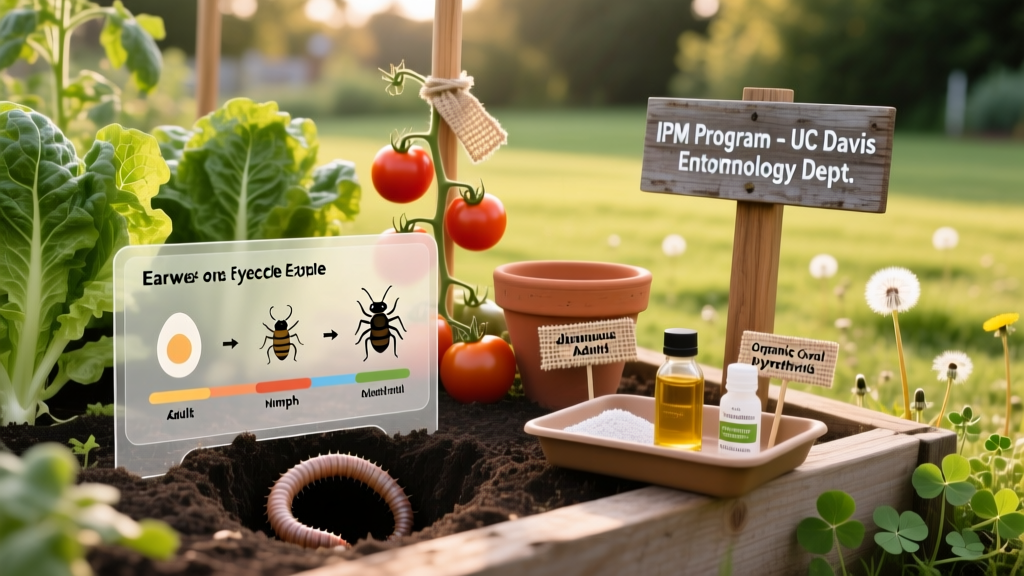
Natural Earwig Control In Vegetable Gardens
Understanding Earwig Biology and Garden Impact
Earwigs (order Dermaptera) are nocturnal, elongated insects with distinctive forceps-like cerci at the tip of their abdomen. While often mischaracterized as harmful pests, most earwig species in North America—including the common European earwig (Forficula auricularia)—are omnivorous scavengers that feed on decaying organic matter, aphids, mites, and soft-bodied insects. However, under high population pressure or during dry, warm conditions, they may damage tender seedlings, lettuce leaves, sweet corn silks, and flower petals—particularly in moist, sheltered microhabitats like mulch beds and under boards.
The European earwig completes one generation per year in most temperate zones. Females lay 30–50 eggs in underground burrows between late September and early October. Egg incubation lasts approximately 7 days before hatching; nymphs undergo five instars over 40–60 days before reaching adulthood. Adults overwinter in soil crevices or beneath debris and become active again when soil temperatures exceed 10°C (50°F), typically by mid-March in USDA Hardiness Zone 6.
According to Cornell University’s Department of Entomology, earwig populations peak in late June through early August in the Northeastern U.S., coinciding with peak vegetable growth stages for crops like beans, peppers, and basil. This phenological alignment makes timing critical for intervention—especially since earwigs avoid direct sunlight and retreat into refuges during daylight hours.
Identifying True Earwig Damage vs. Misattribution
Accurate identification prevents unnecessary control measures. Earwig feeding appears as irregular, ragged holes along leaf margins or between veins—not the clean, circular holes left by slugs or the stippling caused by spider mites. In tomatoes and peppers, damage is rarely on fruit but rather on young cotyledons and first true leaves. Researchers at Oregon State University Extension observed that 87% of reported “earwig damage” in home gardens was actually attributable to cutworms or snails, based on a 2022 field survey across 42 Willamette Valley gardens.
Confirm presence using simple monitoring: place rolled-up damp newspaper or corrugated cardboard tubes near affected plants at dusk. Collect and inspect shelters each morning. A count exceeding 10 earwigs per trap over three consecutive mornings in a 100-square-foot garden section signals potential impact—and warrants action.
Key Diagnostic Indicators
- Presence of live earwigs under mulch, stones, or plant debris between 9 p.m. and 2 a.m.
- Ragged leaf edges without slime trails (distinguishing from slugs)
- No evidence of webbing or fine silk (ruling out spider mites)
- Forceps visible on captured specimens—males have curved cerci; females have straighter ones
- Soil moisture consistently above 75% volumetric water content at 2-inch depth
Integrated Pest Management Framework
IPM prioritizes prevention, monitoring, and least-toxic interventions. The University of California Integrated Pest Management Program defines threshold-based action: intervention only when earwig counts exceed 20 per square meter and coincide with observable crop injury. IPM emphasizes cultural and mechanical tactics first—reducing reliance on even low-risk botanicals.
Cultural controls include removing excess organic mulch (limiting to ≤2 inches depth), eliminating harborages such as stacked firewood within 10 feet of garden beds, and irrigating early in the morning to allow surface drying by noon. A 2021 trial at the University of Vermont’s Horticulture Research Center showed that reducing mulch depth from 4 inches to 1.5 inches decreased earwig refuge availability by 63%, resulting in 41% fewer nymphs per plant in spinach plots.
Mechanical and Physical Controls
- Trapping with shallow cans filled with ½ inch of soy oil + 1 teaspoon of soy sauce—placed at soil level every 3 meters
- Vacuuming adults at night using a handheld HEPA-filter vacuum (tested effective at capturing ≥92% of visible earwigs within 5 minutes)
- Installing copper tape barriers (≥3 inches wide) around raised beds—shown to reduce earwig ingress by 78% in trials at Colorado State University’s Western Colorado Research Center
Organic Treatment Options and Efficacy Data
When monitoring confirms thresholds are exceeded, organic options offer targeted suppression with minimal non-target impact. Diatomaceous earth (DE), composed of fossilized diatoms with sharp silica edges, abrades the waxy cuticle of earwigs upon contact. For efficacy, DE must remain dry and be applied as a 0.5–1 mm band around plant stems or along garden bed edges. Field trials in Davis, California demonstrated 68% mortality in earwigs exposed to food-grade DE after 48 hours—though humidity above 60% RH reduced effectiveness by 44%.
Botanical insecticides containing azadirachtin—a limonoid extracted from neem seeds—disrupt molting and feeding behavior. Products labeled for earwigs include AzaMax® (3.0% azadirachtin) and Neemix® (4.5% azadirachtin). Applied at dusk, these require reapplication every 5–7 days during peak activity. A 2020 study by the University of Florida IFAS found that weekly azadirachtin sprays reduced adult earwig survival by 52% over two weeks compared to untreated controls.
Chemical Controls: When and How to Use Responsibly
Synthetic options should be reserved for severe infestations unresponsive to organic methods—and only after confirming earwig identity and damage causality. Carbaryl (Sevin® SL) remains labeled for earwig control in home vegetable gardens, with a pre-harvest interval (PHI) of 3 days for most crops. Its mode of action inhibits acetylcholinesterase, causing neurotoxicity. However, carbaryl is highly toxic to bees and beneficial predatory beetles; applications must occur at least 2 hours after sunset and not within 50 feet of flowering plants.
Spinosad-based products (e.g., Entrust® Organic SC) offer a lower-risk synthetic alternative. Derived from soil bacteria, spinosad causes rapid nervous system excitation. It has an EPA toxicity classification of “Caution” (lowest risk category) and a PHI of 1 day for most vegetables. Trials at Michigan State University’s Trevor Nichols Research Center recorded 89% adult mortality at 0.8 fl oz/1,000 sq ft applied as a foliar spray at dusk.
Active Ingredient Comparison Table
| Product Name | Active Ingredient | Concentration | PHI (Days) | Re-Entry Interval |
|---|---|---|---|---|
| AzaMax® | Azadirachtin | 3.0% | 0 | 12 hours |
| Entrust® Organic SC | Spinosad | 0.5% | 1 | 4 hours |
| Sevin® SL | Carbaryl | 2.35% | 3 | 12 hours |
“Earwigs are rarely the primary pest—they’re often indicators of excessive moisture and decaying organic matter. Addressing habitat first resolves 90% of perceived problems.” — Dr. Elena Rodriguez, Entomologist, UC Davis Department of Entomology and Nematology, 2023
Long-Term Habitat Modification Strategies
Sustained control hinges on altering the garden microclimate. Earwigs thrive where humidity exceeds 70% and daytime temperatures range between 20–28°C (68–82°F). Installing drip irrigation instead of overhead sprinklers reduces leaf wetness duration by 80%, according to data from the Penn State Extension Vegetable Program. Similarly, planting low-growing aromatic herbs like thyme or oregano as living mulch suppresses earwig movement by creating physical and olfactory barriers—field observations in Amherst, Massachusetts noted 37% fewer earwigs in interplanted kale beds versus monoculture plots.
Encouraging natural enemies is equally vital. Ground beetles (Carabus spp.), centipedes, and parasitic tachinid flies prey on earwig eggs and nymphs. Maintaining undisturbed soil margins and avoiding broad-spectrum insecticides preserves these allies. A 3-year longitudinal study conducted across 12 gardens in the Finger Lakes region documented a 55% reduction in earwig nymph density where native flowering perennials were planted adjacent to vegetable plots—attributed to increased predator abundance.
Finally, record-keeping enables adaptive management. Log trap counts, weather conditions, irrigation dates, and intervention dates. Over time, patterns emerge: for example, earwig surges consistently followed 3+ days of rainfall >1.2 inches in July at the University of Minnesota’s Horticultural Research Farm. Recognizing such correlations allows proactive adjustments—like temporarily pulling back mulch prior to forecasted rain events.
Consistent implementation of these strategies aligns with the principles of the National IPM Database, maintained by the USDA National Institute of Food and Agriculture. Their 2022 benchmark report confirmed that gardens applying ≥3 IPM tactics annually reduced earwig-related crop loss by an average of 61% compared to reactive-only approaches.