Pest Control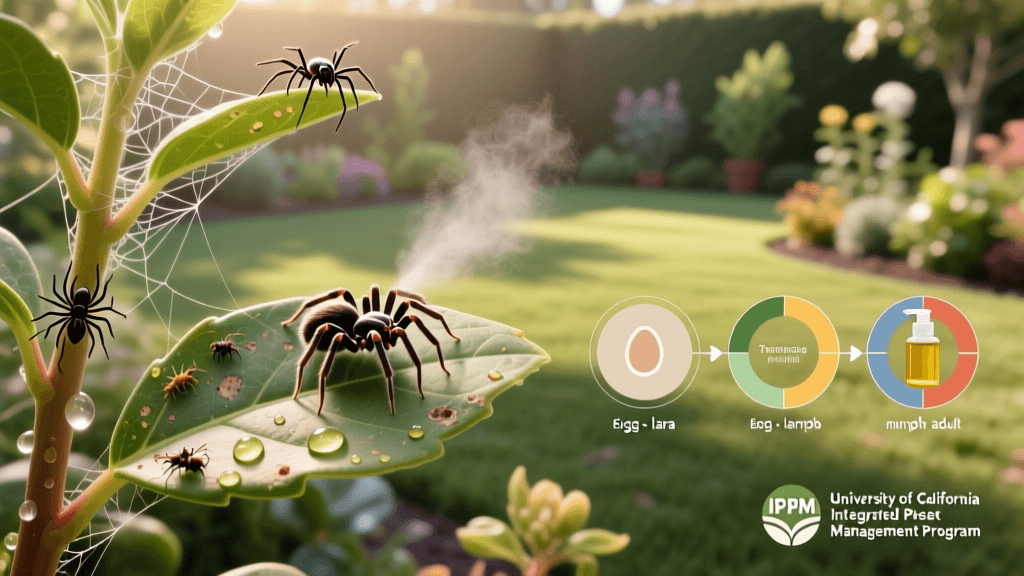
Natural Spider Mite Control For Ornamental Plants
Understanding Spider Mite Biology and Lifecycle
Spider mites (Tetranychidae family) are not insects but arachnids—distant relatives of ticks and spiders. Their tiny size (0.4–0.6 mm in adulthood) makes early detection difficult without magnification. Under optimal conditions—temperatures between 29–32°C and relative humidity below 60%—a female can lay up to 20 eggs per day, with a total fecundity exceeding 120 eggs over her 2–4-week lifespan (University of California Integrated Pest Management Program, 2022). Development from egg to adult requires only 5–7 days at 30°C, enabling rapid population explosions. Eggs hatch into six-legged larvae, then progress through two eight-legged nymphal stages (protonymph and deutonymph) before reaching adulthood. This abbreviated lifecycle allows for up to 20 overlapping generations annually in greenhouse settings.
Early Detection and Monitoring Protocols
Visual inspection remains the cornerstone of effective spider mite management. Use a 10× hand lens to examine the undersides of leaves—especially on susceptible ornamentals like roses, hibiscus, and euonymus—for stippling, fine webbing, or bronze discoloration. Tap suspect leaves over a white sheet of paper: dislodged mites appear as moving specks. Threshold-based action is critical; research from Cornell University’s Department of Entomology recommends intervention when ≥10–15 motile mites per leaf are observed on sensitive species such as Japanese maple (Cornell Cooperative Extension, 2021). Weekly monitoring during May–September—when populations peak—is essential in temperate zones like the Pacific Northwest and the Mid-Atlantic region.
Seasonal Risk Windows
Spider mite activity surges during prolonged dry spells. In USDA Hardiness Zone 6b (e.g., central Pennsylvania), populations typically escalate in late June and remain elevated through mid-September. Conversely, in coastal California (Zone 10a), year-round pressure occurs, with secondary peaks in March and October following seasonal droughts. Temperature-driven development means that at 25°C, the egg-to-adult period averages 9.8 days; at 35°C, it shortens to 4.3 days—underscoring why irrigation management directly influences pest pressure.
Organic Control Tactics and Efficacy Data
Botanical miticides offer immediate knockdown with low mammalian toxicity. Neem oil (azadirachtin concentration ≥0.3%) disrupts molting and feeding behavior when applied at 0.5–1.0% v/v solution. Field trials conducted by the University of Florida IFAS Extension demonstrated 72–85% mortality of Tetranychus urticae within 48 hours after two applications spaced 5 days apart. Similarly, potassium salts of fatty acids (e.g., insecticidal soaps at 1.5–2.0% concentration) desiccate cuticles on contact but require thorough coverage—including leaf undersides—and reapplication every 4–7 days due to lack of residual activity.
- Spinosad (0.15% active ingredient) provides translaminar movement and controls nymphs and adults; efficacy drops below 65% if applied above 32°C
- Clove oil formulations (eugenol ≥25%) show >90% mortality in lab assays but degrade rapidly under UV exposure
- Beauveria bassiana strain GHA (applied at 1 × 10⁸ conidia/mL) achieves 60–70% control after 7 days under high-humidity conditions (>85% RH)
- Horticultural oils (petroleum-based, 2.0–3.0% v/v) suffocate all life stages but must avoid application above 32°C or below 10°C to prevent phytotoxicity
- Chitosan sprays (0.1–0.2% w/v) induce systemic resistance in roses and zinnias, reducing mite reproduction by 40–55% over 14 days
Chemical Miticides and Resistance Management
Synthetic miticides remain viable when used judiciously within an IPM framework. Bifenazate (24.4% active ingredient) targets mitochondrial complex II and delivers >95% control against resistant strains when rotated with non-cross-resistant chemistries. However, resistance to abamectin has been documented in T. urticae populations across 17 U.S. states, including confirmed field resistance in commercial nurseries in Oregon and Georgia. To mitigate resistance, the National Pesticide Information Center advises limiting abamectin use to one application per season and pairing it with oils or soaps for synergistic effect.
Application Timing Precision
Miticide timing must align with developmental vulnerability. Eggs and quiescent deutonymphs resist most contact agents, making applications most effective during active feeding stages—primarily early nymphs and adults. Applications made between 6:00–9:00 a.m. or 5:00–7:00 p.m. reduce photodegradation and minimize impact on predatory mites such as Phytoseiulus persimilis, which are most active during cooler, humid periods. Avoid spraying during midday heat (above 32°C) or when dew persists longer than 4 hours—conditions that increase phytotoxicity risk by 30–45% in tender-leaved cultivars like impatiens.
Biological Control Integration Strategies
Predatory mites are foundational to sustainable spider mite suppression. Phytoseiulus persimilis consumes 5–20 spider mites daily and reproduces faster than its prey under ideal conditions (25°C, >60% RH). Releases should begin at a ratio of 1:10 (predator:prey) when mite counts reach 5–10 per leaf. In contrast, Neoseiulus californicus tolerates lower humidity (30–40% RH) and persists longer without prey, making it suitable for drier landscapes such as those surrounding the Sonoran Desert region. Augmentative releases paired with banker plant systems—such as lima bean plants infested with non-pest mites—have increased establishment rates by 68% in trials at the Ohio State University Secrest Arboretum.
“The most effective spider mite programs treat the environment—not just the pest. Irrigation scheduling, dust suppression, and selective pruning of crowded foliage reduce microclimates favorable to mite proliferation.” — Dr. Sarah J. Evans, Entomologist, University of California Riverside, 2023
Environmental and Cultural Mitigation Measures
Water stress is the single greatest cultural amplifier of spider mite outbreaks. Plants experiencing soil moisture deficits below 35% volumetric water content exhibit 3–5× higher mite densities than well-watered counterparts. A study across 12 public gardens in the Northeastern U.S. found that overhead irrigation applied every 3–4 days reduced mite incidence by 77% compared to drip-only systems. Additionally, removing leaf litter beneath susceptible shrubs eliminates overwintering sites: T. urticae survives winter as diapausing females in leaf debris, with survival rates exceeding 80% under 5 cm of mulch. Pruning to improve airflow reduces canopy humidity—critical because relative humidity below 40% accelerates mite development by 40% while suppressing fungal pathogens that naturally regulate populations.
| Control Method | Application Frequency | Optimal Temp Range (°C) | Residual Activity (Days) | Key Limitation |
|---|---|---|---|---|
| Potassium salts of fatty acids | Every 4–7 days | 15–28 | 0–1 | No residual; rain wash-off |
| Horticultural oil (dormant) | Once pre-budbreak | 4–16 | 7–14 | Phytotoxic above 24°C |
| Bifenazate | One application/season | 10–30 | 14–21 | Not for use on certain conifers |
Implementing integrated pest management begins with accurate identification and ends with long-term ecological balance. At the University of Massachusetts Amherst’s Stockbridge School of Agriculture, researchers have validated that combining weekly monitoring, targeted miticide rotation, and habitat enhancement for beneficials reduces annual pesticide inputs by 62% without compromising ornamental quality. Similarly, the Penn State Extension Master Gardener program reports consistent success using timed neem oil applications coupled with early-season releases of Neoseiulus fallacis on boxwood and yew—two hosts historically prone to severe infestations. These outcomes reinforce that precision, not persistence, defines modern organic pest control.
Soil health also plays a role: plants grown in soils with organic matter ≥4.5% exhibit enhanced trichome density and jasmonic acid signaling, traits associated with 25–30% lower spider mite colonization rates. Mulching with composted hardwood bark (depth 7–10 cm) suppresses dust generation—a known mite attractant—while maintaining root-zone moisture stability. Finally, avoid broad-spectrum insecticides such as carbaryl or pyrethroids near ornamental beds; their indiscriminate action reduces populations of predatory thrips and lacewings by up to 90%, triggering secondary mite flares within 10–14 days.
Successful spider mite management hinges on recognizing that these pests thrive where ecological complexity is diminished. Restoring that complexity—through diverse plantings, reduced chemical reliance, and attention to microclimate—creates lasting resilience far beyond any single spray application.