Gardening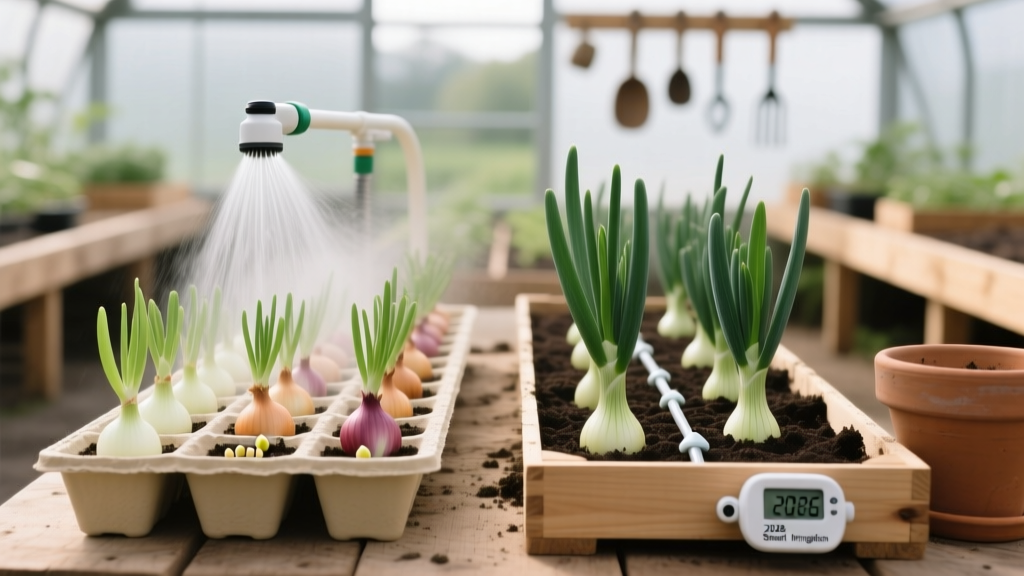
Irrigating Onions 2026: Sets vs Seeds & Day-Length Types
David ParkPublished
Introduction to Onion Irrigation in 2026
As we navigate the 2026 gardening season, water conservation and precision irrigation are at the forefront of successful vegetable production. Onions (Allium cepa) are notoriously demanding when it comes to soil moisture. Unlike deep-rooted crops like tomatoes or corn, onions possess a very shallow, sparse root system that rarely extends beyond the top 12 inches of soil. This physiological limitation means they cannot access deep soil moisture reserves, making them highly susceptible to drought stress and fluctuations in surface water levels.
For home gardeners and small-scale market growers utilizing sprinkler and automated irrigation systems, a one-size-fits-all watering approach will inevitably lead to split bulbs, stunted growth, or fungal diseases. To achieve massive, perfectly cured bulbs, your irrigation strategy must be meticulously tailored to two critical factors: whether you are planting from sets or seeds, and whether you are growing long-day or short-day varieties. In 2026, leveraging smart irrigation controllers and precision sprinkler heads is no longer optional; it is essential for managing these variables effectively.
Onion Sets vs. Seeds: Germination and Early Watering Needs
The method you choose to start your onions drastically dictates your initial sprinkler setup and precipitation rates. Onion sets (small, dormant bulbs grown the previous year) and true onion seeds have entirely different water requirements during their establishment phases.
Irrigating Onion Sets
Onion sets are relatively forgiving but require a specific watering protocol to break dormancy without triggering bolting. When planted in early spring, sets need a deep, thorough initial soaking to encourage rapid root emergence. However, traditional high-precipitation spray heads (which can output 1.5 to 2.0 inches per hour) often cause soil crusting and runoff before the water penetrates the root zone.
For sets, utilize rotary nozzles (such as the Hunter MP Rotator or Toro Precision Rotary Nozzles) that apply water at a slower rate of 0.4 to 0.6 inches per hour. This allows the moisture to infiltrate deeply into the soil profile without pooling on the surface. Once established, sets require a consistent 1 inch of water per week. Warning: Water stress during the early vegetative stage of sets can cause the plant to perceive environmental stress, leading to premature bolting (going to seed) rather than forming a bulb.
Irrigating Onion Seeds
Direct-sowing onion seeds presents a unique irrigation challenge. The seeds are tiny and must be planted no deeper than 1/4 inch. If you use standard overhead sprinklers, the heavy water droplets and high flow rates will wash the seeds away, bury them too deep, or cause severe soil crusting that prevents delicate seedlings from emerging.
For the first 14 to 21 days after sowing, the top 1/2 inch of soil must remain continuously moist but never waterlogged. The best approach for 2026 is to install micro-sprinklers or low-volume misting heads on a dedicated irrigation zone. These heads provide a gentle, fog-like application that keeps the seedbed moist without disturbing the soil structure. You may need to run this micro-sprinkler zone for just 3 to 5 minutes, two to three times a day, depending on your local evaporation rates. Once the seedlings reach 3 inches in height and develop a fibrous root system, you can transition back to standard rotary sprinklers or drip tape.
Long-Day vs. Short-Day Onions: Regional Irrigation Scheduling
Onions are photoperiodic, meaning the initiation of bulb formation is triggered by the length of daylight. Understanding your day-length type is crucial for scheduling your smart sprinkler controller, as the seasonal timing of their growth dictates the evapotranspiration (ET) rates they will experience.
Long-Day Onions (Northern Latitudes)
Long-day onions require 14 to 16 hours of daylight to initiate bulbing. They are typically planted in early spring in northern regions (above the 35th parallel) and harvested in late summer. Because their active bulbing phase coincides with the peak heat of July and August, evapotranspiration rates are at their annual maximum.
According to the University of Minnesota Extension, long-day onions require consistent moisture during this high-heat bulbing phase. Your sprinkler system must be programmed to deliver up to 1.5 inches of water per week during peak summer heat. Utilizing a smart controller integrated with a local weather station or soil moisture sensor (like the Irrometer Watermark) is highly recommended to automatically adjust run times based on real-time summer ET data.
Short-Day Onions (Southern Latitudes)
Short-day onions require only 10 to 12 hours of daylight to bulb. They are planted in the fall or late winter in southern regions and harvested in late spring. Their growth cycle avoids the extreme heat of summer, meaning their water requirements are generally lower, and the risk of overwatering is significantly higher.
The Texas A&M AgriLife Extension notes that short-day onions are highly susceptible to fungal pathogens, particularly downy mildew and pink root, which thrive in cool, damp conditions. If you are using overhead sprinklers for short-day onions, it is an absolute necessity to program your irrigation controller to water only in the early morning (e.g., 4:00 AM to 6:00 AM). This ensures the onion foliage dries completely before nightfall. Never run overhead sprinklers in the evening for short-day varieties.
2026 Sprinkler Hardware and Smart Controllers
To manage the nuanced needs of onions in 2026, upgrading your irrigation hardware is a wise investment. Here is the recommended setup for optimal onion production:
- Smart Controllers: Models like the Rachio 4 or Hunter Pro-C2 equipped with Hydrawise software allow you to create separate zones for your delicate seed beds and your established bulb beds, adjusting watering schedules based on hyper-local 2026 weather forecasts.
- Rotary Nozzles: Replace traditional spray heads with multi-trajectory rotary nozzles. They reduce wind drift and apply water slowly, preventing the shallow onion roots from being exposed by soil erosion.
- Soil Moisture Sensors: Onions are sensitive to both drought and waterlogging. Installing a soil moisture sensor at a 6-inch depth will prevent your system from watering when the shallow root zone is already saturated, saving water and preventing bulb rot.
Comparison Chart: Watering Needs by Onion Type and Stage
| Growth Stage | Onion Sets Water Needs | Onion Seeds Water Needs | Recommended Sprinkler Type |
|---|---|---|---|
| Germination / Planting | Deep soaking (1 inch) | Light misting (keep top 1/4" moist daily) | Micro-sprinklers / Misters |
| Vegetative Growth | 1 inch per week | 1 inch per week (once 3" tall) | Rotary Nozzles (Low Precipitation) |
| Bulb Initiation | 1 to 1.5 inches per week | 1 to 1.5 inches per week | Rotary Nozzles / Drip Tape |
| Bulb Maturation | Taper off to 0.5 inches | Taper off to 0.5 inches | Rotary Nozzles |
| Pre-Harvest (Curing) | Zero water (stop completely) | Zero water (stop completely) | System Off |
The Critical Taper: Pre-Harvest Irrigation Management
The most common irrigation mistake made by home gardeners is overwatering onions as they approach maturity. As the 2026 summer progresses and your long-day onions begin to form large bulbs, you will notice the green tops naturally bending and falling over. This is the plant's biological signal that bulbing is complete and it is preparing for dormancy.
At the first sign of widespread top-fall, you must drastically reduce your sprinkler run times. Cut the water application in half for one week, and then shut off the irrigation zone completely for the final 7 to 14 days before harvest. This tapering process forces the onion to draw moisture from its outer scales, causing them to dry and form the protective, papery wrapper that is essential for long-term storage. If you continue to run your sprinklers at full capacity until the day you pull the onions, the outer scales will remain thick and fleshy, leading to immediate neck rot and spoilage in storage.
For further reading on regional variety selection and soil preparation, consult the comprehensive guides provided by Penn State Extension, which offers excellent advice on matching soil drainage profiles to your specific onion variety. By combining the right day-length variety with a precision-tuned sprinkler system, your 2026 onion harvest will be the most productive and flavorful on record.
