Gardening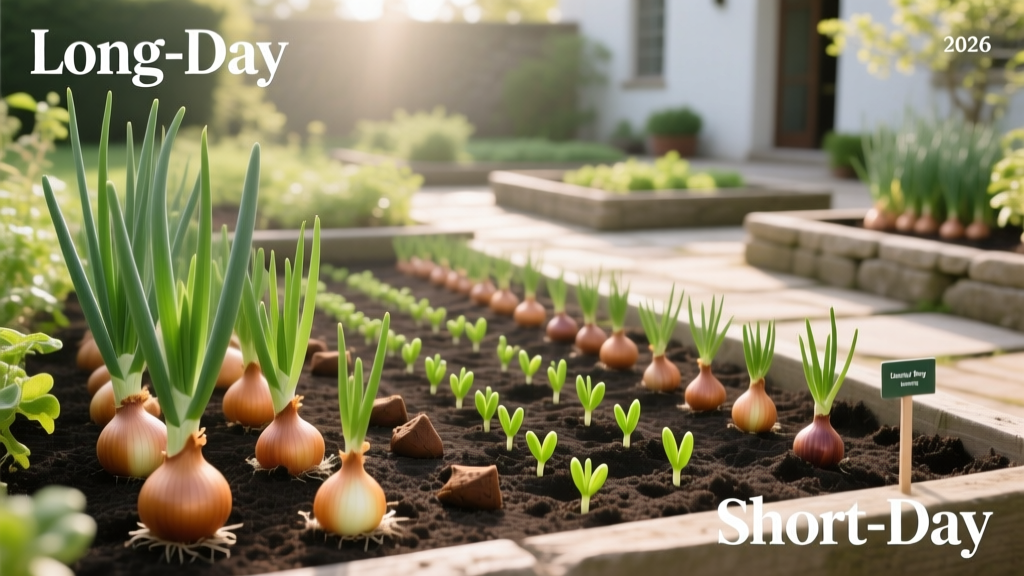
Edible Landscaping: Onion Sets Vs Seeds & Day-Length Guide 2026
James MillerPublished
The Rise of Foodscaping: Integrating Onions into the Ornamental Landscape
As we navigate the 2026 growing season, the traditional boundary between the ornamental garden and the utilitarian vegetable patch has completely dissolved. Edible landscaping, widely known as foodscaping, has evolved from a niche gardening trend into a fundamental principle of modern landscape design. Homeowners and designers alike are seeking outdoor spaces that are as productive and ecologically beneficial as they are visually stunning. Among the most versatile, structural, and beneficial crops you can integrate into your ornamental borders are onions (Allium cepa).
Onions offer far more than just culinary value. Their upright, architectural foliage provides excellent vertical lines in spring garden beds, their delicate spherical flowers attract vital pollinators, and their natural pest-repelling properties make them invaluable companions in a polyculture foodscape. However, successfully growing onions in an ornamental setting requires a solid understanding of two critical horticultural concepts: planting from sets versus seeds, and selecting the correct day-length variety for your specific latitude.
Onion Sets vs. Seeds: Choosing the Right Method for Your Foodscape
When planning your 2026 edible landscape, your first decision is whether to plant onion sets (small, dormant bulbs grown the previous year) or start from seed. Both methods have distinct advantages depending on your design goals, budget, and patience.
Planting from Sets
Onion sets are the traditional choice for home gardeners seeking convenience and immediate visual impact. Because they are already partially grown, sets bypass the fragile germination phase and establish themselves rapidly in the landscape. This means you get immediate vertical green shoots to define your garden borders early in the spring. Sets are also less susceptible to early-season weed competition, which is crucial when interplanting in dense, ornamental foodscaping beds where hoeing is difficult.
However, sets do have limitations. The variety selection is generally restricted to standard commercial cultivars (typically basic yellow, white, or red onions). Furthermore, sets are more prone to 'bolting' (premature flowering) if they experience a sudden cold snap after planting, which can ruin the bulb's development.
Starting from Seeds
For the dedicated foodscaper looking to incorporate unique, heirloom, or visually striking varieties into their landscape, seeds are the superior choice. Starting from seed opens up a massive catalog of options, including the stunning burgundy-hued 'Red of Florence' (Rossa di Firenze) or the massive, globe-shaped 'Ailsa Craig'. These unique varieties add incredible color and form to edible landscape drifts. Seeds are also significantly more cost-effective and far less likely to bolt than sets. The trade-off is time: seeds must be started indoors under grow lights 10 to 12 weeks before your last expected spring frost.
Comparison: Sets vs. Seeds in the Edible Landscape
| Feature | Onion Sets | Onion Seeds |
|---|---|---|
| Time to Harvest | 70–90 days from planting | 100–140 days from transplanting |
| Landscape Impact | Immediate vertical structure in spring | Slower initial visual impact; requires indoor starting |
| Variety Selection | Limited to standard commercial types | Extensive; includes rare heirlooms and unique colors |
| Bolting Risk | Moderate to High (if exposed to cold snaps) | Very Low |
| 2026 Avg. Cost | $8.00–$12.00 per bag of 50 sets | $3.50–$5.00 per packet of 200+ seeds |
Day-Length Demystified: Long-Day vs. Short-Day Onions
The most common reason for onion crop failure in home gardens is ignoring photoperiodism. Onions are strictly photoperiodic, meaning the initiation of bulb swelling is triggered entirely by the length of daylight, not by the plant's age, size, or the ambient temperature. If you plant the wrong day-length type for your geographic latitude, you will be left with a beautiful patch of green scallions, but zero harvestable bulbs.
According to the Old Farmer's Almanac, matching your onion type to your hardiness zone is non-negotiable for a successful 2026 harvest.
Short-Day Onions (10–12 Hours of Daylight)
Short-day onions begin forming bulbs when the day length reaches 10 to 12 hours. These are specifically bred for southern latitudes and warmer climates (USDA Zones 7 through 10). In these regions, they are typically planted in the fall or late winter, growing steadily through the cool months and bulbing up in the early spring before the intense summer heat sets in. If you plant a short-day onion in a northern zone, it will experience 14+ hours of daylight while still a tiny seedling, triggering premature bulbing and resulting in a marble-sized onion.
Long-Day Onions (14–16 Hours of Daylight)
Long-day onions require 14 to 16 hours of daylight to trigger bulb formation. These are the standard choice for northern gardeners in USDA Zones 3 through 6. They are planted in early spring as soon as the soil can be worked. They spend the long, sunny days of early summer growing lush, green tops, and only begin to bulb in mid-to-late summer when the days are at their absolute longest. Planting a long-day onion in the deep south will result in continuous top growth with no bulb formation, as southern summer days never reach the 14-hour threshold.
Intermediate / Day-Neutral Onions (12–14 Hours of Daylight)
For gardeners in the middle latitudes (USDA Zones 5 through 7), intermediate or day-neutral onions are the perfect bridge. They require 12 to 14 hours of daylight to bulb, making them incredibly versatile and forgiving for mid-country foodscapers.
Latitude and Day-Length Mapping Guide
| Onion Type | Daylight Trigger | Best USDA Zones | Planting Season | Popular Foodscape Varieties |
|---|---|---|---|---|
| Short-Day | 10–12 hours | Zones 7–10 (South) | Fall / Late Winter | Texas Supersweet, Red Creole |
| Intermediate | 12–14 hours | Zones 5–7 (Mid) | Early Spring | Candy, Red Knight, Superstar |
| Long-Day | 14–16 hours | Zones 3–6 (North) | Early Spring | Walla Walla, Patterson, Red Wing |
Design Strategies for the Onion Foodscape
Integrating onions into your ornamental landscape requires a shift in perspective. Instead of planting in rigid, agricultural rows, think in terms of drifts, borders, and polycultures.
Edging and Pathway Borders
The upright, slender foliage of onions makes them excellent living edging for garden pathways or raised bed borders. Planting a dense double row of 'Stuttgarter' sets along the edge of a walkway creates a neat, formal boundary that suppresses weeds and deters crawling pests from entering your ornamental beds.
Companion Planting and Polyculture Drifts
Onions are powerhouse companions in the edible landscape. Their strong, sulfurous scent masks the volatile compounds of susceptible plants, effectively confusing pests. Interplanting onions among your shrub roses deters aphids, while pairing them with carrots masks the scent of the carrots from the destructive carrot rust fly. In 2026, regenerative foodscaping designs heavily favor these polyculture drifts over monoculture rows, creating a resilient, self-supporting ecosystem that drastically reduces the need for organic pest interventions.
Embracing Ornamental Bolting
While commercial growers view bolting (premature flowering) as a crop failure, foodscapers can embrace it as a design feature. If a few of your onions send up a flower stalk, let them bloom! The spherical, starry umbels of onion flowers are visually stunning, resembling their purely ornamental Allium cousins. They act as a magnet for beneficial insects, hoverflies, and native bees. Leaving a few bolting onions in the landscape provides vital vertical architecture and supports local pollinator populations throughout the late spring.
Soil Preparation and Planting Techniques
Onions are heavy feeders with notoriously shallow root systems. They require loose, well-draining soil rich in organic matter to expand their bulbs without restriction. Before planting, amend your landscape beds with 2 to 3 inches of finished compost. Aim for a soil pH between 6.0 and 6.8.
According to the University of Minnesota Extension, ensuring adequate phosphorus is critical for strong root development and eventual bulb swelling. Use a balanced organic fertilizer at planting, and switch to a nitrogen-heavy liquid feed (like kelp or fish emulsion) every two weeks during the early vegetative growth stage. Stop fertilizing once the bulbs begin to swell and push through the soil surface.
When planting sets, push them into the soil so the tips are just barely visible above the surface. Space them 4 to 6 inches apart in the ornamental bed. If you are growing from seed, start them indoors in deep flats, and transplant the seedlings outdoors when they are about the thickness of a pencil, trimming the tops back by one-third to encourage root focus.
Harvesting, Curing, and Functional Decor
Onions are ready to harvest when their green tops naturally flop over and begin to turn brown. In a foodscape, this usually occurs in mid-to-late summer for long-day varieties, or late spring for short-day varieties. Gently lift the bulbs with a garden fork and lay them out in a warm, dry, shaded area with excellent airflow for 10 to 14 days to cure.
Once cured, the aesthetic utility of the onion continues. Braiding onions with their dried stalks intact and hanging them in a pergola, on a porch, or in a garden shed provides stunning, rustic, functional decor. The Royal Horticultural Society notes that properly cured and braided onions can store for up to 8 months in a cool, dry environment, providing a continuous link between your summer garden efforts and your winter kitchen.
Conclusion
Foodscaping with onions in 2026 is about merging the practical with the beautiful. By understanding the distinct advantages of sets versus seeds, and by carefully selecting the correct day-length variety for your specific latitude, you can transform this humble kitchen staple into a structural, pest-repelling, and pollinator-friendly star of your edible landscape. Whether used as a formal pathway border, a companion to your prized roses, or an ornamental bolting feature, onions prove that the most productive gardens are also the most beautiful.
