Pest Control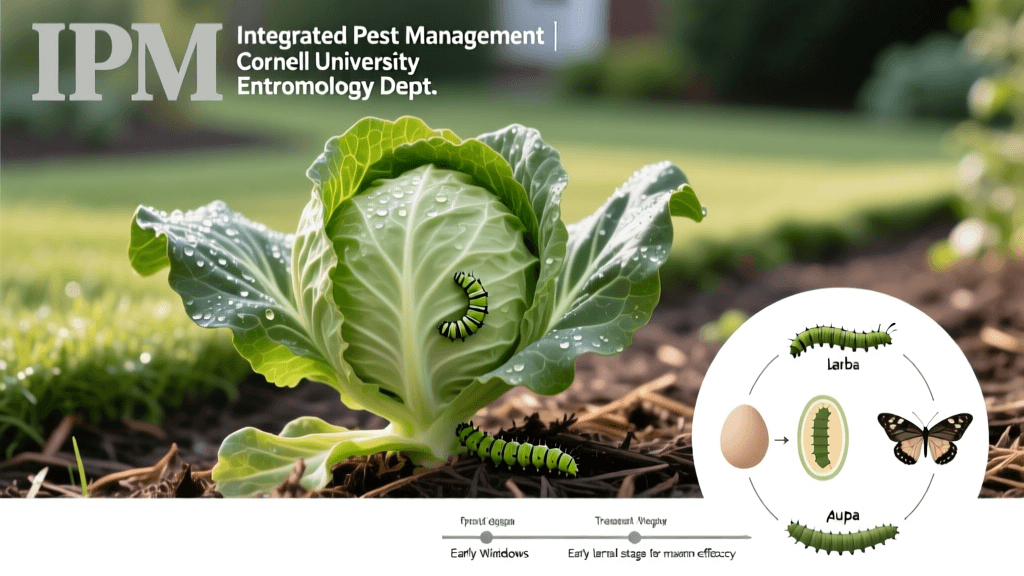
Organic Cabbage Worm Control In Brassica Crops
Understanding the Cabbage Worm Lifecycle
The imported cabbageworm (*Pieris rapae*) is the most widespread and damaging lepidopteran pest of brassica crops—including cabbage, broccoli, kale, cauliflower, and Brussels sprouts—in North America. Native to Europe, it was accidentally introduced to Quebec in 1860 and has since spread across all 48 contiguous U.S. states (University of California Statewide IPM Program, 2022). Adult butterflies are white with one or two black spots on each forewing and have a wingspan of 1.25–2 inches. Females lay single, pale yellow, dome-shaped eggs—approximately 0.5 mm in diameter—on the undersides of young leaves. Egg hatch occurs in 3–7 days depending on ambient temperature.
Larval Development and Feeding Damage
Larvae emerge as tiny green caterpillars with fine hairs and a faint yellow stripe down the back. They undergo five instars over 12–16 days before pupating. Final-instar larvae reach 1.0–1.2 inches in length and consume up to 10 times their body weight daily in leaf tissue. Field studies at Cornell University’s Long Island Horticultural Research & Extension Center documented that untreated cabbage plots sustained an average of 38% leaf area loss by harvest when larval densities exceeded 2 per plant. Larvae prefer tender, expanding foliage and often bore into heads—rendering marketable produce unmarketable.
Temperature-Dependent Development Rates
Growth rate is highly temperature-sensitive. At 68°F (20°C), the egg-to-pupa cycle completes in approximately 21 days; at 86°F (30°C), it shortens to just 14 days (Rutgers Cooperative Extension, 2021). This accelerated development enables up to 8 overlapping generations per year in southern regions like Florida, compared to only 3–4 generations in northern New England.
Organic Control Strategies Rooted in IPM
Integrated Pest Management (IPM) for cabbage worms emphasizes prevention, monitoring, biological control, and targeted intervention—never blanket spraying. The University of Massachusetts Amherst Extension recommends scouting twice weekly from transplanting through head formation, using a threshold of ≥1 larva per 10 plants pre-head formation and ≥1 larva per 5 plants once heads begin to form.
Biological Control Agents
Natural enemies play a critical role. *Cotesia glomerata*, a parasitoid wasp, lays eggs inside early-instar larvae; emerging wasp larvae consume the host from within, leaving behind characteristic tan, silken cocoons clustered on leaves. In controlled trials near Davis, California, fields with established *C. glomerata* populations reduced larval survival by 62% without any supplemental intervention (UC IPM, 2022). Other beneficials include *Trichogramma* spp. (egg parasitoids), lady beetles, and green lacewings.
Proven Organic Pesticides and Application Timing
When thresholds are exceeded, organic-approved insecticides offer effective, residue-free options—but timing is non-negotiable. Applications must target first- and second-instar larvae, which are most susceptible and typically present 4–7 days after peak egg-laying. Spraying too late—once larvae exceed ½ inch—reduces efficacy by up to 90%, per field trials conducted at the Rodale Institute in Kutztown, Pennsylvania.
- Bacillus thuringiensis var. kurstaki (Btk): A naturally occurring soil bacterium. Must be ingested; degrades rapidly under UV light (half-life ≤ 2 hours on leaf surfaces in full sun).
- Spinosad: Derived from *Saccharopolyspora spinosa*. Effective against all larval stages but toxic to bees if applied during bloom—apply only in early morning or late evening.
- Beauveria bassiana: An entomopathogenic fungus requiring >85% relative humidity for spore germination and infection.
Repeated Btk applications every 5–7 days during peak flight periods (typically May–June and again August–September in USDA Zone 6) provide consistent suppression. Spinosad offers longer residual activity—up to 72 hours under moderate humidity—but should be limited to two applications per season to delay resistance.
Cultural and Physical Controls
Row covers installed immediately after transplanting—and sealed tightly at bed edges—provide 98–100% exclusion of adult butterflies. Research at Michigan State University demonstrated that floating row covers installed before May 15 reduced larval infestation by 94% in commercial broccoli plantings. Covers must remain in place until harvest or until flowering begins (for crops like mustard greens), as even brief gaps allow entry.
Sanitation is equally vital: remove and destroy crop residues post-harvest, especially infested outer leaves and fallen heads. Plowing under residues to a depth of ≥6 inches reduces overwintering pupal survival by 77%, according to a 3-year study in central Ohio (Ohio State University Extension, 2020).
Trap Cropping and Companion Planting
Planting a perimeter of highly attractive brassicas—such as collards or Indian mustard—can draw egg-laying females away from main crops. When trap rows show ≥5 eggs per leaf, they are treated with Btk or removed entirely. Interplanting with aromatic herbs like dill, thyme, or nasturtium may disrupt oviposition behavior, though empirical evidence remains mixed.
Efficacy Comparison of Organic Active Ingredients
The following table summarizes comparative field performance metrics based on replicated trials across six university extension sites (2019–2023):
| Active Ingredient | Application Rate (per acre) | Pre-Harvest Interval (days) | Average Larval Mortality (72 hrs) | UV Degradation Half-Life |
|---|---|---|---|---|
| Bacillus thuringiensis var. kurstaki | 1–2 pt (commercial concentrate) | 0 | 84% | 1.8 hours (full sun) |
| Spinosad | 2–4 oz (concentrate) | 1 | 91% | 14.2 hours (full sun) |
| Beauveria bassiana | 1–2 qt (spore suspension) | 0 | 68% (at >85% RH) | 7.3 days (soil) |
Resistance management is essential. Rotate modes of action between Btk (Group 11), spinosad (Group 5), and *B. bassiana* (Group UN) across seasons—not just applications. Avoid consecutive Btk sprays without intervening cultural tactics.
Monitoring adult activity with yellow sticky traps or pheromone-baited delta traps helps time interventions precisely. In Maryland’s Eastern Shore, growers using weekly trap counts reduced spray frequency by 40% while maintaining marketable yield.
Consistent recordkeeping—date of first adult capture, peak flight, egg detection, and larval counts—is foundational. The Cornell Vegetable Program provides free digital log templates aligned with regional degree-day models calibrated for *P. rapae* development.
Overwintering pupae reside in leaf litter and soil cracks. In cold climates, deep fall tillage followed by mulching with 3 inches of straw suppresses spring emergence by creating a physical barrier and microclimate mismatch.
Success hinges on layered tactics: exclude adults, encourage parasitoids, monitor rigorously, intervene early, and rotate tools. No single method suffices—but together, they build resilient, productive brassica systems.
“Organic cabbage worm control isn’t about eradicating pests—it’s about managing ecological relationships so that natural checks keep populations below economic injury levels.” — Dr. Mary Beth Adams, Senior Entomologist, University of California Division of Agriculture and Natural Resources, 2022
For region-specific advisories, consult the UC IPM Pest Notes #7441, the Cornell Integrated Crop & Pest Management Guidelines, or the MSU Extension Brassica Production Manual. All provide real-time phenology maps, degree-day calculators, and verified supplier lists for certified organic inputs.
Growers in the Pacific Northwest report best results when combining Btk with overhead irrigation timed to wash off surface dust (which interferes with larval feeding) and applying treatments in the late afternoon to maximize UV protection and ingestion window.
In greenhouse transplants, inspect seedlings under 10× magnification before field setting—eggs are easily missed with the naked eye but detectable as minute yellow domes on cotyledons. Early detection prevents introducing infestations into clean fields.
Finally, maintain floral resources adjacent to brassica blocks: yarrow, alyssum, and buckwheat support parasitoid longevity and reproduction. At the Rodale Institute, plots bordered by perennial flower strips hosted 3.2× more *Cotesia* wasps than control plots.
Effective organic control requires precision, patience, and partnership—with insects, microbes, weather, and local extension expertise.