Tree Care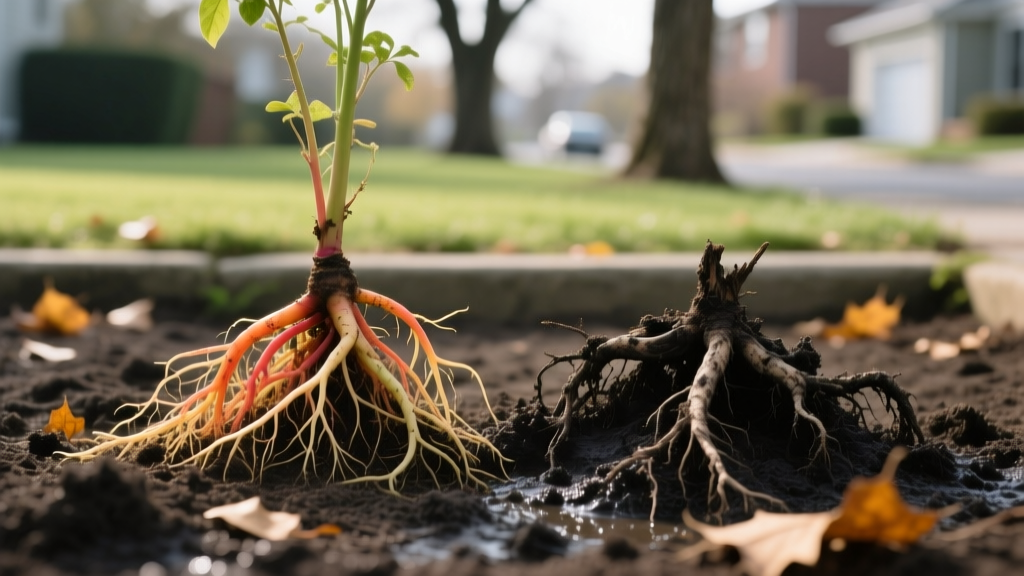
Phytophthora Root Rot: Treating Lawn and Tree Infections
Lisa ThompsonPublished
The Hidden Link Between Declining Lawns and Dying Trees
When homeowners notice yellowing turf and wilting tree canopies simultaneously, the immediate assumption is often drought stress or a nutrient deficiency. However, when lawn diseases and tree decline occur in the same saturated zones of your yard, the true culprit is frequently a devastating soil-borne water mold known as Phytophthora. While often categorized under general lawn disease identification, Phytophthora root and crown rot is a severe threat to the structural integrity and longevity of your landscape trees.
Managing this pathogen requires a unified approach to tree care and turf management. In this guide, we will explore how to identify Phytophthora across different plant species, differentiate it from common environmental stresses, and implement a targeted treatment plan to save your landscape.
What is Phytophthora?
Often mistaken for a fungus, Phytophthora (Greek for "plant destroyer") is actually an oomycete, or water mold. It thrives in poorly drained, compacted soils where moisture levels remain high for extended periods. According to the Clemson University Home & Garden Information Center, this pathogen produces microscopic, swimming spores called zoospores that navigate through water films in the soil to infect vulnerable root hairs and the root crown.
The life cycle of this pathogen is uniquely adapted to wet environments. When soils become saturated, the pathogen produces lemon-shaped sporangia. These sporangia either germinate directly or release dozens of motile zoospores that swim through soil water films to locate root exudates. Once they attach to a root, they form a cyst and penetrate the plant tissue. During dry periods, the pathogen survives as thick-walled chlamydospores in the soil or within dead plant debris, waiting for the next heavy rain to resume the infection cycle.
Identifying the Pathogen in Turf and Trees
Symptoms in Lawns and Turfgrass
In turfgrass, Phytophthora blight or root rot manifests as irregular, water-soaked patches that rapidly turn brown and necrotic. Unlike typical fungal lawn diseases like dollar spot or brown patch, Phytophthora-affected turf feels slimy when wet and lacks distinct fungal fruiting bodies or smoke rings. The grass roots will appear dark brown, mushy, and easily slough off when pulled.
Symptoms in Landscape Trees
For trees, the infection usually begins at the fine feeder roots before moving to the structural roots and the root crown. Key indicators include:
- Canopy Dieback: Thinning foliage, abnormally small leaves, and premature autumn coloration.
- Wilting: Leaves that droop during the heat of the day and fail to recover overnight.
- Crown Cankers: Dark, sunken lesions at the soil line. If you scrape away the outer bark at the base of the trunk, the inner cambium layer will appear brick-red or cinnamon-brown instead of healthy green or white.
Pro Tip: Use a pocket knife to gently scrape the bark at the root flare. A distinct margin between healthy white tissue and diseased reddish-brown tissue is a hallmark of Phytophthora crown rot.
Diagnostic Soil Testing
Before applying expensive chemical treatments, confirm the presence of Phytophthora through laboratory soil and root tissue testing. You can submit samples to your local university extension plant diagnostic clinic. Collect a 6-inch core of soil from the drip line of the affected tree, including both fine roots and surrounding earth. Place the sample in a sealed plastic bag and ship it via overnight courier to ensure the water mold spores remain viable. Testing typically costs between $50 and $150 and will differentiate Phytophthora from Pythium or Rhizoctonia.
Comparison Chart: Phytophthora vs. Drought Stress
Because the symptoms are remarkably similar, use this comparison chart to guide your diagnosis before applying treatments.
| Diagnostic Feature | Drought Stress | Phytophthora Root Rot |
|---|---|---|
| Soil Moisture | Dry, pulling away from foundations | Wet, mucky, or poorly drained |
| Root Appearance | Dry, brittle, desiccated | Dark, mushy, lacking root hairs |
| Inner Bark Color | Green or white (moist) | Cinnamon-brown or brick-red |
| Response to Watering | Improves within 24-48 hours | Decline accelerates |
Actionable Treatment and Management Plan
Once identified, treating Phytophthora requires a combination of cultural, chemical, and biological interventions. The University of Minnesota Extension emphasizes that chemical controls will fail if the underlying soil drainage issues are not resolved.
Step 1: Cultural Controls and Water Management
Phytophthora cannot survive without excess moisture. Your first step is to alter the soil environment:
- Expose the Root Flare: Carefully remove soil and heavy mulch from the base of the tree. The root flare should be fully visible and exposed to the air to allow the crown to dry.
- Improve Drainage: Install French drains or swales to divert surface runoff away from the tree's critical root zone. Avoid planting trees in low-lying areas where lawn irrigation tends to pool.
- Aerate the Soil: Use an air spade or manual core aeration to alleviate compaction in the lawn surrounding the tree, increasing oxygen flow to the remaining healthy roots.
Step 2: Chemical Fungicides (Active Ingredients and Timing)
For high-value trees and severe lawn infections, targeted fungicides are necessary to halt the progression of the water mold. Note that these chemicals are preventative and curative only in the early stages; they cannot resurrect dead root tissue.
- Phosphonates (Phosphorous Acid): Products containing potassium phosphite (e.g., Agri-Fos) are highly effective. They can be applied as a trunk injection, a basal bark spray, or a soil drench. Phosphonates boost the plant's natural defense mechanisms (phytoalexins) and directly inhibit the pathogen. Apply in early spring or early fall when the tree is actively translocating nutrients.
- Metalaxyl and Mefenoxam: These systemic fungicides (e.g., Subdue MAXX) are absorbed by the roots and translocated upward. They are best applied as a soil drench just before the rainy season begins. Warning: Do not rely solely on metalaxyl, as Phytophthora strains can develop resistance.
Step 3: Biological Controls
To restore soil health and introduce beneficial competition, apply biological soil amendments containing Trichoderma harzianum or Bacillus subtilis. These beneficial fungi and bacteria colonize the root zone, outcompeting Phytophthora for space and resources while promoting new root growth.
Cost Breakdown for Professional Treatment
Professional treatment costs vary based on tree size and property layout. A certified arborist utilizing trunk injection systems for phosphonates typically charges $15 to $25 per inch of trunk diameter (measured at breast height). For a mature 24-inch oak, expect to pay $360 to $600 per application. Soil drench applications of metalaxyl for lawn and shrub borders average $0.10 to $0.15 per square foot. While these costs are significant, they are a fraction of the $1,500 to $3,500 required to safely remove and replace a mature, dead landscape tree.
Preventative Soil Care for the Future
Prevention is vastly more cost-effective than treatment. When designing your landscape or maintaining an existing one, adhere to these best practices:
- Smart Mulching: Apply no more than 2 to 3 inches of organic wood chip mulch around trees. Keep the mulch at least 6 inches away from the trunk to prevent trapping moisture against the bark.
- Irrigation Audits: Ensure lawn sprinkler heads are not directly hitting tree trunks. Convert spray heads in tree zones to drip irrigation to maintain consistent, low-volume moisture without saturating the soil profile.
- Resistant Species: If a specific area of your yard is chronically wet, avoid planting highly susceptible species like Dogwoods, Azaleas, or Firs. Instead, opt for resistant alternatives like Bald Cypress, River Birch, or Dawn Redwood.
Conclusion
Treating lawn diseases and tree ailments requires looking beneath the surface. Phytophthora root rot is a formidable opponent that exploits poor drainage and overwatering, turning lush landscapes into declining ecosystems. By accurately identifying the symptoms, modifying the soil environment, and utilizing targeted phosphonate treatments, you can protect both your turf and your trees from this destructive water mold. Always consult with a certified arborist if canopy dieback exceeds 30% or if structural roots are heavily compromised.
