Pest Control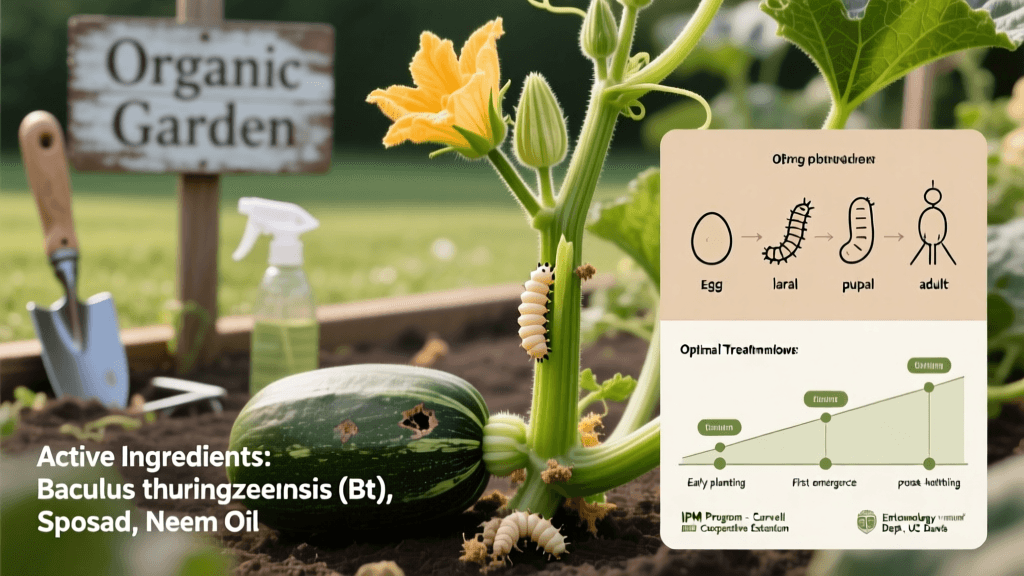
Prevent Squash Vine Borers In Vegetable Gardens
Understanding the Squash Vine Borer Lifecycle
The squash vine borer (*Melittia cucurbitae*) is a destructive moth whose larval stage tunnels into the stems of squash, pumpkins, gourds, and zucchini—causing rapid wilting and plant death. Adult moths emerge in late spring to early summer, with peak flight activity occurring between May 15 and July 15 in most of the eastern and central United States. According to Cornell University’s Vegetable MD Online, adults are active for approximately 4–6 weeks per generation, and in warmer regions like Georgia, two generations may occur annually (Cornell University, 2022).
Females lay single, flattened, reddish-brown eggs at the base of host plants—typically within 1 inch of the soil line. Eggs hatch in 7–10 days, and newly emerged larvae immediately bore into stems. Larval feeding lasts 4–6 weeks, during which they consume vascular tissue, disrupting water and nutrient flow. Larvae reach lengths of up to 1 inch before exiting stems to pupate in the soil at depths of 1–2 inches. Pupation lasts 7–10 days in warm conditions but may extend to 9 months if overwintering occurs.
Early Detection and Monitoring Strategies
Early identification is critical because once larvae enter stems, control options narrow significantly. Scout weekly beginning in early June, especially after observing adult moths. Adults resemble wasps: black with orange-red abdominal segments, transparent hindwings, and a 1–1.25-inch wingspan. They fly during daylight hours—unlike most moths—and are often seen hovering near squash vines.
Look for telltale signs: sawdust-like frass (excrement) near stem bases, small entry holes, and sudden wilting—even when soil moisture is adequate. A 2021 study by the University of Florida IFAS Extension documented that wilting typically appears 7–14 days after larval entry, with mortality occurring within 3–5 days if untreated (UF/IFAS, 2021).
Trapping Techniques
Yellow sticky traps placed at plant height can intercept adult moths. Research from Purdue University Entomology shows trap capture peaks coincide with egg-laying windows—making them valuable for timing interventions.
Alternatively, use pheromone traps containing *cis*-11-tetradecenal, the primary sex pheromone component. These attract male moths and help estimate population pressure. Traps should be deployed by May 10 in USDA Hardiness Zone 6 and earlier in southern zones.
Organic Control Methods
Organic strategies emphasize physical barriers and biological agents. Floating row covers installed at planting and secured tightly at the edges prevent egg-laying—but must be removed during flowering to allow pollination. Remove covers no later than when first female flowers open, typically 35–42 days after seeding.
Beneficial nematodes—specifically *Steinernema carpocapsae*—are effective against early-instar larvae when applied as a soil drench. Apply in the evening when soil temperatures are between 60°F and 85°F, and ensure thorough coverage of the lower 6 inches of stems and surrounding soil. A field trial conducted in Madison County, Ohio, demonstrated 68% larval reduction when nematodes were applied within 3 days of egg hatch (Ohio State University Extension, 2020).
Botanical insecticides like spinosad (derived from *Saccharopolyspora spinosa*) provide contact and stomach activity. Spinosad-based products labeled for squash vine borer include Entrust SC (0.5% spinosad) and Monterey Garden Insect Spray (0.25% spinosad). Apply as a targeted stem drench every 5–7 days during peak egg hatch, starting 5 days after first moth capture.
Cultural Practices That Disrupt the Lifecycle
- Plant resistant cultivars such as ‘Zucchino Scalpo’ and ‘Crown Prince’, which exhibit thicker stem tissue and reduced susceptibility.
- Practice crop rotation—maintain at least 3 years between cucurbit plantings in the same bed—to disrupt overwintering pupal development.
- Remove and destroy infested vines immediately; do not compost them—larvae survive standard backyard composting temperatures.
- Till soil to a depth of 4–6 inches in fall or early spring to expose pupae to predators and cold desiccation.
Chemical Intervention Options
When organic methods prove insufficient—or in high-value commercial plots—targeted synthetic insecticides offer reliable suppression. Timing remains paramount: applications must coincide with egg hatch, not adult emergence. Soil-applied neonicotinoids like imidacloprid are ineffective against this pest due to poor systemic movement into vine stems.
Instead, foliar sprays containing carbaryl (Sevin SL) or bifenthrin (Bifen IT) deliver strong knockdown. Carbaryl has a 7-day pre-harvest interval (PHI) on squash and a residual activity window of 5–7 days. Bifenthrin provides longer persistence—up to 14 days—but requires careful application to avoid harming pollinators.
For precision delivery, injectable formulations such as Cyonara 9.7 (lambda-cyhalothrin, 9.7% active ingredient) can be administered directly into infested stems using a hypodermic syringe. Inject 0.5 mL per 12 inches of vine length at intervals of 4–6 inches—beginning at first sign of frass. This method achieves >90% larval mortality when applied before extensive internal damage occurs.
Integrated Pest Management Frameworks
Squash vine borer management aligns closely with principles established by the USDA’s National IPM Program and adopted regionally by land-grant universities. IPM emphasizes monitoring, threshold-based action, and layered tactics—including biological, cultural, physical, and chemical tools—to minimize ecological impact while maintaining yield integrity.
The University of Vermont Extension’s IPM program recommends setting an action threshold of ≥2 adult moths per yellow sticky trap per week—or ≥1 confirmed egg per 10 plants—as justification for intervention. Their 2023 regional guidelines further advise combining nematode applications with timed carbaryl sprays to reduce reliance on any single mode of action.
“Prevention is not passive—it’s a sequence of deliberate, timed actions rooted in phenology. Knowing when the moth flies, when the egg hatches, and when the larva begins feeding transforms reactive panic into strategic stewardship.” — Dr. Laura McDermott, Cornell Cooperative Extension, 2021
Regional Timing Charts
Effective control depends on local climate cues. The table below reflects average first-flight dates and optimal treatment windows across three major growing regions:
| Region | First Adult Flight | Peak Egg Hatch Window | Recommended Nematode Application | Row Cover Removal Date |
|---|---|---|---|---|
| New England (e.g., Burlington, VT) | June 10–20 | June 25–July 10 | July 1–5 | July 15 |
| Mid-Atlantic (e.g., State College, PA) | May 25–June 10 | June 10–25 | June 12–16 | July 1 |
| Gulf Coast (e.g., Gainesville, FL) | April 15–May 1 | April 25–May 15 | May 1–5 | June 10 |
Growers in northern latitudes may experience only one generation per season, whereas southern growers face overlapping generations—requiring repeated scouting and multiple intervention cycles. In Mississippi, for example, second-generation adult flights begin as early as August 1, necessitating reapplication of spinosad or bifenthrin by mid-August.
Soil solarization—covering moist, tilled beds with clear polyethylene for 4–6 weeks during peak summer heat—has reduced overwintering pupal survival by 72% in trials conducted at the Texas A&M AgriLife Research Station in Weslaco.
Keep detailed records of moth captures, egg counts, and intervention dates. Such data supports adaptive decision-making and strengthens long-term resilience against this persistent pest.
University entomologists consistently stress that no single tactic eliminates squash vine borers entirely. Success hinges on integrating knowledge of local phenology, precise application timing, and consistent monitoring. As noted by the University of Wisconsin-Madison Department of Entomology, “The most effective growers treat the calendar—not just the symptom” (UW-Madison, 2022).
Stem dissection remains a useful diagnostic tool: cut open wilted stems longitudinally to confirm presence of creamy-white larvae with brown heads and five pairs of prolegs. If found, immediate removal and destruction of affected sections prevents further spread—even if the rest of the vine appears healthy.
Resistant varieties alone are not sufficient. Field trials in Athens, Georgia showed ‘Butterbush’ squash sustained 32% less damage than ‘Black Beauty’, yet still required supplemental nematode treatment under high-pressure conditions.
Finally, avoid broad-spectrum pyrethroids during bloom periods. Their impact on native parasitoid wasps—such as *Apanteles mellitiae*, a documented borer parasitoid identified in North Carolina—can undermine natural control potential.
Consistent mulching with straw or shredded bark helps conceal soil surfaces where pupae reside—but does not eliminate them. For maximum disruption, combine mulch removal with shallow cultivation in early spring.
Always consult your state’s Cooperative Extension Service for localized thresholds and label-compliant product recommendations. Regulatory status and approved uses vary—for instance, spinosad is OMRI-listed for organic production in all 50 states, whereas lambda-cyhalothrin carries aquatic hazard restrictions in Minnesota and Oregon.
By anchoring interventions in verified lifecycle data and university-backed protocols, gardeners and small-scale farmers can significantly reduce losses without compromising ecosystem health.