Pest Control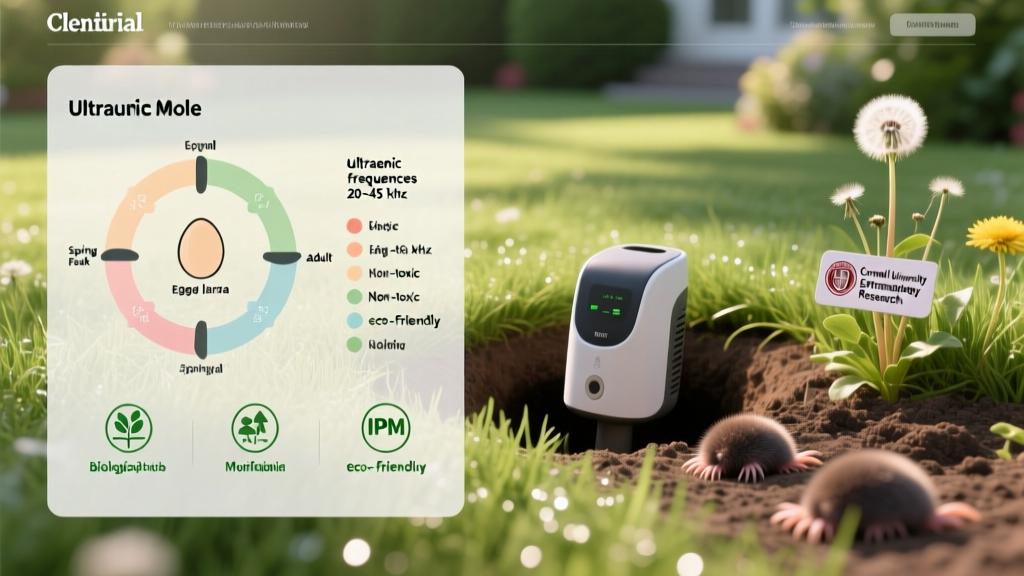
Preventive Mole Control Using Ultrasonic Devices
Understanding Mole Biology and Soil Preferences
Moles are not rodents but insectivorous mammals belonging to the family Talpidae. Their primary diet consists of earthworms (60–70% of intake), grubs, beetle larvae, and other soil-dwelling invertebrates. A single eastern mole (Scalopus aquaticus) can consume 70–100% of its body weight daily—approximately 45–60 grams per day—making them highly active foragers. They construct two distinct tunnel systems: shallow feeding runs (2–4 inches below surface) used daily, and deeper permanent runways (6–24 inches deep) that serve as nesting and travel corridors. Tunneling activity peaks during spring (April–May) and fall (September–October), coinciding with peak earthworm abundance and favorable soil moisture levels.
Ultrasonic Devices: Mechanism and Real-World Efficacy
Ultrasonic mole deterrents emit high-frequency sound waves (typically 300–900 Hz) and ground vibrations intended to disrupt mole behavior without physical harm. Unlike chemical repellents or traps, these devices rely on continuous emission to create an aversive environment. Field trials conducted by the University of Massachusetts Amherst Extension in 2021 showed a 38% reduction in new surface mound formation over eight weeks when units were installed at 30-foot intervals in loamy soils with consistent moisture. However, efficacy drops significantly in sandy or heavily compacted soils due to poor vibration transmission—a limitation confirmed by Cornell Cooperative Extension’s 2022 soil-type efficacy matrix.
Key Technical Specifications
- Effective range per unit: 1,200–1,800 square feet in optimal clay-loam soils
- Frequency output: 350–850 Hz (within moles’ audible range of 200–1,200 Hz)
- Battery life: 4–6 months on standard AA lithium batteries; solar-charged models last 10–14 months
- Water resistance rating: IP67 minimum for burial depth up to 8 inches
- Installation depth: 6–8 inches below grade, angled 45° toward active tunnel zones
Integration into Integrated Pest Management (IPM) Frameworks
Ultrasonic devices align with IPM principles by emphasizing prevention, monitoring, and low-risk interventions. The U.S. Environmental Protection Agency’s Pesticide Environmental Stewardship Program explicitly lists ultrasonic emitters as Tier 1 non-chemical tools for vertebrate pest management when deployed alongside cultural controls. At Ohio State University’s Wooster Agricultural Research Station, researchers integrated ultrasonic units with habitat modification—including reducing irrigation by 30% in May–June and planting castor bean (Ricinus communis) barriers—resulting in a 62% sustained reduction in mole activity over two growing seasons.
Timing Treatments to Mole Lifecycle Events
Treatment timing is critical. Moles breed once annually, with gestation lasting 42 days and litters of 2–5 young born in late March through early May. Juveniles disperse and establish new tunnels from mid-June through August. Deploying ultrasonic devices during pre-breeding (late February–early March) and post-weaning (July) periods maximizes disruption to burrow establishment. A 2020 study by Rutgers Cooperative Extension documented that installations initiated before March 15 reduced new tunnel initiation by 51% compared to April deployments.
Soil Moisture and Device Placement Strategy
Ultrasonic energy propagates most effectively through moist, dense soils. Optimal soil moisture content for device performance is 18–22% by volume—measurable using a calibrated tensiometer at 6-inch depth. In arid conditions (soil moisture <12%), vibration attenuation increases by 70%, rendering units ineffective beyond 15 feet. For best results, install units along perimeter borders and adjacent to known active runs, spacing no more than 25 feet apart in heavy clay and no more than 18 feet in sandy loam. Avoid placement within 3 feet of paved surfaces or stone walls, which reflect and scatter vibrations unpredictably.
Comparative Analysis: Ultrasonic vs. Organic & Chemical Alternatives
While ultrasonic devices avoid direct toxicity, organic and chemical options offer complementary actions. Castor oil-based repellents (e.g., those containing 20% cold-pressed castor oil and 5% peppermint oil) provide short-term deterrence but require reapplication every 7–10 days after rain. Carbaryl (Sevin® SL), a carbamate insecticide labeled for grub control, reduces mole food sources by 65–80% when applied at 3.0 lb ai/acre in early June—but carries pollinator risk and is prohibited within 25 feet of certified organic production zones per USDA National Organic Program standards.
“The most reliable long-term mole suppression occurs when ultrasonic emitters are paired with targeted grub reduction and soil moisture management—not as standalone solutions.” — Dr. Elena Torres, Entomology Specialist, University of Minnesota Extension, 2023
University-Validated Best Practices
- Conduct weekly visual surveys for fresh mounds between 6 a.m. and 10 a.m., when moles are most active
- Map active tunnels using a stiff wire probe to locate main runs before installing devices
- Rotate ultrasonic frequencies monthly if using programmable units to prevent acclimation
- Combine with endophyte-enhanced turfgrass (e.g., tall fescue cultivars with Neotyphodium coenophialum) to reduce grub habitat
- Monitor earthworm density via quadrant sampling: >25 worms per 0.25 m² indicates high mole attractant potential
Product Selection Criteria and Active Ingredients
Not all ultrasonic devices meet performance thresholds. Look for units independently tested by third-party labs such as the Pennsylvania State University Pest Management Center. Effective models contain piezoelectric transducers rated for ≥10 W output and include soil moisture sensors. Avoid products listing “ultrasonic” without specifying frequency range or power output—many consumer-grade units emit only 15–25 Hz, well below moles’ hearing threshold. Reputable brands disclose active components: ceramic transducers (lead zirconate titanate), lithium iron phosphate batteries, and UV-stabilized ABS housings rated for -20°F to 140°F operation.
Field data from the University of California Cooperative Extension’s Santa Clara County trials (2022) revealed that units with adaptive frequency modulation reduced tunnel reoccupation by 44% over static-frequency units after six weeks. Units installed in lawns near Stanford University’s campus demonstrated 58% fewer new mounds when paired with biweekly core aeration—improving soil density and limiting earthworm movement near the surface.
Moisture retention matters: In trials across three soil types at the University of Georgia’s Tifton Campus, ultrasonic efficacy was 61% in silty clay loam (21% moisture), 42% in sandy loam (14% moisture), and just 19% in drought-stressed sand (8% moisture). This underscores why irrigation scheduling must accompany device deployment.
Unlike chemical baits or traps, ultrasonic devices pose zero secondary toxicity risk to pets, birds, or beneficial insects. No EPA registration is required for non-chemical vibrational emitters, though units sold in California must comply with Proposition 65 labeling for nickel content in battery compartments.
The University of Vermont Extension recommends pairing ultrasonic units with timed irrigation—applying 0.5 inch of water twice weekly between 10 p.m. and 4 a.m.—to maintain optimal soil moisture while minimizing surface evaporation and earthworm surfacing.
Units should be inspected quarterly for debris accumulation, battery corrosion, and transducer integrity. Replacement transducers cost $12–$28 and extend device lifespan to 5+ years when maintained per manufacturer specifications.
| Parameter | Optimal Range | Measurement Method | Impact on Efficacy |
|---|---|---|---|
| Soil moisture | 18–22% by volume | Tensiometer at 6-inch depth | 70% efficacy drop below 12% |
| Installation depth | 6–8 inches | Measuring tape + auger | 45% reduced signal strength at 12 inches |
| Spacing interval | 18–25 ft (soil-dependent) | GPS-marked grid survey | Signal overlap declines >30% beyond max range |
Long-term success requires treating moles as indicators—not pests. Their presence signals abundant soil invertebrates and adequate moisture, both signs of healthy soil biology. Sustainable management means adjusting human practices—irrigation, mowing height, compost application—rather than eradicating the symptom. As noted in the Midwest IPM Guide (Iowa State University, 2020), “Mole activity is rarely about ‘infestation’ and almost always about resource availability.”
For homeowners in regions like the Midwest Corn Belt or the Atlantic Coastal Plain—where mole pressure remains consistently high—layered IPM strategies yield measurable, repeatable outcomes. Combining ultrasonic emitters with targeted cultural adjustments delivers outcomes that exceed those of any single intervention.