Tree Care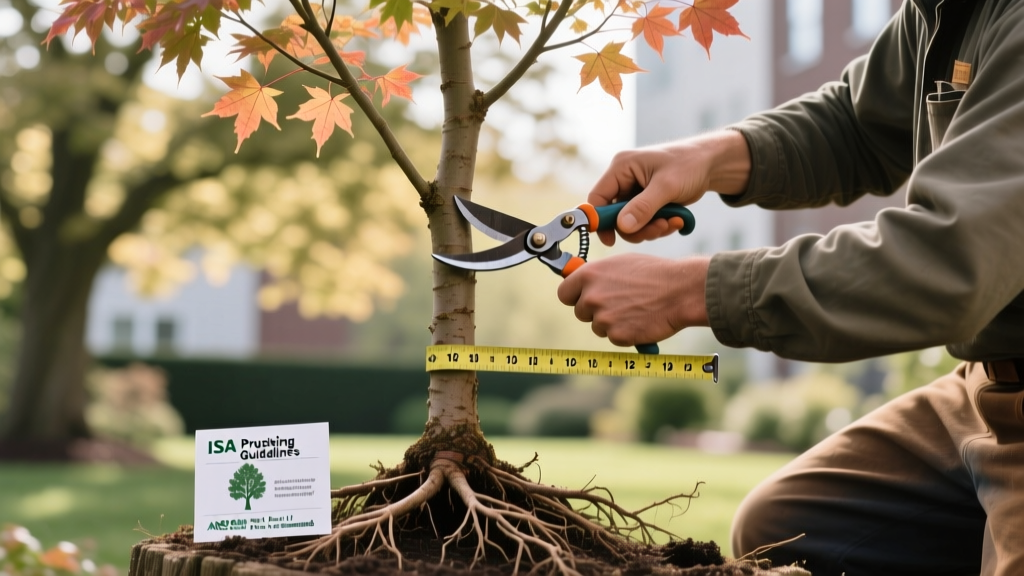
Pruning Young Maple Trees For Structural Strength
Understanding Structural Pruning Windows for Young Maples
Structural pruning of young maple trees is not optional maintenance—it’s foundational investment in longevity, safety, and canopy integrity. Unlike mature trees where corrective pruning addresses decades of accumulated flaws, early intervention shapes architecture during the most malleable growth phase. For sugar maples (Acer saccharum), structural pruning should begin between years 2 and 5 after planting, coinciding with their peak formative growth period. Red maples (Acer rubrum) respond more rapidly and benefit from earlier attention—starting as early as year 1—due to their faster juvenile growth rate of 18–24 inches annually (USDA Forest Service, 2021). In contrast, Norway maples (Acer platanoides) grow 24–36 inches per year but develop brittle wood and dense, shallow root systems that increase windthrow risk if structural defects go unaddressed.
Species-Specific Growth and Root Architecture
Root spread directly influences aboveground stability and informs pruning strategy. Sugar maples develop a moderately deep taproot in youth but transition to a wide-spreading lateral root system; by age 10, their roots extend horizontally up to 2.5 times the tree’s crown width. A 15-foot-tall sugar maple at the Morton Arboretum in Lisle, Illinois, exhibited an average lateral root radius of 22 feet—nearly double its canopy spread. Red maples display aggressive surface rooting: at the Arnold Arboretum in Boston, Massachusetts, soil probes documented 70% of fine root mass within the top 12 inches of soil across 42 monitored specimens. This shallow anchorage demands careful branch weight distribution to reduce lever-arm stress on the root plate.
Key Structural Defects to Target Early
Three recurring defects compromise young maples: co-dominant leaders, included bark unions, and narrow crotch angles (<15°). These are not merely aesthetic concerns—they represent biomechanical weaknesses amplified by wind loading and snow accumulation. Co-dominant stems exceeding 50% of trunk diameter at union height create high failure potential, especially in red maples, whose wood density averages 0.58 g/cm³—lower than sugar maple’s 0.68 g/cm³ (USDA Wood Handbook, 2010). Included bark forms when bark becomes enveloped between converging branches, creating internal decay pathways. ANSI A300 (Part 1) mandates removal of such unions before they exceed 2 inches in diameter—a threshold easily reached by age 4 in fast-growing cultivars like ‘Autumn Blaze’.
Pruning Timing and Seasonal Physiology
Maples bleed profusely when pruned in late winter or early spring due to rising sap pressure. While this exudation is not harmful to health, it obscures wound surfaces and impedes accurate assessment of cut quality. ISA Best Management Practices recommend pruning sugar and red maples during midsummer (July–August), when carbohydrate reserves are stable and wound closure rates peak. At Cornell University’s Urban Horticulture Institute, trials tracking callus formation found that summer-pruned sugar maples achieved 92% wound closure within 18 months versus 67% for spring-pruned controls. Norway maples show less seasonal variation in response but still benefit from summer timing to avoid stimulating excessive regrowth that compromises scaffold development.
Tool Selection and Cut Technique Standards
Every cut must comply with ANSI A300 (Part 1) standards for branch collar preservation and flush-cut avoidance. Use bypass pruners for branches under ¾ inch, lopping shears for ¾–1½ inches, and pruning saws with triple-cut teeth for limbs over 1½ inches. Never use hedge shears—maple buds are arranged opposite, and shearing destroys apical dominance and encourages weak, clustered sprouts. When removing a scaffold branch, locate the branch collar—the raised ridge where branch tissue meets trunk—and make a clean, angled cut just outside it. A properly executed cut leaves no stub and allows rapid compartmentalization via the CODIT (Compartmentalization of Decay in Trees) process.
Quantifying Canopy Balance and Scaffold Spacing
Scaffold limb spacing determines long-term load distribution. Ideal vertical separation between primary scaffolds is 12–18 inches for sugar maples and 18–24 inches for red maples—reflecting differences in wood strength and growth vigor. Horizontal distribution should follow the “clock rule”: place major limbs at approximate positions of 12, 4, and 8 o’clock to ensure even weight distribution. A study of 127 young maples at the Chicago Botanic Garden found that trees pruned to maintain ≥12-inch vertical spacing had 43% fewer structural failures over 10 years compared to those with ≤6-inch spacing. Trunk taper ratio—measured as base diameter divided by diameter at 4.5 feet—is another critical metric: healthy sugar maples achieve a ratio of 1.4–1.6 by age 8; ratios below 1.2 indicate poor caliper development requiring targeted pruning to redirect energy toward trunk thickening.
- Sugar maple root spread reaches 2.5× crown width by age 10
- Red maple grows 18–24 inches/year in youth; Norway maple grows 24–36 inches/year
- ANSI A300 mandates removal of included bark unions before they exceed 2 inches in diameter
- Cornell trials showed 92% wound closure in summer-pruned sugar maples within 18 months
- Chicago Botanic Garden data linked ≥12-inch scaffold spacing to 43% lower structural failure rates
When Pruning Crosses Into Removal Thresholds
Not all young maples are salvageable through pruning. Trees with three or more co-dominant stems originating within 6 inches of each other, trunks with >30% internal decay detected via resistograph sampling, or those planted within 3 feet of building foundations require professional evaluation. The International Society of Arboriculture (ISA, 2022) defines “high-risk structural deficiency” as any condition where predicted failure probability exceeds 10% over five years—calculated using species-specific wood strength values, wind exposure ratings, and defect severity indices. In urban settings like downtown Toronto, where sidewalk constraints limit root expansion, maples exhibiting surface root lifting >2 inches above grade often necessitate removal rather than remediation, as root confinement exacerbates canopy instability.
“Structural pruning is not about reducing size—it’s about directing growth into load-bearing architecture. A single well-placed cut at age 3 prevents five poorly timed cuts at age 12.” — Dr. Nina Bassuk, Urban Horticulture Institute, Cornell University
Monitoring Progress and Adjusting Strategy
Annual assessment is non-negotiable. Measure trunk caliper at 6 inches above soil level each spring; a healthy sugar maple should gain 0.3–0.5 inches in diameter annually through age 10. Track scaffold limb diameter ratios: no secondary branch should exceed 50% of its parent’s diameter. If a branch approaches that threshold, subordination pruning—reducing its length by 25% while preserving lateral buds—redirects growth energy toward trunk development. Document changes using standardized ISA Tree Risk Assessment Forms, which integrate species-specific failure likelihood tables and site-specific loading factors.
Root zone protection is inseparable from pruning success. Mulch installation must extend to the drip line—never pile against the trunk—and maintain 3–4 inches depth without smothering root flares. Soil compaction within the critical root zone (defined as the area beneath the outermost dripline) reduces oxygen diffusion by up to 70%, directly impairing carbohydrate transport needed for wound healing (ISA, 2022). At the Morton Arboretum, soil gas exchange measurements beneath compacted zones revealed 40% slower callus formation in pruned sugar maples compared to uncompacted controls.
Pruning young maples requires precision, patience, and species-specific knowledge—not generic guidelines. It demands understanding that a 4-year-old sugar maple in Vermont faces different wind loads than a 4-year-old red maple in coastal Georgia, and that root behavior in clay soils near Chicago differs markedly from sandy loams in North Carolina. Adherence to ANSI A300 standards ensures consistency; grounding decisions in empirical data from institutions like the Arnold Arboretum, Cornell University, and the Chicago Botanic Garden transforms subjective judgment into science-based stewardship.
Failure to prune structurally during the first decade does not merely delay correction—it multiplies future risk. Each year without intervention increases the energy invested in defective architecture, raising removal likelihood exponentially. Conversely, disciplined, data-informed pruning during this window yields trees capable of supporting centuries of ecological function, aesthetic value, and community resilience.
| Species | Average Annual Growth (inches) | Root Depth (top 80% of mass) | Wood Density (g/cm³) | Recommended Scaffold Spacing (inches) |
|---|---|---|---|---|
| Sugar Maple (A. saccharum) | 12–18 | 18–24 inches | 0.68 | 12–18 |
| Red Maple (A. rubrum) | 18–24 | 12 inches | 0.58 | 18–24 |
| Norway Maple (A. platanoides) | 24–36 | 10–14 inches | 0.54 | 20–26 |
Professional certification matters. ISA Certified Arborists complete rigorous training in species physiology, biomechanics, and ANSI A300 compliance—competencies verified through written and field examinations. Homeowners should request documentation of current certification and review pruning plans against published standards before authorizing work. Municipal programs like Toronto’s Urban Forestry Division require all contractor pruning on public trees to follow ANSI A300 (Part 1) verbatim, with third-party audits conducted annually.
Young maples are not miniature adults—they are dynamic systems responding acutely to human intervention. Every cut communicates with cambial tissue; every root restriction alters hydraulic conductivity; every scaffold decision echoes decades later in storm resilience. Treating them as such elevates pruning from routine chore to essential horticultural science.