
Landscaping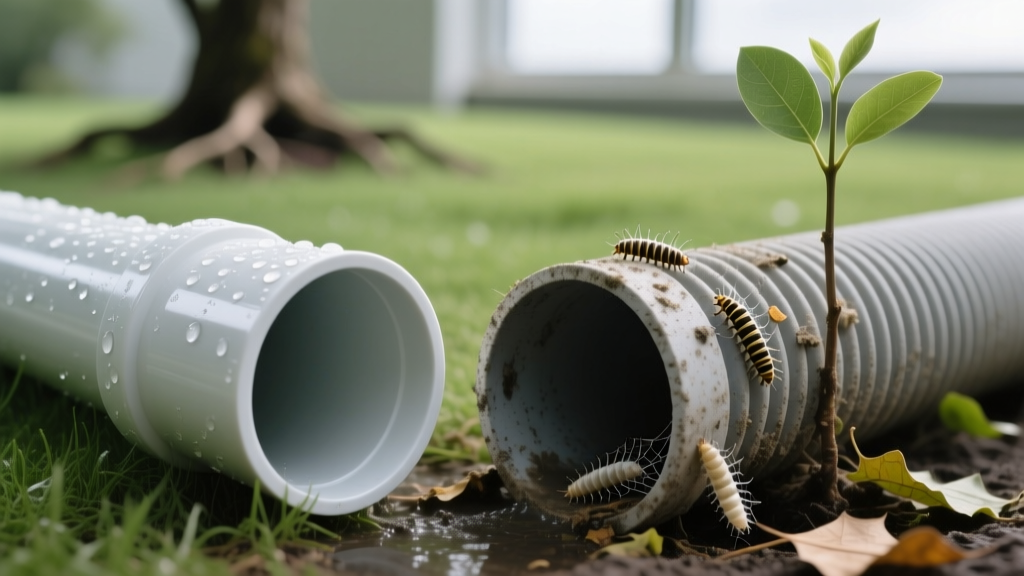
PVC vs Corrugated Drain Pipe 2026: Tree Web Worm Guide
James MillerPublished
The Hidden Link Between Landscape Drainage and Tree Web Worms
When planning a comprehensive landscape drainage system in 2026, most homeowners and contractors focus solely on moving water away from foundations and low-lying turf. However, if your property features susceptible hardwoods like pecan, walnut, cherry, apple, or persimmon, you must also consider the biological threats that interact with your drainage infrastructure. Chief among these is the fall webworm (Hyphantria cunea). While typically viewed as an aesthetic nuisance, fall webworms create a cascade of secondary issues that directly impact soil health, tree vitality, and the physical integrity of your subsurface drainage pipes.
Trees suffering from poor drainage and chronic root asphyxiation are highly vulnerable to secondary pests. As the Arbor Day Foundation emphasizes, trees stressed by waterlogged soil emit specific volatile organic compounds (VOCs) that signal vulnerability to foraging insects. By installing an efficient drainage system, you maintain optimal soil oxygen levels, keeping your trees vigorous and naturally resistant to severe defoliation. Yet, the choice of pipe material—specifically the debate between corrugated HDPE and rigid PVC—plays a massive role in how well your system survives the annual web worm fallout.
The Debris Threat: Silk, Frass, and Autumn Rain
To understand why pipe material matters, you must understand the biology of the infestation. According to Penn State Extension, fall webworms construct massive, protective silken tents over the terminal branches of host trees in late summer and early autumn. Inside these tents, hundreds of caterpillars consume foliage and excrete copious amounts of frass (insect waste).
By late September and October, these tents become heavy, necrotic masses of silk, dead leaves, and frass. When the first heavy autumn rains arrive, this debris is washed off the canopy and swept across the landscape into surface drains, catch basins, and French drains. The University of Kentucky Entomology department notes that the tensile strength of webworm silk is surprisingly high, especially when wet. This silk acts like a net, binding with autumn leaf litter and frass to form dense, concrete-like clogs inside subsurface drainage pipes. The type of pipe you have buried in your yard will determine whether this debris flushes harmlessly into the municipal storm drain or backs up, causing localized flooding and root rot.
Corrugated vs. PVC Drainage Pipe: 2026 Comparison
In 2026, the landscaping industry continues to debate the merits of flexible corrugated pipe versus rigid PVC (Schedule 40 or SDR-35). While corrugated pipe remains popular for its low upfront cost and ease of bending around existing landscape features, its performance in environments heavily populated by web worm host trees is notoriously poor. Below is a comprehensive comparison of how these two materials handle the unique challenges of pest-heavy landscapes.
| Feature | Corrugated Pipe (HDPE) | Rigid PVC (Schedule 40 / SDR-35) |
|---|---|---|
| 2026 Avg Cost (per linear ft) | $0.85 - $1.30 | $2.75 - $4.50 |
| Interior Surface Profile | Ridged and Corrugated | Completely Smooth |
| Web Worm Silk Adhesion | Severe (Silk snags on ridges) | Minimal (Silk slides freely) |
| Joint Integrity | Snap couplers (prone to gaps) | Solvent-welded (watertight seal) |
| Root Intrusion Risk | High (roots enter slits/gaps) | Extremely Low |
| Expected Lifespan | 10 - 15 Years | 50+ Years |
The Downfall of Corrugated Pipes in Pest-Heavy Zones
Corrugated pipes are manufactured with a series of concentric ridges to provide structural flexibility. In a clean, sandy-soil environment, water flows through them adequately. However, when webworm silk and frass enter a slotted or solid corrugated pipe, the ridges act as microscopic catch-points. The silk wraps around the interior corrugations, creating a net that subsequently catches falling autumn leaves, pine needles, and soil sediment.
Within a single season, this biological netting calcifies into a solid plug. Because corrugated pipes cannot be effectively cleared with standard high-pressure hydro-jetting—the jetting nozzle frequently snags on the ridges or blows apart the cheap snap-coupler joints—contractors are often forced to excavate and replace entire sections of the drain. Furthermore, if you are using slotted corrugated pipe for a French drain near a stressed, waterlogged pecan or cherry tree, the shallow, oxygen-starved roots will aggressively infiltrate the slots, intertwining with the webworm debris to create an impenetrable blockage.
Why PVC is the Superior Choice for Web Worm Management
Rigid PVC pipe, particularly SDR-35 (which is lighter and easier to handle than Schedule 40 but features the same smooth interior), is the undisputed champion for landscapes prone to heavy canopy debris. The interior of a PVC pipe is glass-smooth. When a surge of autumn rainwater pushes a slurry of webworm silk, frass, and leaf litter into a PVC drain, the lack of friction allows the debris to remain suspended in the water column and flush completely out of the system.
Additionally, PVC joints are solvent-welded using PVC primer and cement, creating a monolithic, watertight seal. This prevents the egress of water into the surrounding soil (which would exacerbate the very root-rot issues that attract pests in the first place) and completely blocks the ingress of opportunistic tree roots. For homeowners actively managing tree web worm populations, investing in PVC ensures that the subsurface drainage system remains functional and requires virtually zero autumn maintenance.
Trenching and Installation Best Practices Near Susceptible Trees
Upgrading to PVC is only half the battle; how you install it around your vulnerable trees is equally critical. Trees like black walnut, hickory, and sweetgum rely on extensive, shallow lateral root systems to absorb oxygen and nutrients. Trenching for drainage pipes using heavy mechanical excavators can sever these vital roots, inducing massive physiological stress that triggers a severe web worm outbreak the following year.
In 2026, modern landscaping standards dictate the use of hydro-excavation (air trenching or water trenching) when routing PVC pipes within the critical root zone (the drip line) of susceptible trees. Hydro-excavation uses high-pressure air or water to safely part the soil and expose roots, allowing contractors to route the PVC pipe beneath major structural roots without slicing them. If a root must be crossed, the pipe should be dipped below it using gradual 45-degree PVC sweep bends rather than sharp 90-degree elbows, which impede water flow and encourage debris settling.
Always maintain a minimum slope of 1/8 inch per linear foot for your PVC drainage runs. This specific gradient ensures that water moves fast enough to carry the heavy, wet webworm frass out of the pipe, but slow enough to prevent soil erosion around the pipe bedding.
Surface Water Management: Catch Basins and Grates
While the subsurface PVC pipe handles the transport of water, the point of entry is where the battle against webworm debris is won or lost. Never rely on open French drain gravel beds near heavily infested trees. The gravel will quickly become choked with silk and frass, turning into a muddy, impermeable dam.
Instead, install 9x9 inch or 12x12 inch polyethylene catch basins equipped with domed or atrium grates. The atrium grate design features a raised, three-dimensional surface area that prevents flat, wet webworm tents and large leaves from laying flush against the grate and sealing it off. Even if a massive webworm tent washes down and covers part of the grate, the vertical sides of the atrium allow water to continue entering the basin from the top and sides. The catch basin itself acts as a settling chamber, trapping the heavy frass and sediment at the bottom while allowing the water to flow smoothly into the connected PVC pipe.
Seasonal Maintenance: Preparing Drains for the Web Worm Peak
Even with a perfectly sloped PVC system and atrium grates, proactive maintenance is required to keep your landscape pristine. The peak of the fall webworm lifecycle usually coincides with the first major autumn storms. In late August, before the tents reach their maximum size and structural integrity, it is highly recommended to manually prune and remove the webs from the lower branches of your trees. This source-reduction technique drastically reduces the volume of silk that will eventually wash into your drainage system.
Additionally, schedule an annual pipe flushing in early September. Using a garden hose with a high-pressure nozzle, run water through your catch basins and PVC cleanouts. Because the PVC is smooth, this simple annual flush will dislodge any minor accumulations of summer pollen, early frass, or windblown debris, ensuring the pipe has maximum volumetric capacity just before the heavy October rains and the final webworm drop.
Conclusion: Investing in Long-Term Landscape Health
Managing tree web worms is not solely about applying biological controls like Bacillus thuringiensis (Bt) or pruning branches; it is about maintaining a holistic, stress-free environment for your trees. By recognizing the severe clogging hazards that webworm silk and frass pose to traditional corrugated drainage systems, homeowners can make the informed choice to upgrade to smooth-walled PVC. Though the initial material and labor costs for PVC are higher in 2026, the elimination of annual excavations, the prevention of root-rot-inducing clogs, and the preservation of your trees' natural pest resistance make it the most cost-effective and ecologically sound landscaping investment you can make.

