Lawn Care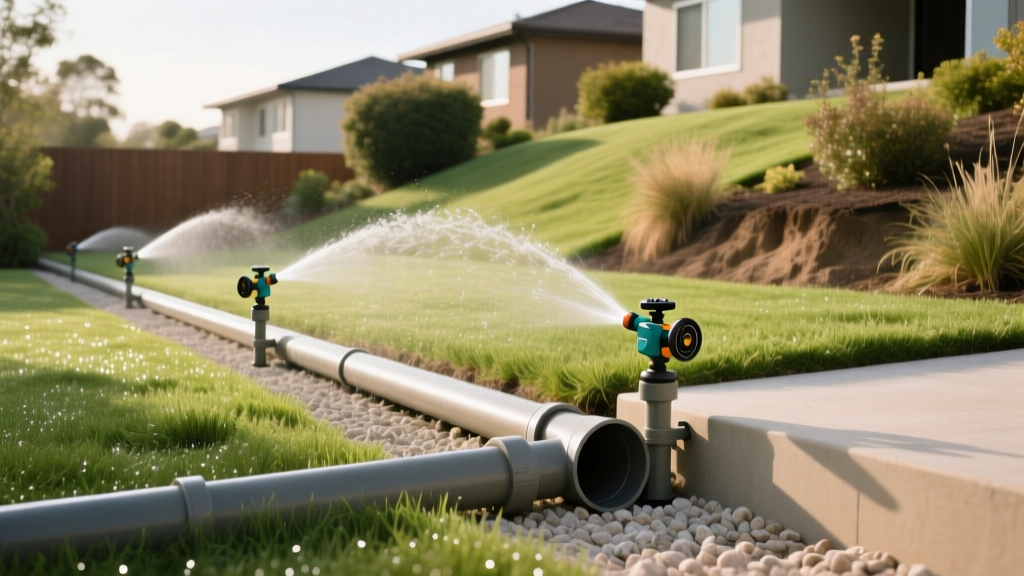
Rain Bird Rotary Sprinkler Spacing Near Drainage Pipes (2026)
Mike RodriguezPublished
The Intersection of Irrigation and Subsurface Drainage
As we navigate the 2026 landscaping season, homeowners and professionals alike are recognizing that a healthy lawn requires a delicate balance between hydration and water removal. While installing a high-efficiency irrigation system is a priority, it must work in perfect harmony with your yard's subsurface infrastructure. Specifically, managing Rain Bird rotary sprinkler head adjustment and spacing around a landscape drainage pipe is a critical skill that prevents soil erosion, overwhelmed catch basins, and costly subsurface pipe damage.
When a powerful rotary head throws a heavy stream of water directly into a French drain gravel trench, a surface catch basin grate, or the exit point of a corrugated HDPE drainage pipe, it defeats the purpose of the drainage system. The sudden influx of surface water can cause soil liquefaction near the pipe trenches, leading to sinkholes or collapsed PVC joints. In this comprehensive 2026 guide, we will explore how to properly adjust and space your Rain Bird rotors to protect your landscape drainage pipes while maintaining lush, head-to-head turf coverage.
Choosing the Right Rain Bird Rotor for Drainage-Heavy Yards
Not all rotary sprinklers are created equal, especially when you are working around sensitive landscape drainage pipes. In 2026, the industry standard for residential and light commercial applications remains the Rain Bird 5000 Plus series and the heavy-duty Falcon SS6535. These models offer superior flow control and arc adjustment, which are mandatory when you need to restrict water from hitting drainage grates.
According to irrigation best practices outlined by the University of Minnesota Extension, matching your sprinkler's precipitation rate to your soil's infiltration rate is vital. When landscape drainage pipes are present, the soil near the drain trenches is often backfilled with gravel or loose amended soil, which drains much faster but is also highly susceptible to washing away if hit by a high-velocity rotary stream.
2026 Rain Bird Rotor Clearance and Specification Table
| Rain Bird Model | Throw Radius | Min. Distance from Drain Grate | Trench Depth Consideration |
|---|---|---|---|
| Rain Bird 5000 Plus Rotor | 25 - 50 ft | 36 inches | Keep sprinkler PVC 12 inches above drainage pipe |
| Rain Bird Falcon SS6535 | 35 - 65 ft | 48 inches | Requires 18-inch lateral separation from French drains |
| Rain Bird MaxRotator (MP) | 8 - 35 ft | 24 inches | Ideal for narrow parkways with shallow corrugated pipes |
Step-by-Step Rain Bird Rotary Adjustment Guide
Proper adjustment is your first line of defense against flooding your landscape drainage pipes. The goal is to utilize the Rain Bird rotor's built-in adjustment features to 'paint' the lawn with water while deliberately leaving the drainage infrastructure dry.
1. Setting the Fixed Left Edge
Hold the center cap of the Rain Bird rotor and rotate it all the way to the right until it stops, then release. Next, rotate it to the left until it stops. This is your fixed left edge. Position this edge so that the water stream will naturally swing away from your landscape drainage pipe exit or catch basin.
2. Adjusting the Arc
Insert the Rain Bird adjustment tool into the arc adjustment socket. Turn clockwise to increase the arc and counterclockwise to decrease it. If you have a drainage pipe running parallel to your property line, you may need to restrict the arc to 90 or 180 degrees to ensure the rotor does not spray water into the neighbor's yard or into a perimeter French drain trench.
3. Radius and Flow Reduction (The Most Critical Step)
This is where you protect your drainage pipes. Insert the tool into the radius reduction screw located on top of the nozzle. Turning this screw clockwise will reduce the throw distance by up to 25%. By dialing back the radius, you ensure that the heavy droplets at the end of the stream do not crash into the gravel bed of your landscape drainage pipe. Furthermore, reducing the flow decreases the overall gallons per minute (GPM) output, giving the soil time to absorb the water rather than running off into the drain grates.
Spacing Strategies: Head-to-Head vs. Grate Avoidance
Standard irrigation design dictates 'head-to-head' coverage, meaning the spray from one sprinkler should reach the adjacent sprinkler head. However, when a landscape drainage pipe is installed beneath the surface, rigid adherence to this rule can cause problems.
Experts at UMN Extension Yard and Garden Infrastructure note that subsurface drainage systems rely on a specific soil gradient to move water into the perforated pipes. If you place a Rain Bird rotor directly on top of or immediately adjacent to a perforated landscape drainage pipe, the constant saturation can cause the surrounding soil to collapse into the pipe's gravel envelope, eventually clogging the geotextile fabric and the pipe itself.
The 3-Foot Buffer Rule for 2026
- Linear French Drains: Keep all rotary sprinkler heads at least 3 feet away from the centerline of a linear French drain trench. Use the radius reduction screw to stop the spray 1 foot short of the trench.
- Catch Basins and Grates: Offset your sprinkler heads so the wind-blown mist does not settle directly onto the grates. Surface water should enter a catch basin via natural sheet flow across the grass, not via direct injection from a high-pressure rotor.
- Dry Well Exits: If your landscape drainage pipe terminates in a dry well or a pop-up emitter, ensure no Rain Bird rotor is spaced within 5 feet of the emitter. A popping emitter combined with a 3 GPM rotary stream will instantly create a localized mud pit.
Installation Precautions: Avoiding Pipe Strikes
When installing or repairing your Rain Bird rotary system in a yard that already features a landscape drainage pipe, trenching requires extreme caution. In 2026, the cost of repairing a crushed Schedule 40 PVC drainage main or a severed HDPE corrugated pipe can easily exceed $1,500 due to excavation and turf replacement costs.
Vertical and Horizontal Separation
When running your irrigation mainline (usually 1-inch or 1.25-inch PVC or poly pipe) parallel to a landscape drainage pipe, maintain a minimum horizontal separation of 12 inches. If the pipes must cross, ensure the irrigation pipe passes above the drainage pipe with at least 6 inches of compacted soil in between. This prevents the heavy, water-filled drainage pipe from settling and crushing your irrigation line over time.
Utilizing Pipe Locators
Before digging new trenches for your Rain Bird rotors, use a ground-penetrating radar (GPR) or a specialized sonde pipe locator to trace the exact path of your subsurface landscape drainage pipes. Many modern drainage systems installed in the early 2020s were laid with tracer wire specifically for this purpose. Locating the wire saves you from driving a shovel through a critical water-management artery.
Integrating Smart Controllers with Drainage Awareness
The smart home revolution has reached the sprinkler valve box. In 2026, pairing your Rain Bird rotors with a smart controller like the Rain Bird ST8I-2.0S or the ESP-ME3 equipped with a flow sensor is a game-changer for yards with extensive drainage pipes.
If a landscape drainage pipe shifts due to frost heave or heavy soil settling, it can pull on nearby irrigation lines or cause the ground to sink, damaging a rotor body. A flow sensor will immediately detect the abnormal water usage caused by a broken pipe or a geysering sprinkler head and shut down the zone. This prevents thousands of gallons of water from flooding your yard and overwhelming your landscape drainage pipes, potentially saving your foundation from water intrusion.
Furthermore, integrating local weather data via Wi-Fi ensures that your Rain Bird rotors do not run during heavy rain events. Overwatering is the number one enemy of subsurface drainage; by letting the smart controller skip cycles after a storm, you allow your landscape drainage pipes to do their job without fighting against your irrigation schedule.
Seasonal Maintenance for Irrigation and Drainage Harmony
To ensure your Rain Bird rotors and landscape drainage pipes continue to work in tandem throughout 2026 and beyond, adhere to this seasonal maintenance checklist:
- Spring Start-Up: When pressurizing the system, check every rotor head near a drainage grate. Ensure the soil hasn't settled over the winter, which can alter the spray angle and cause water to shoot directly into the drain.
- Mid-Summer Audit: Run a catch-can test. Place catch cans near your drainage pipe trenches to verify that the radius reduction screws haven't vibrated loose, which would result in over-spraying the drainage infrastructure.
- Fall Winterization: When blowing out your Rain Bird system with compressed air, ensure the air pressure does not exceed 50 PSI. High-pressure air can travel through compromised irrigation lines and inadvertently blow debris into nearby landscape drainage pipes if the trenches share a gravel bed.
Conclusion
Mastering Rain Bird rotary sprinkler head adjustment and spacing is about more than just achieving a green lawn; it is about respecting the hidden infrastructure beneath your feet. By carefully adjusting arcs, utilizing radius reduction, and maintaining strict clearance from your landscape drainage pipes, you protect your investment in both irrigation and drainage. As water management technologies and techniques continue to evolve in 2026, the fundamental rule remains the same: apply water precisely where the turf needs it, and keep it away from the drains designed to carry it away.
For more detailed schematics on residential water management, professionals frequently consult the official Rain Bird landscape rotors documentation, which provides updated nozzle charts and GPM data essential for calculating your yard's total hydrological load. By combining this data with a well-mapped landscape drainage pipe network, you guarantee a resilient, beautiful, and structurally sound landscape for years to come.