Lawn Care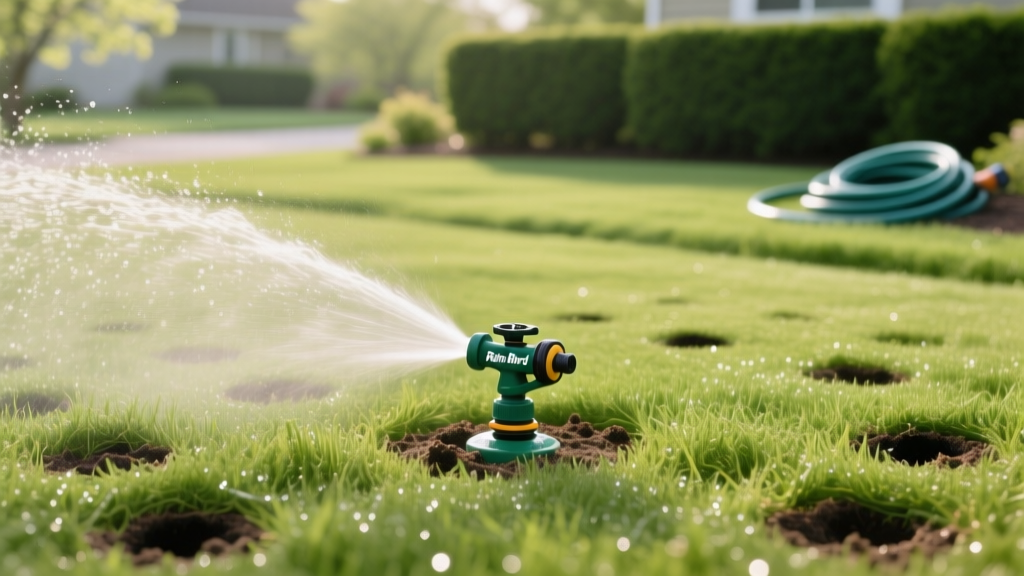
Rain Bird Rotary Sprinkler Adjustment For Core Aeration 2026
Robert HayesPublished
The Synergy Between Core Aeration and Precision Irrigation
Core aeration is one of the most transformative cultural practices you can perform on your lawn. By extracting small plugs of soil and thatch, you alleviate compaction, enhance gas exchange, and create direct pathways for water and nutrients to reach the root zone. However, the benefits of core aeration can be entirely negated if your irrigation system is not calibrated to handle the newly improved soil dynamics. In 2026, with water conservation mandates becoming stricter and summer temperatures more volatile, optimizing your irrigation system is not just a best practice—it is a necessity.
Rain Bird rotary sprinklers are the gold standard for medium to large residential lawns. Unlike traditional spray heads that dump water rapidly, rotors apply moisture at a slower, more deliberate rate. When paired with a recently aerated lawn, this slow application allows water to seep deeply into the aeration holes rather than pooling on the surface. Yet, many homeowners fail to adjust their Rain Bird rotary heads after aerating, leading to uneven coverage, dry spots, and wasted water. This comprehensive guide will walk you through the exact spacing, mechanical adjustments, and scheduling techniques required to synchronize your Rain Bird rotary sprinklers with your core aeration efforts in 2026.
Why Aeration Demands Irrigation Recalibration
Before adjusting your sprinklers, it is crucial to understand how core aeration changes your soil's infiltration rate. Compacted clay soils typically have an infiltration rate of roughly 0.1 to 0.2 inches per hour. When you apply water faster than this rate, runoff occurs, carrying expensive fertilizers into storm drains. According to the University of Minnesota Extension, core aeration can temporarily increase this infiltration rate by breaking up the thatch layer and opening macro-pores in the soil profile.
However, an increased infiltration rate does not mean you should flood the lawn. The goal is to apply water evenly so that every aeration plug receives adequate moisture. If your Rain Bird rotors are spaced too far apart, the overlapping zones will fail to deliver uniform moisture, leaving the soil between the sprinklers dry and compacted. Conversely, if the radius is set too high, wind drift will steal the water before it can enter the freshly opened soil pores. Recalibrating your system ensures that the mechanical application rate perfectly matches the biological uptake rate of your aerated turf.
Spacing Rain Bird Rotary Sprinklers for Aerated Lawns
The most common mistake in residential irrigation is 'gap spacing,' where sprinklers are placed so that the water from one head barely reaches the next. For an aerated lawn to heal and establish deep roots, you must employ 'head-to-head' spacing. This means the distance between two sprinkler heads should be exactly equal to the radius of the water throw. If your Rain Bird rotor throws water 35 feet, the next head must be located exactly 35 feet away.
Head-to-head spacing accounts for wind drift and evaporation, ensuring that the overlapping patterns provide a uniform coefficient of uniformity (CU). The official Rain Bird rotor specifications emphasize that matching precipitation rates across all nozzles in a single zone is critical to prevent overwatering certain areas while underwatering others.
2026 Rain Bird Rotor Spacing and Nozzle Chart
The table below outlines the recommended head-to-head spacing for the most popular 2026 Rain Bird 5000 and 5000 Plus series rotors, utilizing Matched Precipitation Rate (MPR) nozzles. These measurements assume standard residential water pressure (45-50 PSI).
| Rain Bird Rotor Model | Nozzle Size | Max Radius (ft) | Recommended Spacing (ft) | Precipitation Rate (in/hr) |
|---|---|---|---|---|
| 5000 Plus (SAM) | 2.0 MPR | 25 | 25 | 0.42 |
| 5000 Plus (SAM) | 3.0 MPR | 32 | 30 | 0.45 |
| 5000 Plus (SAM) | 4.0 MPR | 38 | 35 | 0.50 |
| 5000 MPR | 3.0 | 30 | 28 | 0.60 |
| 5000 MPR | 4.0 | 35 | 32 | 0.65 |
Note: The SAM (Seal-A-Matic) models are highly recommended for aerated lawns on slopes, as they prevent low-head drainage, keeping water in the lines and ready for the next cycle without leaking into the aeration holes prematurely.
Step-by-Step Rain Bird Rotary Head Adjustment
Once you have verified your spacing, you must physically adjust the heads to ensure the water is landing exactly where your aerated turf needs it. You will need the official Rain Bird multi-tool (or a flathead screwdriver) to perform these adjustments.
1. Adjusting the Arc
Rain Bird rotors allow for an arc adjustment between 40 and 360 degrees. To set the left stop, turn the sprinkler head clockwise until it stops. This is your starting point. To set the right stop, use the multi-tool to turn the arc adjustment screw clockwise to increase the arc or counter-clockwise to decrease it. For aerated lawns near hardscapes, precise arc adjustment is vital; you want to avoid watering sidewalks, which not only wastes water but can cause moss and algae growth in the shaded crevices of your driveway.
2. Adjusting the Radius
After core aeration, the soil near the sprinkler head is highly receptive to water. If the radius is too long, water will overshoot the target zone. Locate the radius reduction screw on top of the nozzle. Turning this screw clockwise reduces the throw distance. According to Texas A&M AgriLife Extension, reducing the radius by more than 25 percent can distort the water stream and ruin the precipitation uniformity. If you need to reduce the throw by more than 25 percent, swap the nozzle for a smaller MPR size rather than choking the screw.
3. Checking the Stream Angle
Ensure the stream is shooting at the optimal 25-degree angle. If it is too low, the water will hit the grass blades immediately surrounding the aerated plug, causing surface tension issues. If it is too high, wind will carry the water away. Use the multi-tool to gently adjust the nozzle ratchet if the head is not popping up to its full height, which is often caused by soil debris falling into the aeration holes near the sprinkler body.
Implementing the Cycle and Soak Method Post-Aeration
Even with perfectly spaced and adjusted Rain Bird rotors, the sheer volume of water applied during a standard 30-minute run time can overwhelm the soil, aerated or not. The 'Cycle and Soak' method is the ultimate strategy for maximizing core aeration benefits. This involves dividing your total watering time into multiple shorter cycles, allowing the soil to absorb the moisture fully between runs.
For example, if your lawn requires 1 inch of water per week, and your Rain Bird 5000 rotors apply 0.5 inches per hour, you need 120 minutes of total run time per week. Instead of running the zone for 40 minutes three times a week, program your controller to run each zone for 10 minutes, wait 45 minutes for the water to infiltrate the aeration holes, and then run the zone for another 10 minutes. This method forces the water deep into the macro-pores created by your aerator, encouraging roots to grow downward in search of moisture, which builds a highly drought-resistant lawn for the peak of the 2026 summer season.
2026 Smart Controller Integration
Manual adjustments and basic timers are becoming obsolete. In 2026, integrating your adjusted Rain Bird rotors with a smart controller like the Rain Bird ESP-TM2 or the ST8I-2.0 is essential for maintaining an aerated lawn. These controllers connect to local weather stations and adjust watering schedules based on real-time evapotranspiration (ET) data.
When paired with an in-ground soil moisture sensor, the smart controller can detect exactly when the water has penetrated the aeration holes and reached the root zone, automatically shutting off the system to prevent deep percolation and nutrient leaching. After a core aeration service, simply activate the 'Cycle and Soak' feature on your smart app, input your soil type (clay, loam, or sand), and let the 2026 algorithms handle the precise timing. This ensures that the mechanical adjustments you made to the rotary heads are supported by intelligent, weather-responsive scheduling.
Conclusion
Core aeration and precision irrigation are two sides of the same coin. Performing one without optimizing the other is a waste of time, money, and natural resources. By ensuring head-to-head spacing, meticulously adjusting the arc and radius of your Rain Bird rotary sprinklers, and utilizing the cycle and soak method, you guarantee that every drop of water is utilized by your turf. As you maintain your lawn throughout 2026, remember that a well-aerated lawn paired with a finely tuned Rain Bird irrigation system is the ultimate defense against heat stress, compaction, and water waste.