Lawn Care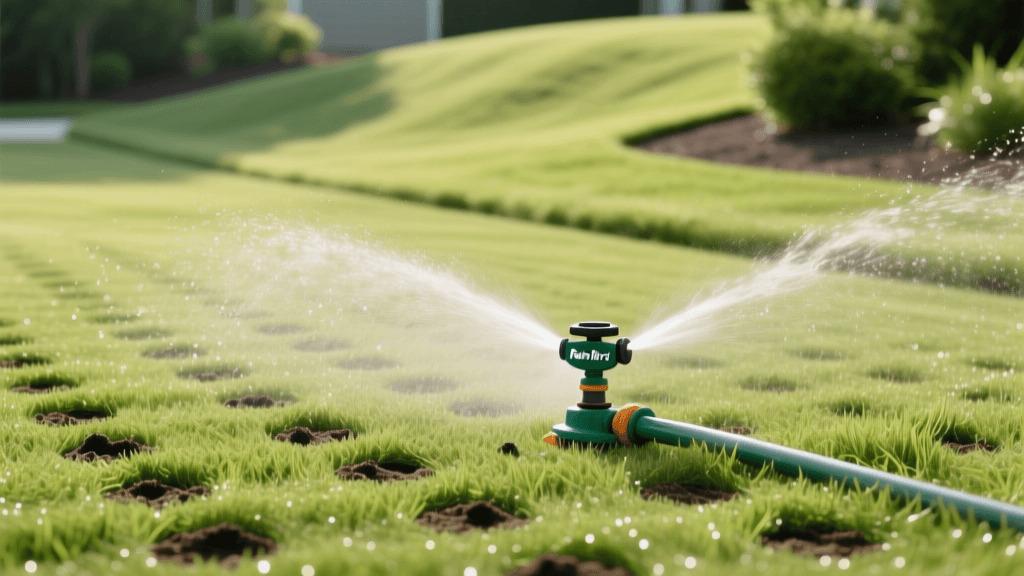
Rain Bird Rotary Sprinkler Setup for Aeration and Seeding 2026
The Critical Link Between Aeration, Seeding, and Irrigation
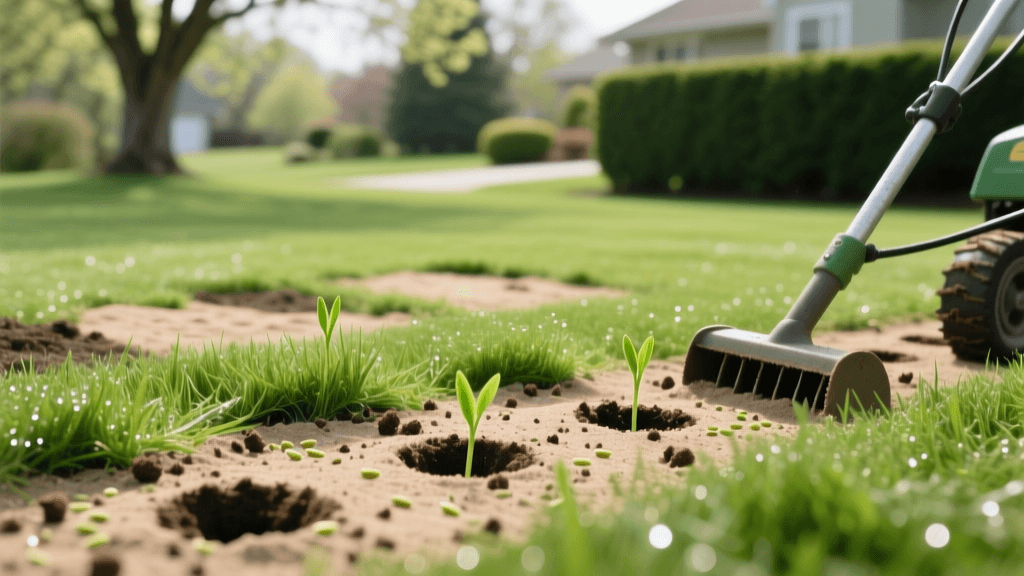
Aeration and overseeding are the undisputed cornerstones of cultivating a thick, resilient, and drought-tolerant lawn. However, as we navigate the increasingly erratic spring and fall weather patterns of 2026, the ultimate success of your seeding efforts hinges entirely on your irrigation strategy. When you core aerate a lawn, you extract thousands of small soil plugs, creating vital channels for oxygen, water, and nutrients. When you drop grass seed immediately after, those aeration holes become the perfect, protected germination pods for new seedlings.
The challenge arises when you turn on the sprinklers. Standard high-pressure spray heads deliver water far too aggressively. They will easily wash your expensive grass seed right out of those aeration holes, pool in the depressions, or create a muddy surface mess that suffocates new grass before it can establish roots. This is where precise Rain Bird rotary sprinkler head adjustment and spacing become your absolute secret weapon. By utilizing the gentle, low-precipitation application of rotary nozzles, you can keep the seedbed consistently moist without disrupting the delicate soil structure you just worked so hard to create.
Why Rain Bird Rotary Nozzles Outperform Standard Sprays for Seeding
To understand why rotary heads are superior for post-aeration care, we must look at the precipitation rate (PR). The precipitation rate is the speed at which water is applied to the lawn, typically measured in inches per hour. Standard fixed spray heads dump water at a rate of 1.5 to 2.0 inches per hour. In 2026, with many municipalities enforcing stricter water conservation guidelines and clay-heavy soils struggling to absorb rapid moisture, standard sprays almost guarantee surface runoff before the water ever reaches the root zone or the bottom of the aeration core.
Rain Bird rotary nozzles, such as the highly efficient R-VAN series or the 5000 Series Rotors, apply water at a fraction of that speed. By delivering a slow, steady stream that rotates across the turf, the soil has ample time to absorb the moisture. According to turf management experts at the University of Minnesota Extension, slow and frequent watering is the gold standard for seed germination, as it maintains the critical surface moisture required for the seed to crack and sprout without causing soil erosion.
| Sprinkler Type | Avg. Precipitation Rate | Runoff Risk on Seeded Lawns | Best Use Case |
|---|---|---|---|
| Standard Fixed Spray | 1.5 - 2.0 in/hr | High | Established lawns, small strips |
| Rain Bird R-VAN Rotary | 0.6 - 0.8 in/hr | Low | Post-aeration seeding, slopes |
| Rain Bird 5000 Rotor | 0.4 - 0.6 in/hr | Very Low | Large turf areas, deep soaking |
Spacing Rain Bird Rotary Heads for Uniform Germination
Proper spacing is non-negotiable when watering newly seeded lawns. If a seed dries out even once during the first 14 days of germination, it will likely die. Rotary sprinkler streams are highly susceptible to wind drift, which is incredibly common during the prime aeration seasons of early spring and early fall. If you space your Rain Bird rotary heads edge-to-edge (where the water from one head barely reaches the next), wind will blow the gentle streams off course, leaving devastating dry patches across your newly seeded lawn.
You must employ the 'head-to-head' coverage rule. This means the sprinkler heads must be spaced so that the water from one head reaches the exact location of the adjacent head. For example, if you are using Rain Bird R-VAN nozzles with a 17-foot radius specification, you should space the sprinkler bodies no more than 14 to 15 feet apart. This overlapping coverage ensures that even if a gentle autumn breeze pushes the water stream, the adjacent head is already covering that zone, guaranteeing uniform moisture across every single aeration hole.
Furthermore, as noted by NC State TurfFiles, uniform distribution uniformity (DU) is critical for preventing localized dry spots that lead to patchy germination. Overlapping your Rain Bird rotary heads by at least 30% ensures that the edges of your lawn receive just as much water as the areas directly beneath the sprinkler heads.
Step-by-Step Adjustment for Gentle Seed Watering
Installing the right nozzle is only half the battle. To truly protect your aeration cores and the seed within them, you must physically adjust the Rain Bird rotary heads to soften the water's impact. Here is how to fine-tune your system for the 2026 growing season.
1. Adjusting the Arc for Precision Coverage
For corner heads or those near garden beds, you need to adjust the arc so you aren't watering your driveway or patio. On a Rain Bird 5000 series rotor, insert the adjustment tool into the top of the nozzle turret. Hold the turret at the desired right-side stopping point, and turn the tool clockwise to increase the arc or counterclockwise to decrease it. For R-VAN nozzles, simply grip the top of the nozzle and rotate the outer ring to set your left and right boundaries. Ensuring water is strictly confined to the seeded turf prevents the waste and hardscape runoff that can trigger local 2026 water violation fines.
2. Reducing the Radius to Protect Aeration Cores
This is the most crucial step for seeding. When water shoots out of a rotary nozzle at maximum distance, it exits with high velocity. When that high-velocity stream hits the soil, it can act like a pressure washer, blasting your grass seed out of the aeration holes and displacing the soil plugs.
To fix this, use the radius reduction screw located on the top of the Rain Bird nozzle. Turn the screw clockwise to reduce the throw distance. By dialing the radius back by just 10% to 15%, you significantly lower the exit velocity of the water stream. The water will still reach the necessary overlapping distance (thanks to your head-to-head spacing), but it will fall much more softly onto the soil surface. This gentle application keeps the seed nestled safely inside the aeration core where it can establish a deep, robust root system.
3. Matching Precipitation Rates Across Zones
A common mistake homeowners make is mixing standard spray heads and Rain Bird rotary nozzles on the same irrigation zone. If your front lawn has both, the areas under the standard sprays will drown and wash away seed, while the rotary areas will remain too dry. You must ensure every head on a single zone has a matched precipitation rate. Fortunately, Rain Bird's R-VAN Rotary Nozzles are designed to be easily retrofitted onto existing spray bodies, allowing you to convert an entire zone to low-precipitation rotary flow in an afternoon without digging up pipes.
Your 2026 Post-Aeration Watering Schedule
Because rotary nozzles apply water slowly, your watering schedule will look different than it would with standard sprays. You must program your smart controller (such as the Rain Bird ESP-TM2 equipped with the LNK2 WiFi module) to prioritize frequency over duration during the first two weeks.
- Weeks 1 and 2 (Germination Phase): Water 3 times per day (early morning, midday, and late afternoon). Because rotaries apply water slowly, run each zone for 8 to 12 minutes per cycle. The goal is to keep the top 1/2 inch of soil and the aeration holes constantly damp, but never soggy.
- Weeks 3 and 4 (Establishment Phase): Reduce frequency to once per day in the early morning, but increase the duration to 20 to 25 minutes per zone. This encourages the new roots to stretch deeper into the aeration channels.
- Week 5 and Beyond (Maturation Phase): Transition to a deep, infrequent schedule. Water 2 to 3 times per week for 35 to 45 minutes per zone. This builds the drought tolerance necessary to survive the peak heat of the 2026 summer.
Troubleshooting Common Seeding Irrigation Issues
Even with perfectly adjusted Rain Bird rotary heads, you may encounter a few hiccups. If you notice misting or fogging at the nozzle, your water pressure is too high (typically above 55 PSI for R-VANs). High pressure atomizes the water, making it useless against wind and prone to evaporation before it hits the seed. Install a pressure-regulating stem or adjust your zone valve to drop the PSI to the optimal 45 PSI range.
If you see puddling around the aeration cores despite using rotaries, your soil is heavily compacted clay that has hydrophobic properties. In this case, do not increase the watering time. Instead, utilize the 'cycle and soak' feature on your Rain Bird controller. Split your 15-minute runtime into three 5-minute cycles, spaced an hour apart. This gives the dense soil time to wick the moisture down into the aeration holes without overwhelming the surface tension.
By mastering the spacing, radius reduction, and scheduling of your Rain Bird rotary sprinklers, you transform your irrigation system from a potential seed-washing hazard into a precision germination tool. Your aeration efforts will finally yield the thick, dark green, weed-free lawn you envisioned for the 2026 season.