Lawn Care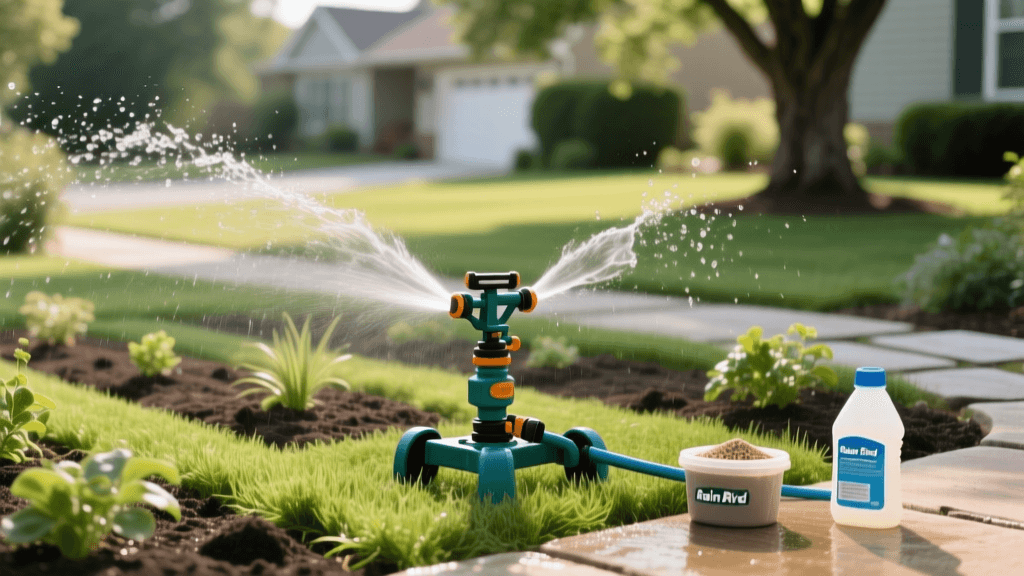
2026 Rain Bird Rotary Sprinkler Spacing for Fertilizer Activation
The Crucial Link Between Irrigation and Fertilizer Activation
When building a comprehensive lawn care strategy for 2026, homeowners often obsess over the exact nitrogen-phosphorus-potassium (NPK) ratios of their fertilizers while neglecting the delivery system that makes those nutrients bioavailable. The most advanced polymer-coated slow-release granular fertilizers or liquid bio-stimulants will fail if they are not properly watered into the soil profile. This is where precise Rain Bird rotary sprinkler head adjustment and spacing becomes the linchpin of your entire fertilizer schedule.
Watering in fertilizer serves two vital purposes: it dissolves granular prills so nutrients can reach the root zone, and it washes corrosive salts off the grass blades to prevent severe foliar burn. According to turfgrass experts at the University of Minnesota Extension, applying 0.25 to 0.5 inches of water immediately after fertilization is mandatory for nutrient activation. However, achieving this exact measurement uniformly across your lawn requires your Rain Bird rotary sprinklers to be spaced and adjusted with mathematical precision.
Understanding Rain Bird Rotary Spacing for Nutrient Uptake
A common mistake in 2026 irrigation design is spacing rotary heads based on their maximum throw distance without accounting for overlap. If a Rain Bird 5000 Plus rotor throws water 35 feet, the next head should be placed exactly 35 feet away—a concept known as 'head-to-head' coverage. The edges of a rotary sprinkler's throw receive significantly less precipitation than the center. If you space heads 50 feet apart to 'save money,' the overlapping edges will suffer from dry spots. When fertilizer lands in these dry spots and isn't watered in, it sits dormant, leading to uneven turf color and patchy weed breakthrough.
Below is a breakdown of the 2026 Rain Bird rotary lineup, their optimal spacing for uniform fertilizer activation, and the best fertilizer types to pair with their specific precipitation rates.
| Rain Bird Model (2026 Lineup) | Optimal Head-to-Head Spacing | Precipitation Rate | Best Fertilizer Application Type |
|---|---|---|---|
| 5000 Plus Series Rotor | 25 ft - 35 ft | 0.4 - 0.6 in/hr | Granular Slow-Release Nitrogen |
| Falcon 6504 Series Rotor | 35 ft - 50 ft | 0.5 - 0.8 in/hr | Liquid Fertigation / Pre-Emergent |
| Maxi-Paw Impact Sprinkler | 20 ft - 40 ft | 0.6 - 1.0 in/hr | Organic Granular / Compost Teas |
Why Precipitation Rate Matters for Fertilizer Types
Different fertilizers require different watering approaches. Heavy synthetic granular fertilizers need a steady, moderate precipitation rate to dissolve without causing surface runoff. The Rain Bird 5000 Plus series is ideal here. Conversely, if you are utilizing a 2026 liquid fertigation system or applying liquid pre-emergent herbicides, you need a slightly higher precipitation rate to push the chemicals deep into the soil barrier before they degrade in the UV light. The Falcon series excels in these scenarios.
Step-by-Step Arc and Radius Adjustment for Fertilizer Zones
Proper spacing is only half the battle; the physical adjustment of the rotary head dictates whether your expensive fertilizer ends up feeding your lawn or polluting the local storm drain. The EPA WaterSense program heavily emphasizes preventing landscape runoff, which is a primary vector for nitrogen and phosphorus entering municipal waterways.
Adjusting the Arc
When fertilizing near hardscapes like driveways and sidewalks, your rotary sprinkler's arc must be dialed in perfectly. If the arc overshoots the lawn, you are watering concrete. Fertilizer that lands on the driveway will dissolve and wash directly into the storm drain. To adjust the arc on a standard Rain Bird rotor:
- Locate the Arc Adjustment Screw: Found on the top of the rotor nozzle turret.
- Set the Right Stop: Turn the turret clockwise to the desired right-side stopping point. Hold it in place.
- Set the Left Stop: Turn the turret counter-clockwise until it clicks, indicating the left boundary.
- Fine-Tune for Edges: In 2026, many homeowners use edge-guards on their spreaders to keep fertilizer off hardscapes. Match your sprinkler arc exactly to this edge-guard boundary to ensure no fertilizer is left unwatered or washed away.
Adjusting the Radius
Using a flat-head screwdriver, turn the radius reduction screw on top of the nozzle. Turning it clockwise reduces the throw distance. This is critical for 'corner' zones where a full 35-foot throw would hit a neighbor's fence or a street. By reducing the radius, you ensure the water (and the dissolved fertilizer) stays strictly within the turf boundaries.
Timing Your 2026 Fertilizer Schedule with Rotary Run Times
To properly activate your fertilizer, you must calculate exactly how long to run your Rain Bird rotary zones. Because rotors apply water much slower than traditional spray heads, running them for a standard 10 minutes will barely dampen the soil, leaving granular fertilizer stuck to the grass blades where it can burn the turf in the afternoon sun.
Pro-Tip: Never guess your run times. Perform a 'Catch-Can Test' by placing empty tuna cans at various distances between your Rain Bird rotors. Run the zone for 20 minutes, measure the water depth, and calculate your exact inches-per-hour (IPH) precipitation rate for your specific water pressure.
Seasonal Run Time Guide for Fertilizer Activation
- Early Spring (Pre-Emergent & Starter Fertilizer): Pre-emergents require a solid 0.5 inches of water to form a chemical barrier in the top inch of soil. Based on an average Rain Bird 5000 IPH of 0.5 inches per hour, you must run your rotary zones for 60 minutes immediately after application. Split this into two 30-minute cycles to prevent runoff on sloped lawns.
- Late Spring (High-Nitrogen Slow-Release): Slow-release granular prills need consistent moisture to break down their polymer coatings. Run your rotors for 30 to 45 minutes to deliver roughly 0.25 to 0.35 inches of water. This moves the nitrogen into the root zone without leaching it past the roots.
- Early Fall (Root-Building Phosphorus/Potassium): Fall fertilizers are designed to build deep root mass for winter survival. You want to push these nutrients deeper into the soil profile. Run your rotary heads for 45 to 60 minutes, followed by a deep, infrequent watering schedule for the rest of the week to draw the roots downward.
Troubleshooting Dry Spots and Fertilizer Burn
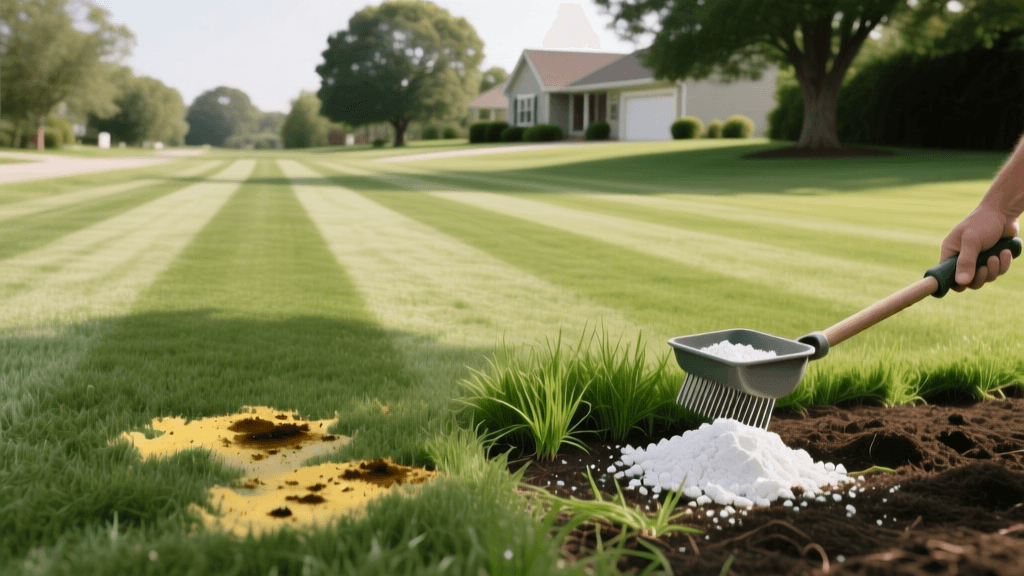
If you notice yellowing patches or streaks on your lawn a few days after fertilizing, your rotary sprinkler adjustments are likely at fault. Here is how to diagnose the issue based on the visual symptoms:
- Streaking (Alternating Green and Yellow Bands): This is a classic sign of poor head-to-head spacing. The yellow bands are the overlapping edges of the rotary throw where the precipitation rate was too low to dissolve the fertilizer. Fix: You must add a rotary head in the middle of the gap or switch to a higher-flow nozzle.
- Tip Burn (Brown Grass Blade Tips): The fertilizer was applied, but the rotary run time was too short. The granules dissolved just enough to create a highly saline, corrosive sludge on the leaf tissue, but not enough water was applied to wash it into the soil. Fix: Increase your rotary run times by 25% during fertilization events.
- Algae or Mushrooms Near Driveways: Your arc adjustment is too wide. The sprinkler is hitting the concrete, causing fertilizer-laden water to pool at the edge of the lawn. Fix: Reduce the arc and radius using the adjustment screws on the rotor head.
Conclusion
As lawn care technology and fertilizer formulations continue to advance in 2026, the fundamental physics of water and soil remain unchanged. Your investment in premium lawn nutrients is entirely dependent on your irrigation system's ability to deliver uniform, measured moisture. By strictly adhering to head-to-head spacing guidelines, meticulously adjusting your Rain Bird rotary arcs to protect hardscapes, and calculating precise run times based on catch-can tests, you guarantee that every granule of fertilizer is activated, absorbed, and utilized by your turfgrass. For more detailed design guides and nozzle charts, consult the official Rain Bird landscape resources to ensure your system is calibrated perfectly for the current season's nutrient demands.