Gardening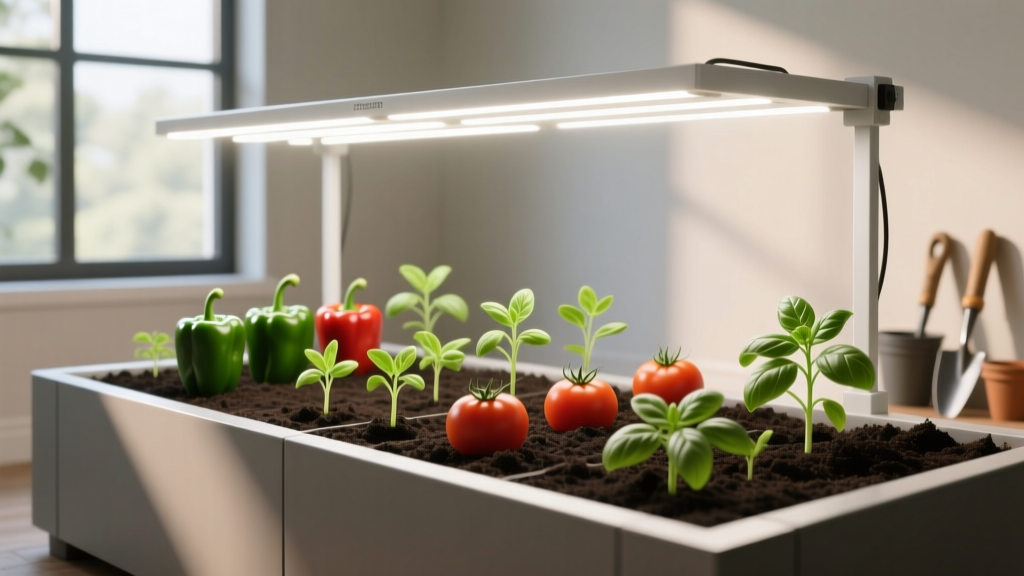
Best 2026 LED Grow Light Schedule for Raised Bed Seeds
David ParkPublished
The 2026 Advantage: Why LEDs are Essential for Raised Bed Transplants
Raised bed vegetable gardening offers unparalleled benefits: superior soil drainage, faster spring warming, and complete control over your soil microbiome. However, to truly maximize the extended growing season that raised beds provide, you need robust, vigorous transplants. As we navigate the 2026 growing season, relying on a sunny windowsill is no longer sufficient for producing the stocky, resilient seedlings required for high-yield raised bed harvests. Modern full-spectrum LED grow lights have completely revolutionized indoor seed starting, offering precise control over light intensity and spectrum that mimics peak summer sun.
Starting seeds indoors under a dedicated LED grow light schedule ensures that your tomatoes, peppers, and brassicas develop strong cellular structures before they ever touch your raised bed soil. According to Penn State Extension, providing adequate light intensity from the moment of germination prevents etiolation (leggy, weak growth), which is the number one cause of transplant shock when moving seedlings outdoors. By mastering your indoor light schedule, you bridge the gap between a controlled indoor environment and the dynamic microclimate of your raised beds.
Understanding PPFD and Spectrum for Seedlings
Before diving into the schedule, it is crucial to understand the metrics that matter in 2026. The horticultural lighting industry has largely moved past simple wattage measurements, focusing instead on PPFD (Photosynthetic Photon Flux Density), measured in micromoles per square meter per second (µmol/m²/s). For seedlings, you do not need the intense light required for flowering fruiting crops. Excessive light can actually bleach tender cotyledons and stunt early root development.
Furthermore, the 2026 market is dominated by full-spectrum white LEDs (often utilizing advanced diodes like the Samsung LM301H series). These diodes provide a balanced spectrum that includes crucial blue wavelengths for compact, vegetative growth and red wavelengths for photosynthetic efficiency. Avoid older, narrow-spectrum "blurple" lights; modern broad-spectrum white LEDs allow you to monitor plant health accurately, as the true color of the leaves is visible to the human eye.
The Ultimate 2026 LED Grow Light Schedule
The following schedule is designed specifically for warm-season and cool-season vegetables destined for raised bed transplantation. It assumes you are using a modern, dimmable full-spectrum LED quantum board or bar-style fixture suspended on adjustable ratchet hangers.
| Growth Stage | Days (Approx.) | Target PPFD (µmol/m²/s) | Light Height (Inches) | Daily Photoperiod |
|---|---|---|---|---|
| Germination | 0 - 7 | Ambient / 0 - 50 | Lights Off or 36"+ | 0 - 12 Hours |
| Cotyledon Emergence | 7 - 14 | 100 - 150 | 24" - 30" | 16 Hours On / 8 Off |
| First True Leaves | 14 - 35 | 200 - 300 | 18" - 24" | 16 Hours On / 8 Off |
| Rapid Vegetative | 35 - 50 | 300 - 450 | 12" - 18" | 14 - 16 Hours |
| Hardening Off (Pre-Bed) | 50 - 60 | 400 - 600 | 8" - 12" | 12 Hours (Matching Outdoors) |
Stage Breakdown and Actionable Tactics
Germination: Most vegetable seeds require darkness and warmth to sprout. Keep your seed trays on a heat mat set to 75°F-80°F. Leave the LED lights off until you see the very first pale green loops breaking the soil surface.
Cotyledon Emergence: The moment you see green, the lights must turn on. If you wait even 24 hours, the seedlings will stretch rapidly toward any ambient light source, resulting in weak stems that will collapse in your raised beds. Set your timer to 16 hours and raise the light to 24 inches to provide gentle, broad coverage.
First True Leaves: As the plant develops its true leaves, its photosynthetic engine ramps up. Lower the light to 18 inches and increase the dimmer to achieve a PPFD of around 250. At this stage, introduce a gentle oscillating fan. The mechanical stress of the wind forces the stems to thicken, preparing them for the outdoor breezes they will face in your raised beds.
Hardening Off: Two weeks before your planned raised bed transplant date, you must adjust the indoor photoperiod to match the natural outdoor daylight hours (usually around 12-13 hours in early spring). Crank the light intensity up and lower the fixture to simulate the unfiltered intensity of the sun.
Recommended 2026 LED Fixtures and Setup Costs
Investing in the right equipment pays dividends when you harvest your first raised bed crops. In 2026, a high-quality 100W to 150W full-spectrum dimmable LED fixture from reputable brands like Spider Farmer, Mars Hydro, or HLG (Horticulture Lighting Group) will cost between $110 and $180. These fixtures easily cover a standard 10x20 inch seed starting tray.
Do not forget the infrastructure. A sturdy wire shelving unit ($60-$90) and a set of adjustable rope ratchet hangers ($15) are mandatory. The ability to easily raise and lower the light fixture is the secret to maintaining the precise PPFD levels outlined in the schedule above without relying solely on the dimmer switch, which can sometimes alter the color spectrum on cheaper models.
Seed Starting Mediums: Cell Trays vs. Soil Blocks for Raised Beds
When growing transplants specifically for raised bed gardens, root health is paramount. Raised beds are notorious for their loose, friable soil structure, which encourages rapid root expansion. To take advantage of this, consider the medium you use indoors.
- Standard Cell Trays: A 50-cell or 72-cell tray is excellent for beginners. However, roots can become bound and circle the plastic walls, leading to transplant shock.
- Soil Blocking: Using a soil blocker to create freestanding cubes of compressed seed starting mix is highly recommended for raised bed gardeners in 2026. As noted by researchers at Wisconsin Horticulture, soil blocks promote "air-pruning" of the roots. When a root reaches the edge of the block, it stops growing and branches internally, creating a dense, fibrous root ball that explodes into your raised bed soil the moment it is transplanted, eliminating transplant shock entirely.
Hardening Off: The Bridge to Your Raised Beds
Your LED grow light schedule culminates in the hardening off process. Raised beds warm up significantly faster than in-ground soil, but the ambient spring air and direct UV radiation can still scorch indoor-grown foliage. Over a period of 7 to 10 days, move your seedlings outdoors to a shaded, protected area for a few hours, gradually increasing their exposure to direct sunlight and wind.
Because your raised bed soil is likely already amended with rich compost and warmed by the spring sun, your carefully light-scheduled, soil-blocked transplants will establish themselves in record time. By controlling the light spectrum, intensity, and photoperiod indoors, you are not just growing seedlings; you are engineering the perfect biological foundation for a record-breaking raised bed harvest.
