Gardening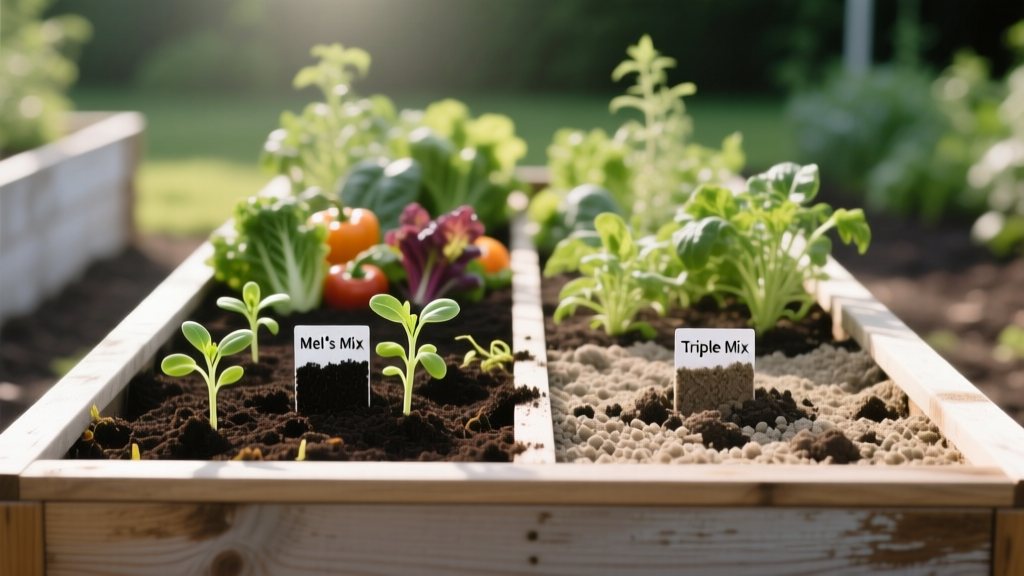
Mel's Mix vs Triple Mix: 2026 Fertilizer Schedules
Sarah ChenPublished
The 2026 Raised Bed Dilemma: Mel's Mix vs. Triple Mix
As home gardening continues to evolve in 2026, raised bed cultivation remains the gold standard for maximizing yields in limited spaces. However, the foundation of any successful raised bed lies beneath the surface. The ongoing debate between Mel's Mix and traditional Triple Mix dominates gardening forums, particularly when it comes to long-term soil fertility and fertilizer schedules. Understanding how these two distinct soil architectures interact with modern fertilizers is critical for your 2026 harvest. According to the University of Maryland Extension, the physical structure of your raised bed soil directly dictates its Cation Exchange Capacity (CEC)—the soil's ability to retain and supply essential nutrients to plant roots. Because Mel's Mix is entirely soilless and Triple Mix relies heavily on mineral topsoil, their fertilization requirements, schedules, and preferred nutrient types are fundamentally different.
Deconstructing the 2026 Soil Recipes
Before establishing a fertilizer schedule, we must understand the baseline nutrient profile of each mix. Mel's Mix, popularized by the Square Foot Gardening Foundation, is a soilless blend consisting of one-third blended compost, one-third peat moss (or sustainably sourced coco coir, which has become the standard in 2026 due to global peatland conservation efforts), and one-third coarse vermiculite. This mix is incredibly light, retains moisture beautifully, and is virtually free of soil-borne pathogens. However, because it contains no mineral soil, its baseline CEC is relatively low, meaning it struggles to hold onto synthetic, water-soluble fertilizers.
Conversely, Triple Mix is a traditional landscaping and gardening staple composed of one-third topsoil, one-third peat moss or coir, and one-third compost. The inclusion of topsoil introduces clay, silt, and sand particles. These mineral components provide a robust structural matrix and a naturally higher CEC. Triple Mix is heavier, more prone to compaction over time, but significantly better at buffering pH swings and retaining granular fertilizers.
The Chemistry of Fertilizer Retention
The divergence in fertilizer types and schedules between these two mixes comes down to nutrient leaching and microbial activity. In a soilless Mel's Mix, nutrients are primarily held within the organic matter of the compost. When you apply a fast-acting synthetic liquid fertilizer, the lack of clay particles means the nutrients can easily wash out the bottom of the raised bed during heavy 2026 spring rains. Therefore, Mel's Mix requires slow-release, organic fertilizers that rely on microbial breakdown. Triple Mix, with its mineral topsoil component, acts like a sponge for ionic nutrients, allowing gardeners to utilize a wider variety of both organic and synthetic granular fertilizers without the immediate fear of nutrient runoff.
Mel's Mix: 2026 Fertilizer Types and Application Schedule
Spring Preparation (April): The primary fertilizer for Mel's Mix is compost itself. In early spring, top-dress your beds with a one-inch layer of premium, diverse blended compost. The Environmental Protection Agency highlights that diverse organic matter is the cornerstone of soil microbiology. To supplement this, work in a slow-release organic granular fertilizer, such as Espoma Garden-tone (3-4-4 NPK), at a rate of 2 cups per 16 square feet. This provides a steady, microbe-mediated release of nitrogen, phosphorus, and potassium that aligns perfectly with the soilless structure.
Summer Maintenance (June to August): Because Mel's Mix drains rapidly, heavy feeders like tomatoes and peppers will exhaust the available compost nutrients by mid-summer. Avoid high-nitrogen synthetic liquids. Instead, transition to a liquid kelp and fish emulsion blend (such as Neptune's Harvest 2-3-1) applied as a foliar spray or soil drench every three weeks. This bypasses the low CEC of the soil and delivers micronutrients directly to the plant tissues.
Fall Restoration (October): After the final harvest, do not leave the soilless mix exposed. Plant a cover crop of winter peas and hairy vetch, or apply a thick mulch of shredded leaves and a light dusting of alfalfa meal to feed the dormant microbial life through the winter.
Triple Mix: 2026 Fertilizer Types and Application Schedule
Spring Preparation (April): Triple Mix requires a more balanced approach to overcome the natural density of topsoil. Before planting, incorporate a balanced granular fertilizer, such as Dr. Earth Organic 5 (4-6-3 NPK) or a standard synthetic 10-10-10, at the manufacturer's recommended rate for your bed's square footage. The mineral particles in the topsoil will bind to the phosphorus and potassium, preventing them from leaching and keeping them available in the root zone throughout the 2026 growing season. Additionally, test your soil pH; topsoil can sometimes be acidic, and a spring application of dolomitic lime may be necessary to reach the optimal 6.2 to 6.8 range.
Summer Maintenance (June to August): Triple Mix holds nutrients well, but heavy feeders will still require a mid-season boost. Side-dress your crops with a high-nitrogen organic fertilizer, such as blood meal or a targeted tomato fertilizer, scratching it lightly into the top inch of the soil. Water deeply to activate the granular nutrients, which the clay in the topsoil will efficiently capture and hold.
Fall Restoration (October): Triple Mix is highly susceptible to winter compaction. In the fall, incorporate a two-inch layer of raw compost and a generous amount of horticultural perlite or biochar to maintain soil aeration. Avoid heavy nitrogen fertilizers in the fall, as the topsoil will retain them, potentially leading to salt buildup over the winter months.
Side-by-Side Comparison Chart
| Feature | Mel's Mix (Soilless) | Triple Mix (Soil-Based) |
|---|---|---|
| Base Recipe | 1/3 Compost, 1/3 Coir/Peat, 1/3 Vermiculite | 1/3 Topsoil, 1/3 Coir/Peat, 1/3 Compost |
| Primary Nutrient Source | Diverse Blended Compost | Mineral Topsoil & Granular Fertilizers |
| Best Fertilizer Type | Slow-Release Organic, Liquid Kelp | Balanced Granular (Organic or Synthetic) |
| Spring Application | Compost top-dress + Espoma Garden-tone | Balanced NPK + pH buffering Lime |
| Summer Application | Foliar Fish Emulsion (Every 3 weeks) | Side-dress Blood Meal or Tomato Food |
| CEC & Nutrient Retention | Low (Prone to leaching) | High (Excellent buffering) |
| 2026 Est. Cost (4x8 Bed) | $140 - $180 (High vermiculite cost) | $90 - $130 (Topsoil is inexpensive) |
2026 Sourcing and Cost Breakdown
The economics of raised bed gardening have shifted significantly by 2026. Mel's Mix is notably more expensive to establish and maintain. Coarse vermiculite prices have surged due to mining supply chain constraints, pushing the initial fill cost of a standard 4x8 foot raised bed (requiring roughly 32 cubic feet of soil) to between $140 and $180. Furthermore, because Mel's Mix relies heavily on compost for fertility, gardeners must budget for premium, multi-source compost additions every single spring. Triple Mix, leveraging locally sourced topsoil, remains the budget-friendly option, with initial fill costs hovering between $90 and $130. However, the trade-off is physical labor; Triple Mix requires annual aeration and careful monitoring of soil compaction and pH levels to ensure the fertilizers you apply remain bioavailable.
Long-Term Soil Maintenance and Final Thoughts
Ultimately, the choice between Mel's Mix and Triple Mix dictates your entire fertilization strategy for the 2026 season and beyond. If you prefer a lightweight, weed-free, and highly controlled soilless environment, Mel's Mix is unparalleled, provided you commit to a strict schedule of organic compost top-dressing and liquid micro-nutrient supplementation. If you favor a more traditional, forgiving soil matrix that can buffer synthetic and organic granular fertilizers alike, Triple Mix is your ideal foundation. Regardless of your choice, consistent soil testing every two years remains the most critical tool in your gardening arsenal, ensuring your fertilizer schedule is always driven by data rather than guesswork.
