Gardening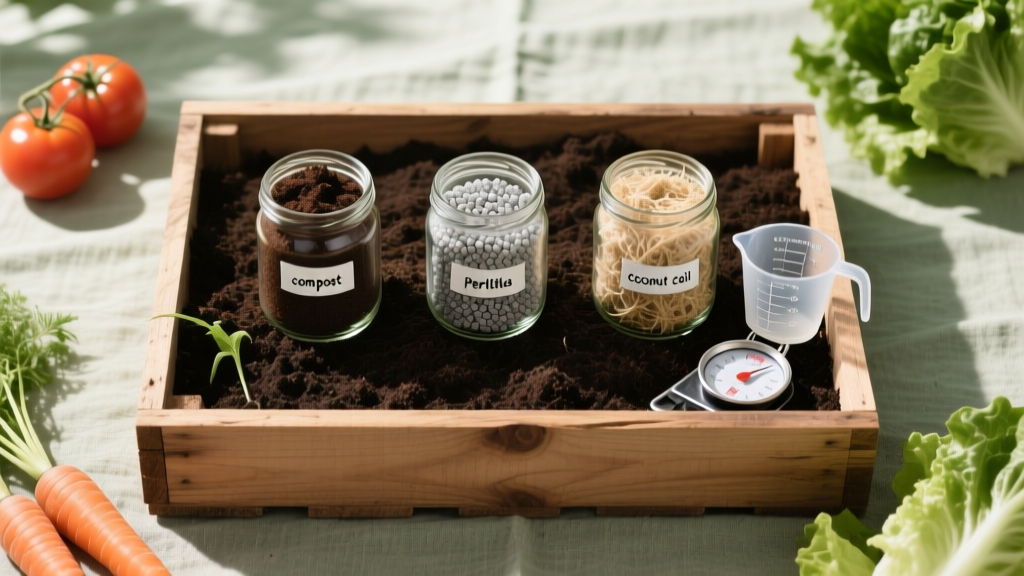
Expert Soil Mix Ratios for Raised Bed Vegetable Gardens
David ParkPublished
Why Native Soil Fails in Raised Beds
Many home gardeners make the costly mistake of filling their newly constructed raised beds with native soil dug from their yard or cheap topsoil from a big-box store. While native soil works fine in the ground, it behaves entirely differently when confined within the walls of a raised bed. In the earth, soil structure is maintained by deep-rooted plants, expansive earthworm networks, and capillary action from the subsoil. When you excavate and move that same soil into a wooden or metal frame, you destroy its natural aggregate structure. Without the subsoil connection, native dirt in a raised bed quickly compacts into a dense, poorly draining brick that suffocates vegetable roots and stunts growth.
To achieve the high yields seen in expert gardens, you must treat a raised bed like a giant container. You need a specialized, engineered soil mix that balances three critical factors: moisture retention, drainage and aeration, and nutrient density. Below, we break down the exact formulations, measurements, and sourcing strategies used by master gardeners and horticulturists to build the perfect raised bed soil ecosystem.
The Two Expert-Approved Soil Formulations
Depending on your budget, local availability, and physical strength (some mixes are heavier than others), you should choose one of the two following expert-recommended formulations. Both are designed to provide a loamy, friable texture that encourages vigorous root branching.
Formula 1: The Organic Soilless Blend
Often adapted from the classic Square Foot Gardening method, this soilless blend is incredibly lightweight, holds moisture beautifully, and is completely free of soil-borne pathogens and weed seeds. It is the gold standard for rooftop gardens, balconies, and gardeners with heavy clay native soil who want a clean slate.
- 33% Coco Coir or Peat Moss: Provides the base structure and holds up to 10 times its weight in water.
- 33% Coarse Vermiculite or Perlite: Ensures permanent aeration and prevents the organic matter from compacting over time.
- 33% Blended Compost: Supplies the slow-release nutrients, beneficial microbes, and humic acids necessary for plant health.
Formula 2: The Mineral Loam Blend
Recommended by several university extension programs, this blend incorporates actual mineral soil to provide long-term structural stability, trace minerals, and a heavier base that prevents tall crops like indeterminate tomatoes or trellised corn from toppling in high winds.
- 50% High-Quality Mineral Topsoil: Must be screened and loamy, not heavy clay.
- 30% Premium Compost: Acts as the primary nutrient source and improves soil aggregation.
- 20% Coarse Sand or Pumice: Guarantees sharp drainage, mimicking the natural percolation rates of sandy loam.
Calculating Volumes for a Standard 4x8 Bed
Before purchasing materials, you must calculate the exact volume required to avoid costly over-ordering or frustrating mid-project trips to the garden center. A standard raised bed measuring 4 feet wide by 8 feet long with a depth of 12 inches requires exactly 32 cubic feet of soil.
Expert Tip: Always calculate your volume based on the depth of the bed, but add a 10% buffer to account for initial settling and watering-in. For a 32-cubic-foot bed, plan to mix roughly 35 cubic feet of ingredients.
Deep Dive: Sourcing the Right Ingredients
Coco Coir vs. Peat Moss
While sphagnum peat moss has been the traditional choice for moisture retention, expert gardeners are increasingly shifting toward coco coir. Peat moss is highly acidic (pH 3.5 to 4.5) and requires the addition of garden lime to buffer it to a neutral pH suitable for most vegetables. Coco coir, a byproduct of the coconut industry, has a naturally neutral pH (5.5 to 6.5) and is a renewable resource. Crucial step: Always rinse compressed coir blocks with fresh water before use to leach out residual sodium salts from oceanic processing.
The Importance of Compost Diversity
Never use a single source of compost. Different composts offer different nutrient profiles. A master gardener will blend at least three to five types of compost to ensure a broad spectrum of micronutrients. Ideal blends include mushroom compost (for calcium and structure), composted cow or poultry manure (for nitrogen and phosphorus), leaf mold (for fungal dominance and humus), and homemade kitchen scrap compost.
Aeration Materials
Vermiculite is excellent for water retention and is preferred for moisture-loving crops like lettuce and cucumbers. Perlite is lighter and provides superior drainage, making it ideal for root crops like carrots and radishes. For a permanent, eco-friendly alternative to both, consider calcined clay or pumice, which will never break down or float to the surface of the bed over time.
Cost Breakdown: Bagged vs. Bulk Delivery
Buying soil in 1.5 cubic foot bags at a retail nursery is convenient but prohibitively expensive for large projects. If you are filling more than one 4x8 bed, ordering bulk materials from a local landscape supply yard will save you hundreds of dollars. Below is a cost comparison for filling a single 32-cubic-foot bed using the Organic Soilless Blend.
| Ingredient | Volume Needed | Retail Bagged Cost | Bulk Supply Cost | Sourcing Notes |
|---|---|---|---|---|
| Coco Coir | 11 cu ft | $65.00 (from blocks) | N/A (Rarely sold bulk) | Buy 5kg compressed bricks online |
| Vermiculite | 11 cu ft | $90.00 | $45.00 | Ensure it is labeled 'Coarse' |
| Blended Compost | 11 cu ft | $70.00 | $25.00 | Local landscape yard bulk bin |
| Total Estimated Cost | 32 cu ft | $225.00 | $135.00 | Bulk saves 40% on average |
Step-by-Step Mixing Protocol
Do not simply dump the ingredients into the bed and stir them with a shovel; this results in uneven nutrient distribution and dry pockets. Instead, use the tarp-mixing method:
- Hydrate the Coir: Expand your coir blocks in a wheelbarrow or large tub 24 hours before mixing. It should feel like a wrung-out sponge.
- Layer on a Tarp: Spread a heavy-duty landscaping tarp on your lawn. Add your compost, followed by the vermiculite, and top with the hydrated coir.
- Roll and Toss: Grab the corners of the tarp with a partner and pull them toward the center, rolling the soil pile over itself. Repeat this from all four sides until the color and texture are completely uniform.
- Fill and Water: Shovel the mix into your raised bed. Once filled to within two inches of the rim, water the bed deeply to settle the soil and eliminate hidden air pockets before planting.
Long-Term Maintenance and Top-Dressing
One of the most common questions experts receive is how to maintain raised bed soil in years two, three, and beyond. Because organic matter breaks down and crops extract nutrients, the soil level in your bed will drop by 2 to 4 inches every season.
Do not attempt to dig or till the established soil, as this will destroy the mycorrhizal fungal networks and earthworm tunnels you have cultivated. Instead, practice 'no-till' top-dressing. Every early spring, apply a 2-inch layer of fresh, diverse compost directly to the surface of the bed. Add a balanced organic granular fertilizer (such as a 4-4-4 blend with added kelp meal) and let the earthworms and spring rains incorporate the nutrients into the root zone for you.
Authoritative Citations and Further Reading
According to the Oregon State University Extension Service (Publication EM 9200, 'Raised Bed Gardening'), the ideal raised bed soil should contain roughly 40% mineral particles, 30% organic matter, and 30% pore space. They explicitly warn against using unamended native clay or silt, noting that 'the physical environment of a raised bed requires a mix that holds adequate water but drains freely to provide oxygen to roots.'
By following these expert ratios and sourcing high-quality, diverse ingredients, your raised bed vegetable garden will not only thrive in its first season but will build a resilient, living soil food web that improves with age, yielding larger harvests year after year.
